School Information System

Choice, Not More Spending, Is Key To Better Schools; Wisconsin 12th in Spending, 24th in Achievement


W. Michael Cox & Richard Alm

Education looms as both cause and cure for the decline of the middle class and the widening gap between rich and poor.

In today’s knowledge-based economy, poorly performing public schools leave many U.S. workers ill-equipped for jobs that pay middle-class wages.

So it follows that improving education is the only way to raise up the poor, reduce inequality and restore the American middle class.

We all want better schools — right-wingers, left-wingers, even business and labor are on board. Most proposals for improving education come down to the same thing — spend more of the taxpayers’ money.

But that’s what we’ve been doing for two or more generations, and it hasn’t worked. Andrew J. Coulson, director of the Cato Institute’s Center for Educational Freedom, calculates that inflation-adjusted spending per pupil more than doubled from $5,500 a year in 1970 to more than $12,500 in 2010.

…..

So why do some states have better public schools — if it’s not a matter of money? Statistical regressions using the adjusted spending and demographic data find that test scores improve significantly as parents get more education and earn higher incomes.

The intuitive story goes like this: Better educated and richer parents tend to appreciate the value of schooling. They insist on better schools for their children and stress education in the home. School districts that spend more tend to be those where the cost-of-living is higher, where income is higher and where adults are better educated.

It’s not the spending that improves scores, it’s the parents’ high expectations and emphasis on education.

Money can buy a lot in public schools — smaller classes, better teachers, modern facilities, computers and other technologies. So why hasn’t spending paid off in better educational outcomes? The biggest impediment is a government-run school system resistant to innovation, indifferent to student needs and mired in mediocrity.

Wisconsin ranks 12th in dollars spent and 24th in achievement among the 50 US states.

State Education Trends by Andrew Coulson:

ong-term trends in academic performance and spending are valuable tools for evaluating past education policies and informing current ones. But such data have been scarce at the state level, where the most important education policy decisions are made. State spending data exist reaching back to the 1960s, but the figures have been scattered across many different publications. State-level academic performance data are either nonexistent prior to 1990 or, as in the case of the SAT, are unrepresentative of statewide student populations. Using a time-series regression approach described in a separate publication, this paper adjusts state SAT score averages for factors such as participation rate and student demographics, which are known to affect outcomes, then validates the results against recent state-level National Assessment of Educational Progress (NAEP) test scores. This produces continuous, state-representative estimated SAT score trends reaching back to 1972. The present paper charts these trends against both inflation-adjusted per pupil spending and the raw, unadjusted SAT results, providing an unprecedented perspective on American education inputs and outcomes over the past 40 years.

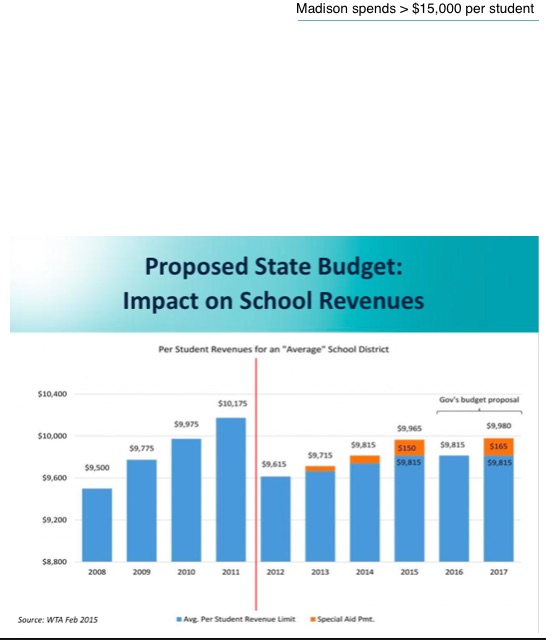
Locally, Madison spends double the national average per student.

Share

“the analysis shows that in a year’s time, on average, students in Los Angeles charter schools make larger learning gains in reading and mathematics”

Center for Research on Education Outcomes (PDF):

Across the country, charter schools occupy a growing position in the public education landscape. Heated debate has accompanied their existence since their start in Minnesota two decades ago. Similar debate has occurred in California, particularly in Los Angeles, with charter advocates extolling such benefits of the sector as expanding parental choice and introducing market-based competition to education. Little of that debate, however, is grounded in hard evidence about their impact on student outcomes. This report contributes to the discussion by providing evidence for charter students’ performance in Los Angeles for four years of schooling, beginning with the 2008-2009 school year and concluding in 2011-2012.

With the cooperation of the California Department of Education (CDE), CREDO obtained the historical sets of student-level administrative records. The support of CDE staff was critical to CREDO’s understanding of the character and quality of the data we received. However, it bears mention that the entirety of interactions with CDE dealt with technical issues related to the data. CREDO has developed the findings and conclusions independently.

This report provides an in-depth examination of the results for charter schools physically located within the Los Angeles Unified School District boundary. It is the first separate analysis by CREDO of the performance of Los Angeles’ charter schools. However, charter schools in Los Angeles were included in the CREDO report on all California charter schools, which can be found on our website.1 This report has two main benefits. First, it provides a rigorous and independent view of the performance of the city’s charter schools. Second, the study design is consistent with CREDO’s reports on charter school performance in other locations, making the results amenable to being benchmarked against those nationally and in other states and cities.

The analysis presented here takes two forms. We first present the findings about the effects of charter schools on student academic performance. These results are expressed in terms of the academic progress that a typical charter school student in Los Angeles would realize from a year of enrollment in a charter school. The second set of findings is presented at the school level. Because schools are the instruments on which the legislation and public policy operate, it is important to understand the range of performance for the schools. These findings look at the performance of students by school and present school average results.

Compared to the educational gains that charter students might have had in a traditional public school (TPS), the analysis shows that in a year’s time, on average, students in Los Angeles charter schools make larger learning gains in reading and mathematics. Results for Hispanic charter students, especially Hispanic students in poverty, are particularly notable. At the school level, we compare the average performance over two growth periods to the average results for the school’s control group. The results in Los Angeles are among the strongest observed in any of the previous CREDO studies. Larger shares of schools outperform their local market in reading and math than was reported in the national study that was released in 2013.2

Meanwhile, a majority of Madison School Board members rejected the Madison Preparatory Academy IB Charter school a few years ago. The traditional – Frederick Taylor -, non diverse governance model remains well entrenched here.

Share

The Charter School Performance Breakout

Karl Zinsmeister:

Many have been puzzled by New York Mayor Bill de Blasio’s skepticism toward charter schools, his calls for ending space-sharing and charging them rent, and his $210 million cut of a construction fund important to the schools. Education reformers are also anxious about the failure of President Obama and Education Secretary Arne Duncan to defend charter schools in the face of these prominent reversals of New York City policy. Is this just about teacher-union politics, or are there perhaps legitimate performance reasons for tapping the brakes on charter schools in public education today?

The first thing to remember about charter schools is how recent an invention they are. Born in the 1990s, it wasn’t until 2006 that total enrollment reached a million children—out of 55 million pupils in the country. More than half of the charters in New York City are less than five years old.

With huge waiting lists for every available seat, though, charters are now beginning to mushroom. Well before Mr. de Blasio faces re-election in 2017, charters will educate 10% of New York City’s public-school students, and they already enroll a quarter of all pupils in some of the city’s poorest districts. Nationwide, charter schools will enroll five million by the end of this decade.

Share

Companies Find Autism Can Be a Job Skill

Shirley Wang:

Some employers increasingly are viewing autism as an asset and not a deficiency in the workplace.

Germany-based software company SAP AG SAP.XE +1.43% has been actively seeking people with autism for jobs, not because of charitable outreach but because it believes features of autism may make some individuals better at certain jobs than those without autism.

It’s a worthy initiative, according to disability experts, since 85% of adults with autism are estimated to be unemployed.

Piloted in Germany, India and Ireland, the program is also launching in four North American offices, according to an announcement Thursday.

SAP aims to have up to 1% of its workforce—about 650 people—be employees with autism by 2020, according to Jose Velasco, head of the autism initiative at SAP in the U.S.

People with autism spectrum disorder—characterized by social deficits and repetitive behavior—tend to pay great attention to detail, which may make them well suited as software testers or debuggers, according to Mr. Velasco, who has two children with the condition.

Share

The Hidden College Problem: When Universities, Not Just Students, Take On Debt

Josh Freedman:

Last week, the University of California got downgraded. Not in the U.S. News or other college rankings, where six of its campuses rank in the top 15 public colleges in the United States; nor in College Prowler’s list of schools with the most attractive men on campus (where flagship UC-Berkeley clocks in at a measly number 1185). Rather, the UC system has been downgraded in the credit markets: ratings agency Moody’s lowered the UC system’s general revenue bonds from Aa1 to Aa2.

People like to talk about student debt – read, for example, my five part series on the topic. (Ok, I know you’re busy. How about at least one part of it? Do it for me.) But university debt, although rarely discussed, is arguably more important. Schools across the country are borrowing more money, and the increasing reliance on debt-financing at universities is adding logs covered in lighter fluid to an already flammable higher education system. The University of California system, for example, has $14.5 billion in outstanding debt, more than double its level in 2005. The total volume of debt across colleges of all kinds has increased so much that interest payments per student have increased 86% since a decade ago despite low interest rates.

Share

Vignettes from the Modern Workplace

Harvard University Press Blog:

For decades, large corporations have been contracting whatever work they can to foreign suppliers—think manufacturing, call centers, etc. Meanwhile, the vitality of the domestic service sector, comprised of all those unable-to-be-outsourced jobs, has become an economic refrain. Yet large employers have also been rapidly shedding those service sector jobs, offering contracts to smaller firms that desperately squeeze costs, resulting in declining wages, eroding benefits, unhealthy workplaces, and greater inequality. In The Fissured Workplace: Why Work Became So Bad for So Many and What Can Be Done to Improve It, David Weil details the pressures of subcontracting, franchising, and supply chains, revealing the distressing state of the “secure” service sector. His book begins with the following series of “Vignettes from the Modern Workplace.”

—–

The-fissured-workplaceA maid works at the San Francisco Marriott on Fisherman’s Wharf. The hotel property is owned by Host Hotels and Resorts Inc., a lodging real estate company. The maid, however, is evaluated and supervised daily and her hours and payroll managed by Crestline Hotels and Resorts Inc., a national third-party hotel management company. Yet she follows daily procedures (and risks losing her job for failure to accomplish them) regarding cleaning, room set-up, overall pace, and quality standards established by Marriott, whose name the property bears.

A cable installer in Dayton, Ohio, works as an independent contractor (in essence a self-employed business provider), paid on a job-by-job basis by Cascom Inc., a cable installation company. Cascom’s primary client is the international media giant Time Warner, which owns cable systems across the United States. The cable installer is paid solely on the basis of the job completed and is entitled to no protections normally afforded employees. Yet all installation contracts are supplied solely by Cascom, which also sets the price for jobs and collects payment for them. The installer must wear a shirt with the Cascom logo and can be removed as a contractor at will for not meeting minimum quotas or quality standards, or at the will of the company.

Share

How Endowment Hoarding Hurts Universities

Jefrrey Brown:

The financial security of a strong university endowment would seem to matter most when hard times come along—when revenues slow and core functions are in danger of being compromised. At such times, an endowment can help guard against shortsighted cost cutting that harms both near-term quality and long-run vitality. But it turns out that many universities do nothing of the sort.

During the recent recession, most endowments took a beating, with the average endowment losing a quarter of its value. That decline followed years of heady growth that led endowments to grow at a far faster clip than university spending did. As a result, the losses suffered in the market meltdown represented a much larger loss relative to universities’ annual operating budgets than did any previous market correction.

Share

Seeking Autism’s Biochemical Roots

Claudia Dreifus:

The biochemist Ricardo E. Dolmetsch has pioneered a major shift in autism research, largely putting aside behavioral questions to focus on cell biology and biochemistry.

Dr. Dolmetsch, 45, has done most of his work at Stanford. Since our interviews — a condensed and edited version of which follows — he has taken a leave to join Novartis, where his mission is to organize an international team to develop autism therapies.

“Pharmaceutical companies have financial and organizational resources permitting you to do things you might not be able to do as an academic,” he said. “I really want to find a drug.”

Q. Did you start out your professional life studying the biochemistry of autism?

Share

Humanities High Anxiety

Timothy Burke:

What I’ll ask about is this: what stirs many tenured faculty in humanities departments at wealthy private colleges and universities to so often pick and fret and prod at almost any perturbation of their worlds of practice–their departments, their disciplines, their publications, their colleges and universities? Why do so many humanistic scholars rise to almost any bait, whether it is a big awful dangling worm on a barbed hook or some bit of accidental fluff blown by the wind into their pond?

The crisis in the humanities, we’re often assured, doesn’t exist. Enrollments are steady, the business model’s sound, the intellectual wares are good.

The assurance is, in many ways, completely correct. The trends are not so dire and many of the criticisms are old and ritualized. Parents have been making fun of the choice to major in philosophy for five decades. Or longer, if you’ve read your Aristophanes.

And yet humanists are in fact anxious. Judging from a number of experiences I’ve had in the last year at Swarthmore and elsewhere, there’s more and more tense feelings coming from more directions and more individuals in reaction to a wider and wider range of stimuli.

Share

Reading lessons: why synthetic phonics doesn’t work

Andrew Davis:

Current government policy concerning reading favours synthetic phonics (SP), where children learn to recognise letters with their associated sounds – and how to blend those sounds to “read” the “words”.

The revised national curriculum, coming into force from September 2014, requires reception and year 1 students to be taught SP. Students aren’t meant to get help from clues such as context, meaning or illustration. It’s difficult to gauge how rigidly this will be enforced, but the situation certainly suggests there’ll be a significant increase in pressure on schools and teachers to conform.

The existing universal imposition of a phonics check on all five and six year-olds reinforces SP. Students are tested on isolated pieces of text – half of them are pseudo-words, such as “vap”, and all of them can be blended from conventional letter sounds.

Much of the current documentation around SP gives the impression that phonemes are sounds from which spoken words can be constructed. For example, the “cat” sound can be made up from |k|, |æ| and |t|. But the term “phoneme” doesn’t mean “sound”; it actually refers to sets of sounds in speech that distinguish one word from another. For instance, /æ/ and /a:/ are separate phonemes in English. /æ/ can be heard in the middle of “hat”, while /a:/ is heard in the middle of “hart”. The change in the middle sound gives us a different word.

Share

“Connected” Math problems: Brandon, Michigan School District underperformed compared to county average

Susan Bromley:

On average, less than one-third of students in third through eighth grades in the “>(Brandon) district are proficient in mathematics, according to the Michigan Educational Assessment Program.

MEAP scores released last month showed 28 percent of third grade students are proficient in math, compared with 40.2 percent statewide and 51 percent in the county. The gap grows larger by fourth grade. While the district showed 30 percent proficient in math at this grade, it was still behind the state at 45.3 percent, and far behind the county at 57 percent proficient.

Scores for science (tested in fifth and eighth grades) and social studies (tested in sixth and ninth grades) are even more dismal.

Less than 50 percent of district students tested proficient in writing in both fourth and seventh grades. The district’s strongest MEAP scores came in reading, ranging from 62 percent proficient in third grade, 55 percent proficient in seventh grade, to 77 percent proficient in eighth grade.

In every subject tested, at every grade level, district students underperformed compared to the county average, by as much as up to 27 percentage points. The district was also under the state averages at math for every grade level tested. The district did outperform the state average in reading for every grade tested besides seventh, and also did better than the state average in seventh grade writing, eighth grade science, and ninth grade social studies.

The district plans to be better prepared for whatever that test is with the board approval of $175,000 worth of new math materials for kindergarten through eighth grades. The materials, to be purchased at the end of this year, are the first new mathematics curriculum to be purchased at the elementary level in 12 years. Kindergarten through fifth grades will be using “Bridges” math curriculum, and sixth through eighth grades will use “Connected Math Project” to support the common core curriculum. Teacher representatives from all grade levels examined materials from several companies and selected Bridges and CMP as the best after sampling them in the classrooms and consulting with Geri Devine, a math consultant from Oakland Schools and district parent.

The materials are not traditional type textbooks, McMahon said, but for 6-8, bound books that each contain a unit of study, notebook like in size and shape. At the elementary level, the new materials are consumables, exercises and activities that a certain amount will have to be replaced yearly at a cost of roughly $20,000-$25,000.

“With the new materials, we should see an increase in scores,” McMahon said. “The publishers will give mathematics professional development and the district is also planning more professional development in the area of math, with instruction by expert users of the materials and those who have a proven track record for improving mathematical competency.”

Much more on Connected Math, here.

Share

The Most Obvious Conspiracy in the History of the World

Bruce Deitrick Price:

People use these snarky expressions when they want to suggest that something is so totally obvious that ten out of ten people will see it instantly.

In a sane world, a good example would be Whole Word (or Look-say, as it was called when introduced in 1931). This is the famously bad reading method where kids have to memorize words as graphic designs, as shapes, as outlines.

Decade after decade, Whole Word produced dreadful results. It’s the main reason we have 50 million functional illiterates. The presence of this obvious hoax in elementary schools would seem to be prima facie proof of a vast conspiracy. Duh.

So how can this hoax survive if it’s so bad? The answer is that most people, once they become fluent readers, lose empathy for the difficulties that children face. As a result, the schools can get away with murder.

We need an easy way for adults to experience what it’s like to learn reading with Whole Word. Then they’ll care! Here’s a simple experiment that will drop you into an all-too-typical first grade:

Share

Could a 3-Year-Old Just “Disappear”?

Jennifer Richler:

A few days ago, an old friend sent me a panicked email. She had just finished reading Ron Suskind’s beautiful essay in the New York Times Magazine about raising a son with autism: “Reaching My Autistic Son Through Disney.” Suskind describes how, at almost 3 years of age, his son Owen “disappeared.” The child was once “engaged, chatty, full of typical speech,” but then he stopped talking, lost eye contact, even struggled to use a sippy cup.

Owen was eventually diagnosed with a regressive form of autism, which Suskind says affects about a third of children with the disorder. “Unlike the kids born with it,” he continues, “this group seems typical until somewhere between 18 and 36 months—then they vanish.”

That was the line that alarmed my friend, whose son is nearing his third birthday. “What is this ‘regressive autism?’ ” she asked me, the resident autism expert in her peer group. (I conducted research on autism and regression in autism before becoming a freelance writer.) “I thought we were out of the woods!”

Share

What medieval Europe did with its teenagers

William Kremer:

Today, there’s often a perception that Asian children are given a hard time by their parents. But a few hundred years ago northern Europe took a particularly harsh line, sending children away to live and work in someone else’s home. Not surprisingly, the children didn’t always like it.

Around the year 1500, an assistant to the Venetian ambassador to England was struck by the strange attitude to parenting that he had encountered on his travels.

He wrote to his masters in Venice that the English kept their children at home “till the age of seven or nine at the utmost” but then “put them out, both males and females, to hard service in the houses of other people, binding them generally for another seven or nine years”. The unfortunate children were sent away regardless of their class, “for everyone, however rich he may be, sends away his children into the houses of others, whilst he, in return, receives those of strangers into his own”.

It was for the children’s own good, he was told – but he suspected the English preferred having other people’s children in the household because they could feed them less and work them harder.

Share

College Admissions Office Finds Ideal Applicant Capable Of Subsidizing Tuition Of 3 Low-Income Students

The Onion:

After carefully scrutinizing the application of high school senior Erica Allson, admissions officers at Wesleyan University confirmed Monday that the 18-year-old was the ideal candidate to subsidize the tuition and fees of three lower-income students. “Erica is truly a perfect fit for us: Not only does she show sufficient academic potential, but her parents are two highly successful professionals capable of paying the school’s annual $47,000 in tuition plus $13,000 in room and board in their entirety,” assistant admissions director Stacey Wright said, adding that she was left in awe after reading Allson’s near flawless income disclosure form. “With the money she’ll bring to campus, we can easily admit several less-well-off students, which will help us project our desired image as a highly progressive and inclusive institution, plus we’ll still have some extra left over to add HDTVs to the dining hall and install a rock-climbing wall in the freshman dorms. It’s all about striking the right balance with our student body.” At press time, administrators confirmed that they had also just admitted a social activist whose contributions to the community would offset the reputations of three football recruits.

Share

Inside the admissions process at George Washington University


Nick Anderson:

Britt Freitag, an admissions officer at George Washington University, confessed she was “slightly nervous” about a candidate for the Class of 2018. His grades were solid, but not stellar. The student had taken some tough courses, but not as many as Freitag would have liked. Test scores, she said, were “definitely on the low side.”

On the other hand, Freitag told two other officers one recent morning, the student compared favorably to his high school classmates, wrote a good essay, showed impressive determination in activities outside class — and had a family connection to GW.

“I could go either way,” Freitag said.

“Either way what?” asked her colleague, Jim Rogers.

Deny or admit, she said, stumped. Her voice fell to a murmur. “You think maybe he’s a wait-list?”

This is the kind of conversation high school seniors across America wish they could hear but never will. For the past few weeks, teams of gatekeepers at colleges have dissected the academic and personal lives of these students in a matter of minutes to reach decisions that will chart their future.

…..

At that point, some tentative decisions might be reversed to boost the financial-aid budget. That could help a few borderline students from affluent families.

Share

Elementary Data: Madison’s Proposed $39,500,000 Maintenance & Expansion Referendum


Madison Schools’ March, 2014 Facility Plan (PDF)::

Shorewood Elementary: In conjunction with building an elevator tower, add a four-classroom addition. The additional classrooms are a relatively easy gain based on the building design.

Shorewood’s 2013-2014 Low Income Population: 33.8%; All Madison Elementary Schools: 52.1%

2012-2013 Basic & Minimal Reading Proficiency: 34.3% Madison School District: 62.5%


In conjunction with building an elevator tower, add a new cafeteria. Convert the existing cafeteria into four classrooms.

Midvale’s 2013-2014 Low Income Population: 60.9%; All Madison Elementary Schools: 52.1%

2012-2013 Basic & Minimal Reading Proficiency: 72.3% Madison School District: 62.5%

Wisconsin DPI School Report Cards: Midvale | Shorewood | Madison School District. Enrollment data.

Related: Madison’s 16% property tax increase since 2007, Median Household Income Down 7.6%, Middleton’s property taxes 16% less. Madison spends about $15k per student, double the national average.

Commentary on Madison and Surrounding School Districts; Middleton’s lower Property Taxes (16%)

Prior to spending more money from what is at best a flat tax base, perhaps Madison citizens might review previous maintenance referendum spending.

Share

Current Madison Elementary School Boundaries…. & the School Board Election


Two Madison School Board candidates recently expressed opposition to boundary changes:

Flores also said when students and parents walk to their schools, it fosters family connections and relationships between families and school faculty.

“If (any) boundary changes obstruct from that, then I’m against that,” said Flores, who also said he supports asking voters for money to expand crowded schools and improve aesthetics. “If we allowed that big of a gap to happen to our own houses, our community would look dilapidated.”

Strong said the neighborhood school concept could benefit the Allied Drive area, where students — predominantly from low-income families — do not attend the same schools.

“A neighborhood school in that area is something we should look at because you do have these kids that are being bused to all these different schools,” he said.

I invite readers to review the District’s current boundaries [2.5MB PDF] vis a vis “walkability”. I continue to be astonished that the community apparently supports such a wide range of low income population across our schools.

Related: Madison’s current low income school population distribution:

Madison has long supported a wide variation in school demographics. The chart above, created from 2013-2014 Madison School District middle school demographic data, illustrates the present reality, with the largest middle school – near west side Hamilton – also featuring the smallest percentage low income population.

Share

The Myth of the Science and Engineering Shortage

Michael Teitelbaum:

Everyone knows that the United States has long suffered from widespread shortages in its science and engineering workforce, and that if continued these shortages will cause it to fall behind its major economic competitors. Everyone knows that these workforce shortages are due mainly to the myriad weaknesses of American K-12 education in science and mathematics, which international comparisons of student performance rank as average at best.

Such claims are now well established as conventional wisdom. There is almost no debate in the mainstream. They echo from corporate CEO to corporate CEO, from lobbyist to lobbyist, from editorial writer to editorial writer. But what if what everyone knows is wrong? What if this conventional wisdom is just the same claims ricocheting in an echo chamber?

The truth is that there is little credible evidence of the claimed widespread shortages in the U.S. science and engineering workforce. How can the conventional wisdom be so different from the empirical evidence? There are of course many complexities involved that cannot be addressed here. The key points, though, are these:

;

Share

What Does Your MTI Contract Do for You? School Calendar

Madison Teachers, Inc. Solidarity Newsletter via a kind Linda Doeseckle email (PDF):

Does it matter to you when school begins in the fall? How about when and how long winter or spring break is? And, how about when the school year ends? Have you thought about how many days you work for your annual salary, or how many hours make up your school day? In members’ responses to many years of MTI bargaining surveys, all of these factors are “very important” to those in MTI’s various bargaining units.

It was MTI’s case in 1966 which gave teacher unions an equal voice in establishing all of the above. Ruling for MTI, the Wisconsin Supreme Court ruled that the school calendar is a mandatory subject of bargaining, meaning that a school district in Wisconsin must negotiate with the union to determine each of the factors described above. However, Governor Walker’s Act 10 reversed the Supreme Court’s ruling, because Act 10 removed workers’ rights to collectively bargain. And now to make it worse, there is a legislative proposal to enable school boards to unilaterally increase the number of hours in a school day.

Walker’s Act 10 enables a school board without a good conscience to abuse staff, especially teachers, because teachers are paid an annual salary not on an hourly basis. MTI’s victory before Judge Colas found Act 10, in great part, to be unconstitutional, which in turn enabled MTI to negotiate Collective Bargaining Agreements for MTI’s five bargaining units for 2014-15. Walker’s appeal of Judge Colas’ decision to the Supreme Court is pending decision. District management meantime, has refused to bargain over the calendar for the 2015-16 school year. This negativity not only impacts teachers’ planning for the 2015-16 school year, but is also causing families not to be able to plan ahead. Many families often plan vacations, weddings and other family and religious events years in advance.

Share

A Positive Madison Magazine Article on Superintendent Jennifer Cheatham

Deanna Wright:

Last April, and to a remarkable amount of fanfare, Jennifer Cheatham became the superintendent of the Madison Metropolitan School District. From the very start, the community has opened its arms to welcome her. When I interviewed her for Madison Magazine TV last month, I was aware that the community, especially parents of color, continues to be hopeful, if not expectant, that she’ll be a superintendent who follows through on her promises to ensure that all students learn—no excuses. Here’s an excerpt of our talk.

Deana Wright: One component of the district’s new strategic framework is parental and community involvement. Research, of course, has shown that when parents get involved in their kids’ education, not only do test scores go up, but disciplinary problems go down. The report does indicate that the plan to develop family engagement strategies for each school is a little behind schedule. What is the next step?

Jennifer Cheatham: Each of our schools develop their school improvement plans, and one of the requirements for those improvement plans is to have a strategy for better engaging families. What we learned quickly is that our schools are struggling with that. They just don’t know enough about what great parent engagement looks like. So, we had to take a close look at, really, what defined parent and family engagement, first of all. I think we intentionally had to slow this work down, because we realized that it was more complicated than we originally thought and we’re trying to re-define family engagement so it isn’t about expecting families to come to us, to come to the traditional events that we hold in our schools, but to really think about family engagement differently.

DW: Does that mean going to them?

Related:

Jennifer Cheatham.

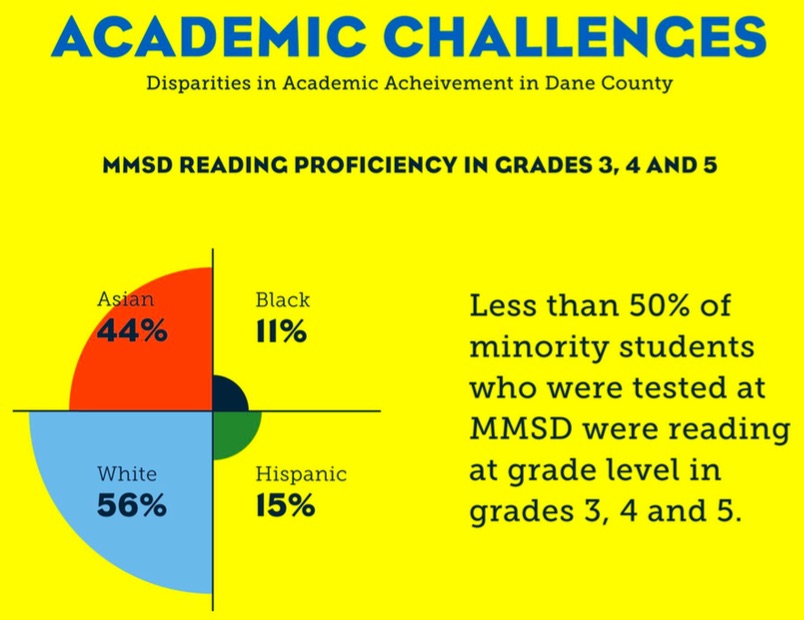
Madison’s long term disastrous reading results

Madison’s 2013-2014 budget, about $392,000,000 or $15k/student

A brief look at recent Madison Superintendents.

Share

Can a scrappy little army bring down #edreform inc.?

edushyster.com:

Reader: I have a confession to make. My path has not been a righteous one. In fact the last time I attended a church service was in the 5th grade, when, as a *plus one* with my best friend’s family, I would pass a confused, incense-choked hour thinking longingly of the donuts that waited downstairs. But that all changed recently when I accompanied wonder blogger Mercedes Schneider to her southern Louisiana church. Her pastor gave a sermon about David and Goliath, so powerful, so perfect for our *2 big 2 fail* times that I have been thinking about it ever since.

Meet Goliath, Inc, Inc, Inc
In Malcolm Gladwell’s provocative study of David and Goliath (note: all references to the Gladwellian oeuvre must be preceded by *provocative*), he alleges that it was double vision that ultimately felled the giant Philistine. Our #edreform equivalent of Goliath—let’s call him *G*—suffers from a different disorder: double hearing. You see, our G lives in an echo chamber such that everything he utters is repeated back to him. He and his G-unit think in the same tanks and watch their Roth’s gently swell in the same banks. In fact, rare is the day in which they encounter a single other individual who does not share their belief that it is a matter of common sense, not to mention fierce urgency, that [INSERT BELOVED REFORMY POLICY HERE] should be implemented posthaste. In fact, in fact, only yesterday G read a brand new study affirming exactly that—well, maybe not a study exactly, more like a collection of handsomely bound talking points. But still…

Share

Harvard’s Exit Strategy

The Economist:

A RECENT Free exchange column looked at how online education might affect higher education. Elite institutions should be fine, we wrote, because they product they offer is completely different from the standardised, distance education that MOOCs offer. Unless, that is, they begin offering their own course material online at low prices, in the process breaking their business model. What is that model? Stanford economist Caroline Hoxby has one answer:

Elite institutions face very different circumstances, Ms Hoxby reckons. They operate like venture-capital firms, offering subsidised, labour-intensive education to highly qualified students. They aim to cultivate a sense of belonging and gratitude in students in order to recoup their investment decades later in the form of donations from successful alumni.

Ironically, these universities may have threatened their own business model by embracing MOOCs. Online courses break the personal link between students and university and, if offered cheaply to outsiders, may make regular graduates feel more like chumps than the chosen few. For top schools, the best bet may simply be to preserve their exclusivity.

The past 24 hours have provided an excellent illustration of both sides of that model. First, NPR’s Planet Money reports:

Share

Charter Advocates Face Gap in Mayor Race

Lisa Fleisher:

For more than a decade, New York’s charter-school advocates and other supporters of education reform have had a powerful ally in Mayor Michael Bloomberg.
But that is likely to change after next year. None of the presumed mayoral candidates fully support Mr. Bloomberg’s policies, which have been at the forefront of a national movement to promote school competition, accommodate charter schools and use test scores to judge schools and teachers.

Share

Basic Skills Versus Conceptual Understanding: A Bogus Dichotomy in Mathematics Education

H. Wu:

EDUCATION SEEMS to be plagued by false dichotomies. Until recently, when research and common sense gained the upper hand, the debate over how to teach beginning reading was character- ized by many as “phonics vs. meaning.” It turns out that, rather than a dichotomy, there is an inseparable connection between decoding–what one might call the skills part of reading–and comprehension. Fluent decoding, which for most children is best ensured by the direct and systematic teaching of phonics and lots of practice reading, is an indispensable condition of comprehension.
“Facts vs. higher order thinking” is another example of a false choice that we often encounter these days, as if thinking of any sort–high or low–could exist out- side of content knowledge. In mathematics education, this debate takes the form of “basic skills or concep- tual understanding.” This bogus dichotomy would seem to arise from a common misconception of math- ematics held by a segment of the public and the educa- tion community: that the demand for precision and fluency in the execution of basic skills in school math- ematics runs counter to the acquisition of conceptual understanding. The truth is that in mathematics, skills and understanding are completely intertwined. In most cases, the precision and fluency in the execution of the skills are the requisite vehicles to convey the conceptual understanding. There is not “conceptual understanding” and “problem-solving skill” on the one hand and “basic skills” on the other. Nor can one ac-quire the former without the latter.
It has been said that had Einstein been born at the time of the Stone Age, his genius might have enabled him to invent basic arithmetic but probably not much else. However, because he was born at the end of the 19th century–with all the techniques of advanced physics at his disposal–he created the theory of rela- tivity. And so it is with mathematics. Conceptual ad- vances are invariably built on the bedrock of tech- nique. Without the quadratic formula, for example, the theoretical development of polynomial equations and hence of algebra as a whole would have been very dif- ferent. The ability to sum a geometric series, some- thing routinely taught in Algebra II, is ultimately re- sponsible for the theory of power series, which lurks inside every calculator. And so on.

Share

Viewpoints: Open enrollment unlocks path to choice Share

Gloria Romero and Larry Sand:

Getting any school choice legislation passed in California is a daunting task. The Legislature, in thrall to the teachers unions, is unwilling to disrupt the moribund status quo, which has led to disastrous consequences for public education. But the Open Enrollment Act has jumped through various legal and political challenges and miraculously survived, though efforts are under way to have it weakened.
Included in California’s 2010 sweeping reform package, the Open Enrollment Act has received far less attention than its sister statute, the “parent trigger” law. But while the parent trigger provision requires the signatures of 50 percent of parents at a school designated as chronically underperforming by the California Department of Education, the open enrollment provision requires only one. It is efficient, simple and unencumbered by the political obstacles that have undermined parent empowerment under the parent trigger law – one parent can rise to the challenge and demand change.

Share

The Power of Open Education Data

Todd Park and Jim Shelton:

That’s why we are excited about the Education Data Initiative, an Administration-wide effort to “liberate” government data and voluntarily-contributed non-government data as fuel to spur entrepreneurship, create value, and create jobs while improving educational outcomes for students. The Education Data Initiative is part of a recently announced series of Open Data Initiatives in energy, health care, public safety, and education to spark new private-sector consumer-facing and business-oriented tools, products, and services – such as mobile apps and websites- all while rigorously protecting personal, proprietary, and national security information.
Led by the U.S. Department of Education, in close partnership with the White House and other agencies, the Education Data Initiative seeks to (1) work with data owners inside and outside of government to make education-related data available, machine-readable, and accessible, while ensuring personal privacy is protected, and (2) collaborate with private-sector entrepreneurs and innovators to ensure they are aware of these existing and newly available digital assets and encourage them to include these data as inputs into their new products, services, and features that can improve student success.
For example, existing Federal databases of higher education information available on education.data.gov (e.g., institutional prices, graduation rates, loan default rates, etc.) can fuel new or improved online services that help students and their families make informed choices about which college to attend, based on indicators of affordability and quality. Similarly, making individual federal financial aid application and award data securely available to applicants and borrowers in machine-readable form promises to help customize and personalize college-choice tools and services.

Share

Vouchers Breathe New Life Into Shrinking Catholic Schools

Stephanie Banchero & Jennifer Levitz:

It had been years since Principal Kathleen Lowry pulled extra desks from the dusty attic of St. Stanislaus, the only Catholic school left in this port city. But after Indiana began offering parents vouchers in the spring of 2011 to pay for private tuition, she had to bring down 30 spare desks and hire three teachers’ aides.
Thanks to vouchers, St. Stanislaus, which was $140,000 in debt to the Catholic Diocese of Gary at the end of 2010, picked up 72 new students, boosting enrollment by 38%.
“God has been good to us,” says Ms. Lowry. “Growth is a good problem to have.”
For the first time in decades, Catholic education is showing signs of life. Driven by expanding voucher programs, outreach to Hispanic Catholics and donations by business leaders, Catholic schools in several major cities are swinging back from

Share

Forget B-School, D-School Is Hot

Melissa Korn & Rachel Emma Silverman:

Stanford University’s d.school–the Hasso Plattner Institute of Design–has gained recognition in recent years for introducing the trendy, but murky, problem-solving concept known as “design thinking” to executives, educators, scientists, doctors and lawyers. Now other schools are coming up with their own programs.
Students at Stanford University’s Hasso Plattner Institute of Design — the d.school — have their photos posted on the walls of a main meeting space.
Design thinking uses close, almost anthropological observation of people to gain insight into problems that may not be articulated yet. For example, researchers may study the habits of shoppers waiting to pay for groceries in order to create a more efficient checkout system that maximizes last-minute purchases while keeping customers moving quickly.
Traditionally, companies have relied on focus groups to get feedback on products that were already in development. With design thinking, potential solutions–products, processes or services–are modeled, often using simple materials like markers and pipe-cleaners, then tested and quickly adjusted based on user feedback.

Share

WEAC has no regrets about failed Walker recall

Meg Jones:

Since the collective bargaining measure was enacted last year, WEAC’s membership has dropped from around 90,000 to 70,000, but the remaining membership became energized by the recall. Union leaders are hopeful that passion will continue as the union rallies around issues such as public school funding. The union is working on membership drives this summer.
“I think we will be smaller but stronger,” Bell said.
Burkhalter estimated 25% to 30% of WEAC members voted for Walker in 2010 while on Tuesday about 5% voted for the governor.
“He really united our membership,” said Burkhalter.
Bell said Walker prevailed in the recall partly because many voters don’t like recall elections and some believed recalls should only be used in cases of malfeasance. She admitted public employees were easy targets for the governor and Republican lawmakers because of generous pensions and benefits, which Bell noted were mostly a result of former Republican Gov. Tommy Thompson’s qualified economic offer law that gave better benefits in return for salary concessions to public school employees several years ago.

Related: WEAC: $1.57 million for Four Wisconsin Senators.

Share

What’s Wrong with Multi-Culturalism, Part 1

Kenan Malik:

I gave the Milton K Wong lecture in Vancouver on Sunday. I very much enjoyed the event- it was a stunning venue, a superb audience and a good discussion of the issues. My thanks to the Laurier Institution, University of British Columbia and CBC for inviting me. Entitled ‘What is Wrong with Multiculturalism? A European Perpective’, the lecture pulled together many of the themes about immigration, identity, diversity and multiculturalism of which I have been talking and writing recently. It was a long talk, so I am splitting the transcript into two. Here is the first part; I will publish the second part later this week. It will be broadcast in full on 22 June on the CBC’s Ideas strand.
It is somewhat alarming to be asked to present the European perspective on multiculturalism. There is no such beast. Especially when compared to the Canadian discussion, opinion in Europe is highly polarised. And mine certainly is not the European perspective. My view is that both multiculturalists and their critics are wrong. And only by understanding why both sides are wrong will we be able to work our way through the mire in which we find ourselves.
Thirty years ago multiculturalism was widely seen as the answer to many of Europe’s social problems. Today it is seen, by growing numbers of people, not as the solution to, but as the cause of, Europe’s myriad social ills. That perception has been fuel for the success of far-right parties and populist politicians across Europe from Geert Wilders in Holland to Marine Le Pen in France, from the True Finns to the UK Independence Party. It even provided fuel for the obscene, homicidal rampage last year of Anders Behring Breivik in Oslo and Utøya, which in his eyes were the first shots in a war defending Europe against multiculturalism. The reasons for this transformation in the perception of multiculturalism are complex, and at the heart of what I want to talk about. But before we can discuss what the problem is with multiculturalism, we first have unpack what we mean by multiculturalism.

Share

The Greenfield School Revolution & School Choice

Greg Forster & James Woodworth

The recent explosion of educational innovation has focused primarily on creating wholly new models of what a school can be. From KIPP to carpe Diem, education is entering a revolutionary period driven by the reinvention of the entire school rather than by gradual programmatic reforms. Although some of these new models have been more successful than others, and the level of success for any given new model can be debated, there is a growing consensus that these new school models collectively represent a dramatic challenge to the status quo in education.
These “greenfield school models” do not just challenge our assumptions about schooling. They also challenge the assumption that one school model can provide the right education for every child. The public mind has been opened to the potential of educational options as never before.
The nation faces two crucial challenges as we enter this new period. Only a tiny fraction of the promise and potential of greenfield school models has been tapped so far. how can we create far more of these models, with greater variation and more institutional support for innovation? And how is it possible for greenfield school models to create improvement in the vast majority of schools, the “un-reinvented” regular public schools, given that even gradual attempts at programmatic reform within those schools have been ineffective over the past 50 years?
Universal school choice has great potential to meet both of these challenges. Although the private school sector provides structures that should be inviting to entrepreneurs, currently they do not find the private school sector attractive. The “tuition barrier” locks out institutional change; private schools can’t reach out to a large enough base of families seeking different learning environments, because they must charge tuition. By lowering the tuition barrier and allowing private schools to serve new populations, universal choice would provide educational entrepreneurs with dramatically more freedom and support than they currently enjoy even in charter schools. entrepreneurs would be more free to innovate beyond the confines of the “default” public school model, giving them the ability to truly reinvent the school.

Share

How should mathematics be taught to non-mathematicians?

Tim Gowers:

Michael Gove, the UK’s Secretary of State for Education, has expressed a wish to see almost all school pupils studying mathematics in one form or another up to the age of 18. An obvious question follows. At the moment, there are large numbers of people who give up mathematics after GCSE (the exam that is usually taken at the age of 16) with great relief and go through the rest of their lives saying, without any obvious regret, how bad they were at it. What should such people study if mathematics becomes virtually compulsory for two more years?
A couple of years ago there was an attempt to create a new mathematics A-level called Use of Mathematics. I criticized it heavily in a blog post, and stand by those criticisms, though interestingly it isn’t so much the syllabus that bothers me as the awful exam questions. One might think that a course called Use of Mathematics would teach you how to come up with mathematical models for real-life situations, but these questions did, and still do, the opposite. They describe a real-life situation, then tell you that it “may be modelled” by some formula, and proceed to ask you questions that are purely mathematical, and extremely easy compared with A-level maths.

Share

College 2.0: An Entrepreneurial Approach to Reforming Higher Education

Ben Wildavsky and Robert E. Litan, Ewing Marion Kauffman Foundation:

A far-reaching discussion is taking place in the United States about the challenges facing higher education and the possible forms postsecondary learning might take in the future. Notwithstanding the strengths of our best research institutions, the shortcomings of many U.S. colleges and universities are significant. There is growing evidence that they need to focus more effectively on student learning, improve completion rates, lower costs, make much better use of technology, boost productivity, improve delivery of instruction for nontraditional students, and take innovations to scale more quickly.
To make this happen–and to provide brand-new alternatives to traditional models–a more entrepreneurial approach to postsecondary education is sorely needed. But even as a period of unusual ferment in U.S. higher education gets under way, numerous barriers continue to slow innovation and thwart experimentation, both in traditional institutions and in start-up ventures.
In an effort to understand the nature of those barriers and to generate ideas for overcoming them, in December 2011 the Ewing Marion Kauffman Foundation convened a diverse group of analysts and practitioners for a two-day retreat in Palm Beach, Florida. Participants included Shai Reshef, founder of the University of the People; the management editor of The Economist; the founders of startups 2tor, Inc. and StraighterLine; senior leaders of nontraditional universities such as Olin College and Western Governors University; the president and CEO of Kaplan, Inc.; the directors of education policy at the American Enterprise Institute, the Brookings Institution, and the Center for American Progress; and professors who both study and participate in postsecondary reform initiatives.

Share

NSF Releases Report Detailing Substantial Growth in Graduate Enrollment in Science and Engineering in the Past Decade

National Science Foundation:

A recent report released by the National Science Foundation found that graduate enrollment in science and engineering grew substantially in the past decade.
Approximately 632,700 graduate students were enrolled in science, engineering and health programs in the United States as of fall 2010. This was a 30 percent increase from 493,000 students in 2000, according to the National Science Foundation’s Survey of Graduate Students and Postdoctorates in Science and Engineering.
The growth in first time, full-time graduate student enrollment in science, engineering, and health programs over this time was even greater, with a 50 percent increase from approximately 78,400 students in 2000 to almost 118,500 students in 2010.

Share

Madison Teachers Newsletter; Teacher & Labor Course

Solidarity 65K PDF:

Register now for Teaching Labor History Course August 6 and 7
Many MTI members have asked that MTI once again sponsor a staff development course conducted by the UW Extension’s School for Workers on “Teaching Labor History Through Film and Media: Struggles from Our Past & Present, Part 2”. Using films, music and other sources (which were not shown during last year’s course) this class will look at some of the epic struggles of workers in recent and contemporary history and will discuss ideas about teaching labor history and collective bargaining in the classroom. The course will also examine the impact of economic, social and political conditions on workers and their unions, as well as the role played by business and government. The course will also examine the significance of immigration, and ethnic, racial and gender differences to the evolution of the American working class.
The ten (10 ) hour, two-day course will meet from 9:30 a.m. – 3:00 p.m. on August 6 and 7, 2012. The course is offered at no cost to MTI members, a light lunch will be provided. Space is limited to the first 40 registrants. Under the terms of MTI’s Collective Bargaining Agreement, Madison teachers may be eligible for 1.0 PAC credits, subject to approval by the MTI/MMSD Professional Advancement Credit Committee.
Contact MTI to register (257-0491 or mti@madisonteachers.org)

Share

Birmingham School Board Questions Nerad About Controversy in Madison

Laura Houser:

In 2006, you were the Wisconsin Superintendent of the Year. Can you address why some of your later evaluations in Madison haven’t reflected that?
In March, the Madison Board of Education evaluated Nerad on the low end of “proficient” in an evaluations system designed to mimic the Wisconsin Knowledge and Concepts Examination.
According to the Wisconsin State Journal, Nerad scored lowest in “strategic leadership and district culture,” and in “staff evaluation and personnel management.”
However, Nerad said Thursday there are two things he has not been deserving of: being named superintendent of the year and being assessed as barely proficient.
“The last couple years in Madison have been challenging (and) there’s no one that wishes I could be more of a unifying force than me,” Nerad said. “I ask only to be judged on my whole record.”
What is your recommended evaluation process between yourself and the school board?
“I’m a big believer in evaluation,” Nerad said, noting that if he were hired, he and the school board would have to agree on evaluation metrics.
“We should have a conversation about what that assessment should look like, (but) I believe in holding myself to the highest standards when it comes to improvement goals.”
How did you whittle down your plan to reduce the achievement gap from $12 million to $4 million?
Nerad admitted that upon cutting down his plan’s price tag, it wasn’t able to accomplish everything it originally set out to do. According to the Wisconsin State Journal, the original plan included 40 strategies for reducing the achievement gap; the revised plan has 21 strategies.
“I felt it was my responsibility to present something (to the school board) that’s stable financially,” Nerad said, noting he and his team had to prioritize the most important strategies.
His plan to fund the first year of the achievement gap plan? Nerad said he is proposing to use Madison’s fund balance — similiar to Birmingham Public School’s fund equity — and leaving it to the school board to decide where funding should come from in coming years.

Much more on outgoing Madison Superintendent Dan Nerad, and Birmingham, here.

Share

Attention education experts! Why do so many kids graduate with poor reading and math skills?

Katy Murphy:  

We’ve all seen the reports on college-level remediation — the high numbers of kids who graduate from high school and are admitted to college with low reading comprehension and math skills. Here, you’ll find the CSU freshman proficiency rates for 2010.
One of my colleagues wants to explore some of the reasons behind this phenomenon. You’d think I would have a clear idea, after covering k-12 for so long, but I’m afraid to say that I don’t.
That’s where you come in — the people who teach kids how to read and/or solve mathematical problems, who supervise or coach those who do, or parents who watch the system closely. As you look at the system from pre-k through high school, where do you see the breakdowns happening, and what are the fixes?

Share

Forget Wisconsin, The Unions’ Biggest Loss Was in CA. And What It Means For Improving Schools

Andrew Rotherham:

Pension reform will help cities balance budgets, but will their schools still be able to attract talented teachers?Bad news for teachers and other public-sector employees: America is more than ready to cut your pensions and benefits. While most politicos had been focusing this week on the Wisconsin recall, an election 2,100 miles away in San Jose, Calif., may be a bigger harbinger of the kind of austerity voters are developing a taste for.
In this city of about a million residents an hour south of San Francisco, voters on Tuesday approved arguably the country’s boldest pension cuts. San Jose’s Democratic mayor, Chuck Reed, has been grappling with ballooning pension costs that have increased from $73 million to $245 million in the last decade. Retirement costs already consume more than 20% of the city’s general fund, which helps explain why Reed was pushing San Jose to pass Measure B, which would give voters the power to approve increases in pension benefits and give the city the power to suspend automatic 3% annual raises during a fiscal crisis. The measure would also make workers contribute half the cost of their pensions; employees currently pay $3 for every $8 the city contributes, and the city is financially responsible for any shortfalls. Also included are provisions to curb the abuse of disability benefits. It’s a tough package — and will certainly be challenged in court because it changes benefits not only for future workers, something everyone agrees is legal, but for current ones as well. Nonetheless, voters passed it by a stunning margin of 69.5% in favor, 30.4% opposed. A pension reform measure also passed in San Diego.

Share

The Pros & Cons of Accountability

PBS NewsHour

Judy Woodruff:As part of our American Graduate focus on teachers, testing and accountability, Ray Suarez moderated a discussion with several New York public school teachers on the challenges they face in the classroom and how they think they should be evaluated.
Finally tonight, our series on teachers, testing and accountability.
On Monday and Tuesday, we heard from philanthropist Melinda Gates of the Gates Foundation, and Diane Ravitch, a historian and former assistant secretary of education.
Ray Suarez recently moderated a conversation, one of a dozen events in the past year held with teachers around the country. This one was organized by WNET in New York City, featuring educators from each of the city’s five boroughs.
It’s part of our American Graduate project sponsored by the Corporation for Public Broadcasting and the Bill and Melinda Gates Foundation.

Share

Student who doubled as high school’s custodian now Harvard-bound

Nancy Cordes:  

It’s high school graduation season, and one young woman who is getting her diploma this evening is our choice for “most likely to succeed” — because she already has, against some incredible odds.
At 6 this morning, long before her classmates were even awake, 18-year-old Dawn Loggins was already pushing a mop through her high school in Lawndale, N.C. — where she also works as a custodian.
“I’ll work two hours before school. And then I’ll go to school. And then I’ll come back and work two hours after school,” Dawn said. Then homework when she gets home.
Home — for Dawn — is complicated. For years she moved around, sometimes squatting with her drug dealer stepfather and unemployed mother.

Share

Schools Get Tough on Pranks

Nathan Koppel:

It is a time-honored ritual for high-school students: flouting authority one last time before graduation.
But this year, the senior prank has been no laughing matter at schools around the country. Administrators have suspended or even filed criminal charges against students for pranks that have ranged from the classic food fight to creative uses of animals to cause an uproar.
“Schools understand that students want to leave their mark on the way out the door, but a better way to do that is to take up a donation and plant an oak tree,” said Mark Goulet, a lawyer for the school board in Smithville, Texas, where students last month were suspended after a cafeteria food fight involving burritos.
“Some kids ordered double lunches,” Mr. Goulet said. “It was a melee.”

Share

Body Language

Lapham Quarterly:

A version of this joke appears in a 1941 dissertation on “the gestural behavior of eastern Jews and southern Italians in New York City, living under similar as well as different environmental conditions.” The study was written by David Efron, who grew up in an orthodox Jewish home in Argentina and arrived in New York for graduate study in the 1930s. By his own account, when he spoke Spanish, he gestured with “the effervescence and fluidity of those of a good many Argentinians.” When he spoke Yiddish, his gestures were more “tense, jerky, and confined.” He sometimes combined the two styles, as when “discussing a Jewish matter in Spanish, and vice versa.” After living in the United States for a few years, he found his gestures becoming “in general less expansive, even when speaking in his native tongue.” His gestural identity was further complicated by the “symbolic Italian movements” he had picked up from Argentine-Italians and reinforced on a trip through Italy. But no matter what language he spoke, he proved to be “an adroit table-pounder.”
Efron was one of the last students of the famous anthropologist Franz Boas. Boas spent his career arguing that it was culture and environment, not biological race, that accounted for differences in how groups of people behaved. Efron’s study was designed as a challenge to the impressionistic explanations of gesture that the race theorists of the 1930s were passing off as science. One claimed that Jews of mixed race who no longer had other Jewish physical traits could still be identified by their gestures. Another categorized gesture by race: Nordic gestures were restrained; Mediterranean gestures were playful; the gestures of the Phalic race (as in the German region of Westphalia) reminded one of a fleeing chicken; Italian gestures were explained with reference to hot blood, light bones, and poor impulse control.

Share

The ‘autism epidemic’ and diagnostic substitution

Deevy Bishop:

Everyone agrees there has been a remarkable increase in autism diagnosis across the world. There is, however, considerable debate about the reasons for this. Three very different kinds of explanation exist.

  • Explanation #1 maintains that something in our modern environment has come along to increase the risk of autism. There are numerous candidates, as indicated in this blogpost by Emily Willingham
  • Explanation #2 sees the risks as largely biological or genetic, with changing patterns of reproduction altering prevalence rates, either because of assortative mating (not much evidence, in my view) or because of an increase in older parents (more plausible). 
  • Explanation #3 is very different: it says the increase is not a real increase – it’s just a change in what we count as autism. This has been termed ‘diagnostic substitution’ – the basic idea is that
    children who would previously have received another diagnosis or no diagnosis are now being identified with autism spectrum disorder (ASD). This could be in part because of new conceptualisations of autism, but may also be fuelled by strategic considerations: resources for children with ASD tend to be much better than those for children with other related conditions, such as language impairment or intellectual handicaps, so this diagnosis may be preferred.

Share

In Defense of School Testing

Anne Murphy Paul:

The school year is winding down, but one faction within the world of education is ratcheting up: the anti-testing movement. More parents are pulling their kids out of end-of-year math and literacy assessments. More teachers and administrators are speaking up against testing–like the group of school district superintendents in Georgia who are calling on the state legislature to reconsider its test-based accountability system. And a national resolution condemning testing has now attracted the endorsements of more than 300 organizations and 8,500 individuals. Standardized testing is “an inadequate and often unreliable measure of both student learning and educator effectiveness,” the resolution reads in part, and “the over-reliance on high-stakes standardized testing in state and federal accountability programs is undermining educational quality and equity in U.S. public schools.”

Share

Chicago Teachers union faces dilemma as strike vote nears

Greg Hinz:

If I were a member of the Chicago Teachers Union, I would vote for that strike authorization today. Mayor Rahm Emanuel hasn’t given me much choice.
Then I would pray — a lot — that a strike never occurs. And get on the phone to CTU President Karen Lewis to tell her she would be absolutely bonkers to actually take ’em out this fall.
The facts of life, Chicago-style, are that the CTU — arguably the city’s most powerful labor union — is in the fight of its life this economically difficult time.

Share

State accountability system flags 10 Madison schools for poor minority-student achievement

Matthew DeFour:

Ten Madison schools and five others in Dane County have been identified among the lowest performers in the state in terms of low-income and minority student achievement under a new statewide school accountability system.
The Department of Public Instruction developed the system — which identifies schools as “focus” and “priority” — to obtain a waiver from requirements under the federal No Child Left Behind law, which for the past decade has resulted in sanctions for certain schools.
The Madison schools identified as “focus” schools are Allis, Falk, Lakeview, Leopold, Midvale/Lincoln, Lowell, Orchard Ridge, Sandburg, Schenk and Thoreau elementaries. Other local “focus” schools include West Middleton Elementary in Middleton-Cross Plains, Bird Elementary in Sun Prairie, and Badger Ridge Middle, and Glacier Edge and Sugar Creek elementaries in Verona.
Madison Superintendent Dan Nerad, in a letter Tuesday to parents at the affected schools, said “the district is still learning the full details and impact on schools.”

Related: Wisconsin Education wake-up call is looming and www.wisconsin2.org.

Share

Time to Try Charter Schools

The Columbian:

Efforts are under way to place an initiative on the Nov. 6 ballot that would ask voters to allow 40 public charter schools around the state in five years. Supporters have until July 6 to gather almost 250,000 signatures. It’s a worthwhile effort and a modest proposal, a mere foot in the door in Washington, one of just eight states that do not have charter schools.Before explaining why this is a good idea, we will first point out that this is precisely why the initiative process is important in our state. The Columbian believes the premier function of initiatives is not necessarily to change laws but more effectively to force action after the Legislature has refused to act. A good example is the statewide ban on indoor smoking in public places. After legislators continually neglected this issue, the people took the matter upon themselves. The result was Initiative 901, which passed in 2005 by 63.2 percent of voters statewide (65.6 percent in Clark County).
We’d like to see the same public mandate expressed about charter schools. The concept has reached its time in Washington. Charter schools are much easier than public schools to open or close, and they have shown varying degrees of success around the country. Charter schools are run independent of public school districts. Each is governed by a multiyear performance contract that requires improvements in student performance.

Share

CollegeScam

Richard Vedder:

A generation ago Charles Sykes wrote a controversial, provocative, but I think 90 percent correct book, ProfScam. I think a better than decent case can be made for a new book, a sequel if you will, called CollegeScam. Professors are not the only ones engaged in using higher education for personal power and glory.
“Is College Too Easy?” is the headline of a superb story by Daniel de Vise on page one of today’s Washington Post. In it, de Vise presents in substantial detail data from the National Survey of Student Engagement (NSSE) that show students study relatively little. Average total time on all academic work amounts to about 27 hours a week, the story says.
Since the typical student is in class at best 32 weeks a year, the total annual hours spent “learning” is on average about 864 (27 x 32), less than one-half the time the student’s parents are spending on their jobs, partly to support the education of their child. As de Vise notes, five-year-old kids in kindergarten spend about as much time on school work as 20-year-old college students.

Share

Timing is right for MPS to consider a longer day

Milwaukee Journal-Sentinel:

The recall race for governor is over, and with teachers union contracts coming to an end, Milwaukee Public Schools Superintendent Gregory Thornton may have an opportunity to bargain for things that he could not have gotten if it were not for Act 10, the law that sharply curtailed collective bargaining for most public workers.
So far, Thornton and the School Board have been quietly active. The board voted to require employees to contribute more to their health insurance premiums and retirement benefits, a move that will reduce the district’s deficit and save millions of dollars that can be reallocated to the classroom. Years of rising benefits and retirement costs combined with budget cuts were choking the life out of MPS. With the last of the union contracts coming to an end in 2013, Thornton and the board will have more flexibility.
But it will take more than asking for bigger contributions from the rank and file to improve the district’s performance. Right now, MPS ranks near the bottom for urban districts in the United States in fourth- and eighth-grade reading for minority boys. Last month, Thornton said he was disappointed that he has not been able to move the needle.

Share

Madison Superintendent Dan Nerad’s Birmingham Candidate Response

Laura Hoser:

How does a school district know when it has an effective program?
This can be a struggle for school districts, Nerad said, but programs need to be evaluated over time, districts need effective ways to collect data, and there needs to be systems in place that allow teachers to collaborate around data and solve problems.
What is the role of principals, the school board and superintendent in terms of innovation and curriculum development?
According to Nerad, the school board ensures there are enough resources for curriculum development and innovation, the superintendent is responsible for outlining what that curriculum will look like, while schools have the responsibility to implement curriculum in the way that’s best for each building.
What is your budgeting process and how would you go about cutting money from Birmingham’s budget?
Budgeting has to be a year-round process, Nerad said, and should he be hired, he would go to district stakeholders — whether they be parents, teachers or community members — and ask: what are your priorities?
How would you engage the rest of the Birmingham community, including the local business community?
Nerad said he would work with the district public relations office to focus heavily on engagement and outreach. “I do believe in putting a face on the superintendency,” he said.
How did you build consensus on an important issue?
When trying to reach consensus on tough issues, Nerad said he uses voting procedures and works to ensure people are heard. “My whole life has been dedicated to those kinds of practices.”
How do you judge whether a school board is doing a good job?
According to Nerad, the school board should be a model for the entire district.
“I believe if the superintendent evaluates the board, the board should evaluate itself,” Nerad said. “If we want our staff to grow, we have to model that kind of commitment. It’s about the whole organization getting better, from the superintendent to the board to teachers to support staff.”

Much more on outgoing Madison Superintendent Dan Nerad, here.
A quick comparison of Birmingham and Madison schools.

Share

Education wake-up call is looming

Sarah Archibald & Michael Ford:

Wisconsin is about to get a wake-up call about the quality of its K-12 education system.
The Department of Public Instruction’s attempt to get a waiver from the federal government’s flawed No Child Left Behind law includes plans to increase testing standards for Wisconsin pupils.
According to the DPI, the effect of this change will be “dramatic” because while Wisconsin students will take the same test they do now, they’ll need much higher scores to be deemed proficient.
Currently, 83% of eighth-graders who take the Wisconsin Knowledge and Concepts Exam are said to be proficient in reading, for example. Under the proposal to index scores to the National Assessment of Educational Progress, that percentage would plummet to just 35%.
In other words, state testing next year will show substantially fewer Wisconsin pupils proficient in core subjects.
More rigorous standards will demand smarter instruction. Fortunately, Wisconsin is well-positioned to use value-added analyses of standardized tests as a tool to improve instructional decisions in ways that benefit students.

Using Value-Added Analysis to Raise Student Achievement in Wisconsin.
www.wisconsin2.org

Share

Don’t let failed prep school end dialogue

Chris Rickert:

t was already something of a fig leaf for a district that rejected the much less expensive Madison Prep amid opposition from the teachers union and liberal activists who painted the school’s chief advocate, Urban League of Greater Madison president Kaleem Caire, as something of a school privatization Trojan Horse for the right.
(I never really understood how a black guy of modest origins who struggled in the Madison schools himself got tossed in with the likes of Newt Gingrich.)
This despite one of the widest racial achievement gaps in the state and a dismal four-year graduation rate for blacks of 50 percent.
I called Cummings on Saturday to see what he thought of Thursday’s news.
“I hate to be a cynic,” he said, but he’d seen it happen “over and over and over. … It’s easy to wear people out by giving them hope.”
Cummings initially wasn’t a big fan of Madison Prep. It would have served only a few dozen students, he argued, and what minority kids need is a districtwide attitude adjustment toward the issue.

Much more on the proposed Madison Preparatory IB charter school, here.

Share

The dreaded gaokao looms

Patti Waldmeir:

Tomorrow cities throughout China will divert traffic, close internet cafés, prohibit horn honking, muzzle public mourning and even change some aircraft flight paths so that 9m of the country’s top students can concentrate on the “gaokao“, the university entrance exam to beat all others, the final act in an educational drama that begins at birth and involves not just the whole family but the whole country.
UK A-levels and the US Scholastic Aptitude Test are no slouches either, but one image from the internet last month captures the degree to which the gaokao is in a class of its own: students in Hubei province sit huddled over desks piled high with books – and each one is hooked up to an intravenous drip delivering amino acids to help them survive the ordeal. University places are scarce, and most students can forget about getting one if they do not do well on gaokao.
Western students, of course, have been known to mainline coffee (or worse) to keep awake at exam time – but the teacher is not usually handing out the uppers. In Hubei, the school was not only dispensing the drips but the government was providing a subsidy to pay for them.

Share

Managing Talent for School Coherence: Learning from Charter Management Organizations

Michael DeArmond, Betheny Gross, Melissa Bowen, Allison Demeritt, Robin Lake via a kind Deb Britt email:

The current wave of new teacher evaluation systems around the country offers an opportunity to broaden the conversation surrounding teacher effectiveness and its relationship to school coherence, to look at how schools and school systems might take a more integrated and intentional approach to attracting, training, and managing high-quality teachers. Charter management organizations (CMOs) are an important but overlooked source of ideas for thinking about how to build talent management systems that get the right teachers into the right schools and create coherent work environments that develop and support teacher performance.
This report examines how CMOs manage teacher talent: How do CMOs recruit and hire teachers? How do they develop teachers? And how do they manage teacher performance? CRPE researchers analyzed data from a larger study of CMOs conducted jointly by Mathematica Policy Research and CRPE. That study offered a rich array of data on how CMOs manage teachers, including in-depth case study data and survey data from CMO central offices and principals.

Share

The Best Third-Grade Teacher Ever

Andrew Lo:

One of the most important economic issues we face today is how much to spend on education, both individually and as a society. As tax revenues decline due to demographic changes and deteriorating business conditions, municipalities have to make tough choices about which programs to cut, and education is often an early victim. Because we don’t yet have good measures of all the future benefits produced by better education today, school programs are easy targets for cost-cutting measures, especially in lower-income regions where parents are focused on meeting more basic needs and less likely to put up a fight. But experiments like Geoffrey Canada’s Harlem Children’s Zone hint at the enormous impact that early educational support can have on lifetime achievement.
I have my own example: Mrs. Ficalora, the best third-grade teacher ever.
In 1968, as a third-grade student at P.S. 13–a neighborhood public elementary school in Queens, New York–I had the amazing good luck of being in Barbara Ficalora’s class. Mrs. Ficalora changed my life. A slender tallish woman with a radiant smile, a Jackie Kennedy hairdo, and a warm but commanding and confident presence, she was everything a third-grader wished for in a teacher. When she spoke, we all listened, and despite the fact that there were close to 30 students in her class, she always seemed to be speaking to each of us individually, managing to make each of us feel special, appreciated, and cared for. She lauded Richie Weintraub on his prowess in punchball during recess. She extolled the impressive acting ability of Bruce Bernstein in our school play. She cooed over the exotic sari worn by Nuri Tjokroadismarto at the international potluck dinner she organized for the students and their parents. And even when she teased the Vorcheimer twins for their messy desks–comparing them to Fibber McGee’s closet–we all understood that she did it with great affection and respect for the two boys, despite the fact that no one knew who Fibber McGee was or what his closet had to do with their desks.

Share

The case against single-sex schooling

Rebecca Bigler and Lise Eliot:

Educators have spent several decades trying — and largely failing — to improve public schools. What if the solution were as easy as re-sorting students into their classrooms? Some supporters believe single-sex schooling is just such a magic bullet. But multiple lines of research show that single-sex schooling is both ineffective and detrimental to children’s development. This is why we support the American Civil Liberties Union’s new effort to investigate potentially unlawful single-sex programs in school districts across the country.
Throughout the United States, hundreds of public schools are segregating boys and girls as young as kindergarten age into single-sex classrooms based on highly distorted claims about differences in their brains and mental skills. What’s worse, such schools are ignoring important research showing that such segregation may actually be harmful to children.
Consider the new Franklin Academy for Boys in Tampa, a public middle school whose charter application states that “the typical teenage girl has a sense of hearing seven times more acute than a teenage boy,” and continues with this claim, “Stress enhances learning in males. The same stress impairs learning in females.”

Share

Recall Day Rhetoric

A few links related to Wisconsin’s recall election:
#wirecall on Twitter
Madison Teachers, Inc Twitter Feed; Pro-Recall
Madison’s Isthmus
True School Activists Vote for Walker by “Penelope Trunk”, via a kind reader’s email.
TJ Mertz: Why Scott Walker doesn’t recall the QEO and how to help recall him
WisPolitics Elections Blog (WisPolitics is now owned by the Capital Times Company)
MacIver Institute
Milwaukee Journal-Sentinel All Politics Blog.
Daily Kos
Talking Points Memo
Five Thirty Eight Blog..
National Review
WEAC Twitter Feed
AFSCME Twitter Feed
Politico

Share

The Top 400 World Universities

London Times & Thomson Reuters:

The Times Higher Education World University Rankings were developed in concert with our rankings data provider, Thomson Reuters, with expert input from more than 50 leading figures in the sector from 15 countries across every continent. We believe we have created the gold standard in international university performance comparisons.
Our rankings of the top universities across the globe employ 13 separate performance indicators designed to capture the full range of university activities, from teaching to research to knowledge transfer. These 13 elements are brought together into five headline categories, which are:
Teaching — the learning environment (worth 30 per cent of the overall ranking score)
Research — volume, income and reputation (worth 30 per cent)
Citations — research influence (worth 30 per cent)
Industry income — innovation (worth 2.5 per cent)
International outlook — staff, students and research (worth 7.5 per cent).

Read the analysis, here.
The University of Wisconsin-Madison ranks 27th.
Related: Towards a Global Common Data Set for World University Rankers
.

Share

Changing the Economics of Education

John Hennessy and Salman Khan:

Is there anything to be done about the rising price of higher education? That was the question posed to John Hennessy, president of Stanford University, and Salman Khan, founder of Khan Academy, a nonprofit online-learning organization. They sat down with The Wall Street Journal’s Walt Mossberg to discuss how technology might be part of the solution.
Here are edited excerpts of their conversation.
Cost Curve
MR. MOSSBERG: Is it either moral or sustainable for elite colleges and universities to be charging what is approaching $60,000 a year to go to college?
MR. HENNESSY: I think the real question is whether or not what we’re charging is a worthwhile investment for the American public and for families. That’s the key question. The elites have the advantage in that they have been able to significantly subsidize what they charge with financial aid. It’s a really interesting business we’re in. First we charge less than it costs us to provide an education, because we subsidize everybody to some extent. And then if you can’t afford it, we give you a discount.
MR. MOSSBERG: You have a lot of money at Stanford. I’ve been, until recently, a trustee of Brandeis University. It’s a very good university. It charges about what you do. But it doesn’t have your money, and there are a lot of colleges like that.

Share

The Expense of Teacher Union Contracts

Steve Gunn, Research by Victor Skinner:

The School District of Philadelphia is facing a $218 million budget deficit in fiscal 2013, with forecasts for a $1.1 billion shortfall by 2017.
The district’s School Reform Commission has responded with a controversial plan to close as many as 60 schools over the next five years and divert about 40 percent of the district’s students into public charter schools, according to media reports.
The plan has been met with a great deal of resistance from the Philadelphia Federation of Teachers. Nobody knows at this point if the money-saving plan will be implemented, or how the district will find its way out of its deficit situation.
In the meantime, it’s clear that the school district is in the midst of a severe financial emergency, and must find a way to cut costs without negatively impacting students.
A good place to start would be the PFT’s collective bargaining agreement.
We recently inspected a copy of the agreement, then used a freedom of information request to measure the costs of various provisions in the contract for the 2010-11 school year.
We found numerous examples of huge costs that could have been postponed, trimmed or cancelled to save the district millions of dollars without affecting anyone’s base salary.
The list included $14.4 million to cover a three percent salary increase for teachers, a $66 million contribution to the union’s “Health and Welfare Fund” and $165 million for free- or low- cost employee health insurance.

Share

Peterson, Howell and West: Teachers Unions Have a Popularity Problem

Paul Peterson, William Howell & Martin West:

However Wisconsin’s recall election turns out on Tuesday, teachers unions already appear to be losing a larger political fight–in public opinion. In our latest annual national survey, we found that the share of the public with a positive view of union impact on local schools has dropped by seven percentage points in the past year. Among teachers, the decline was an even more remarkable 16 points.
On behalf of Harvard’s Program on Education Policy and Governance and the journal Education Next, we have asked the following question since 2009: “Some people say that teacher unions are a stumbling block to school reform. Others say that unions fight for better schools and better teachers. What do you think? Do you think teacher unions have a generally positive effect on schools, or do you think they have a generally negative effect?”
Respondents can choose among five options: very positive, somewhat positive, neither positive nor negative, somewhat negative, and very negative.

Share

Oregon’s new education chief: ‘Poor for now’ won’t be a problem for Rudy Crew

Susan Nielsen:

Rudy Crew’s mom died when he was 2. His dad had plenty of reasons to stay in bed in the morning, as Crew put it, but he got up every day and worked hard to raise his children right.
“My father,” Crew wrote in a 2007 book, “made sure I had a safe place to take risks, to learn independence, and eventually to believe that poor for now did not mean poor forever.”
Now Crew is Oregon’s first chief education officer, tapped by Gov. John Kitzhaber and formally hired last week to lead the state’s education enterprise from preschool to college. This core tenet of Crew’s belief system — that poor for now doesn’t mean poor forever — drove him to the top of the national heap of K-12 superintendents. It also makes him a bracing choice to help Oregon shake off the poverty mentality that drags down education in this state.

Share

Cozy Board/Superintendent Relationship?

The Des Moines Register, via a kind reader’s email:

Beyond the personal side of this story, the emails raise questions about the school district’s management and the relationship between the superintendent and the school board.
For one, Sebring meddled far too much in a new Des Moines charter school that had been overseen by her twin sister, Nina Rasmusson. Scores of emails reveal Sebring was directly engaged in internal affairs of the school, and that Sebring sought to use her influence to shield her sister from criticism. Rasmusson resigned from the job on Sebring’s advice to avoid being fired because of problems in the charter school.
One email reveals Sebring’s attitude about her relationship with school board members: “We’re having a little trouble reigning (sic) in two of our new board members,” she wrote in a Feb. 10 email to Rasmusson. “They are well-intentioned but crossing the line.”
It’s easy to see how Sebring might have had the idea the board worked for her, not the other way around. Other emails suggest Sebring had a close personal relationship with at least one member of the board.
It appears she’d had them under her thumb for years. Members allowed Sebring to hire her sister, even though that clearly posed a conflict. They said nothing when she failed to promptly deliver a state accreditation report showing problems with the district.
And, to the end, board members seemed more concerned with protecting her than holding her accountable and being accountable to the public. They held a closed-door meeting to discuss her unexpected resignation May 10.
They knew Sebring had violated the district’s technology policy forbidding the use of school computers or email for personal correspondence and the exchange of sexually explicit messages. Yet they issued a release that misled the public by failing to disclose the full story about why she resigned early.
This school board thanked Sebring for her service and let her go on her way, protecting her to the very end.
This is the same school board the public now must rely on to find and supervise the next superintendent. Members should be taking responsibility for their mistakes. They should be learning from them and making changes in how they do business. A school board is the boss of a superintendent. It’s time for this board to finally figure that out.

Share

Why is Qatar investing so much in education?

Sean Coughlan:

When oil rich countries get involved in global education projects, it is easy to be cynical and only expect some air-brushed philanthropy and gold-plated business school sponsorships.
But the Gulf state of Qatar is providing something more substantial.
So much so that it is becoming one of the most significant players in the field of education innovation, supporting a raft of projects from grassroots basic literacy through to high-end university research.
As well as trying to fast-forward its own education system, it is supporting projects in some of the toughest environments.

Share

Recruiting More Black Teachers Should be a Madison School District Goal

The Wisconsin State Journal:

Howard, who supported Madison Prep, also favors launching pilots to test new approaches to helping struggling students.
“The assumption is that everything is working,” he said, “and it’s not.”
The district should boost efforts to involve more parents in their children’s educations, though that’s not easy.
At the same time, the district needs to pay for a backlog of school maintenance projects without balancing the district budget on the backs of struggling homeowners. Madison is already a high-spending district, so more and more money isn’t the solution.
The school administration’s plan has some merit but mostly stays the course. And more of the same won’t cut it.
The best path now is to recruit more black teachers, try even harder to engage parents, and seek innovation.

Related: Madison Schools Administration has “introduced more than 18 programs and initiatives for elementary teachers since 2009” and the Madison School District’s strategic plan update.

Share

The Reforms I’m For

Charlie Mas:

We spend a lot of time talking about the reforms promoted by Education Reform Advocacy Organizations which we oppose. I also spend a lot of time correcting them when they say that those who oppose them are fighting for the status quo. So folks might wonder what reforms I actually support. It’s a fair question.
I absolutely believe that public K-12 education in Washington, and across the country, needs serious reform. It is build on a model that, in turn, is built on the faulty assumption that the students will fit a narrow mold. The system is set up to expect and serve students who come able and ready to learn in a traditional school setting. The whole thing needs to be reconfigured around a different, more accurate, set of beliefs around who the students are, what they need, and how public schools can deliver it.
The solutions presented by Education Reform Advocacy Organizations, such as LEV, are not serious reforms. They do not address the problem. Some of them, such as charter schools, create an opportunity to bypass the problem – an opportunity which, sadly, often goes unused. Some of them, such as merit pay for teachers, have nothing to do with the problem.

Share

Big education issues won’t change with Wisconsin election results

Alan Borsuk:

In the closing moments of Thursday night’s debate between the two candidates for governor, Milwaukee Mayor Tom Barrett raised a point that intrigues me. In fact, separate from all the other aspects of Tuesday’s historic recall election, I think it resonates across the debate about education in America:
Brass knuckles or handshakes?
Share a cup of coffee or send incendiary tweets?
What’s the best way to get things done amid differences?
Facing Scott Walker, the Republican governor who sat next to him at a round table at Marquette Law School, the Democratic challenger said, “You and I know that if you had accepted back in February of 2011 the offer from those employees to allow them to pay towards their health care and towards their pensions, we wouldn’t be sitting here tonight.”
Walker replied, “That’s just fundamentally wrong.” He said that even as public union leaders offered to accept cuts in benefits for their members, following Walker’s proposal to strip public unions of almost all their powers, local unions across the state were rushing to make contract deals that protected their benefits.
“Actions speak louder than words,” he said.

Share

The questions we should ask when it comes to class size in N.J. schools

Laura Waters:

Mitt Romney visited a charter school in West Philadelphia last Thursday and, either brazenly or cluelessly, addressed that third rail of education politics, class size.
“In schools that are the highest-performing in the world,” he said, “their classroom sizes are about the same as in the United States. So it’s not the classroom size that’s driving the success of those school systems.”
An opportunity for a rational discussion of the costs and benefits of small class size?
More like a greedy Democratic pounce on Romney’s education street cred. President Obama’s spokeswoman sneered, “What planet does he live on?”
Philadelphia Mayor Michael Nutter emoted, “I’m not sure what universe he’s operating in, but we certainly know in Pennsylvania, every parent knows, every second-grader knows, that smaller class sizes are preferable.”

Share

Nancy Sebring resigns from Omaha superintendent job

Mary Stegmeir & Jens Manuel Krogstad:

In a stunning reversal of fortune, former Des Moines Superintendent Nancy Sebring went from presiding over Iowa’s largest school district to losing a new job she had landed to lead the Omaha schools, after disclosure she had used Des Moines school equipment to send and receive sexually explicit emails.
The Omaha school board voted Saturday afternoon without discussion to accept her resignation from the job she was to start July 1.
The vote capped a rapid-fire series of developments that unfolded in less than 20 hours:
8:46 p.m. Friday: The Des Moines Register publishes an online story reporting that Sebring’s abrupt, earlier-than-scheduled departure from the Des Moines district May 10 came after she was confronted by school board members about the discovery of the explicit emails.

Outgoing Madison Superintendent Dan Nerad interviewed for the Omaha position.

Share

University Information Services with API’s

Kin Lane:

APIs are making information more accessible across many industries and sectors, but one area I haven’t seen a lot of movement, until recently, is at Universities.
Last month, Harvard openly licensed their library meta data and through a partnership with the Digital Public Library of America, made it available via APIs. But today’s story is more about APIs driving the operations side of higher ed at the University of Washington.

Share

A Game of Inches

Matthew DiCarlo:

One of the more telling episodes in education I’ve seen over the past couple of years was a little dispute over Michelle Rhee’s testing record that flared up last year. Alan Ginsburg, a retired U.S. Department of Education official, released an informal report in which he presented the NAEP cohort changes that occurred during the first two years of Michelle Rhee’s tenure (2007-2009), and compared them with those during the superintendencies of her two predecessors.
Ginsburg concluded that the increases under Chancellor Rhee, though positive, were less rapid than in previous years (2000 to 2007 in math, 2003 to 2007 in reading). Soon thereafter, Paul Peterson, director of Harvard’s Program on Educational Leadership and Governance, published an article in Education Next that disputed Ginsburg’s findings. Peterson found that increases under Rhee amounted to roughly three scale score points per year, compared with around 1-1.5 points annually between 2000 and 2007 (the actual amounts varied by subject and grade).
Both articles were generally cautious in tone and in their conclusions about the actual causes of the testing trends. The technical details of the two reports – who’s “wrong” or “right” – are not important for this post (especially since more recent NAEP results have since been released). More interesting was how people reacted – and didn’t react – to the dueling analyses.

Share

Why privatize education?

kelli lundgren:

Something is wrong with conservatives’ free market argument for privatization of Utah’s public schools as promoted by several Republican legislators and their ally, the corporate lobbyist American Legislative Exchange Council, or ALEC.
If a free market were truly free, by definition our society would need to completely remove education from federal and state control, including eliminating funding by taxes.
Vouchers could not be used. This, too, pools society’s money for redistribution. No, for pure competition, a family would need to use its own direct tax savings to pay for the education of each child. Conservatives may respond, “Federal and state governments still need to collect taxes, but then distribute the money for private schools of choice.”

Share

Hold education bureaucracy accountable, or lose your right to do it

Laurie Rogers:

“Villainy wears many masks, none so dangerous as the mask of virtue.”– Ichabod Crane, in the 1999 film version of “Legend of Sleepy Hollow”
“If you’re going through hell, keep going.”-Walt Disney
Those who still think America’s public schools are focused on academics are behind the times. Money, control and influence are the priorities now. You can tell because of the battle being fought behind the scenes in our school districts over open government.
Citizens who want to know what government schools are doing with our dollars and children are finding that many in leadership don’t want us to know. As we push for information, they’re pushing back. This struggle is taking place earnestly – even fiercely. It’s also happening quietly, largely because the media aren’t much help. (Many of those whose job is to inform the public have become sycophantic defenders of the government and aggressive attackers of the people.)

Share

NJ Report Cards Cause Consternation Re: “Real” Cost Per Pupil

New Jersey Left Behind:

The NJ DOE released the 2010-2011 School Report Cards yesterday, with a few new bells and whistles. One new feature is accurate graduation rates, previously self-reported by individual districts; another spotlights the cost per pupil when other costs – mandated preschools, out-of-district tuition, debt, transportation – are added to the mix.
(Weirdly, Trenton Public Schools is missing from the database.)
Here’s a rundown of local coverage, which is primarily focused on school costs.
NJ Spotlight (its interactive Report Card here) comments on the impact of NJ’s fiscal difficulties on school costs:

Share

California School district earns ‘independence’ from state control

Jill Tucker:

Richmond Unified, the first school district in California to go bankrupt and require a bailout loan, made its last payment to the state Friday – four years early.
District officials, in what is now called West Contra Costa Unified, squirreled away enough money during tough economic times to pay off the $29 million loan made 21 years ago.
The final payment of $8,130,607.58 was handed over to state Superintendent Tom Torlakson at Richmond’s Ford Elementary Friday morning.
The settling of the debt ends two decades of state control over the district, which serves 30,000 students in 50 schools across five cities.
“We’re ready to pay you off and get you out of our hair,” school board President Charles Ramsey told Torlakson as he handed him the oversized check.

Share

Why California Should Scrap the Academic Performance Index

Richard Lee Colvin:

A few years ago, the symptoms of academic failure at Audubon Middle School southwest of downtown Los Angeles were obvious. Students roamed the trash-strewn campus during class hours, unafraid of consequences. The principal was rarely around, and when he was, he almost never visited classrooms. Observations required for teacher evaluations often were not done, yet teachers still received good ratings. The faculty divided into camps. Some closed their classroom doors and did the best job they could. Others did little more than show videos, knowing it didn’t matter. The nearest Subway restaurant did a brisk business delivering sandwiches to classrooms during instructional time. “This was not a functioning school,” one teacher said. “It was sink or swim, and we were just barely keeping our heads above water.”

Share

Dan Nerad a Semi-Finalist for the Birmingham, MI Schools Superintendent; District spends about 10% less per student than Madison

Pat Schneider:

Madison School District Superintendent Dan Nerad made the cut Saturday to become one of two finalists for the top job at a school district in suburban Detroit, according to an online report.
Nerad was selected as a finalist for superintendent of the Birmingham Public Schools at a special Saturday session of the School Board, the Birmingham Patch reports.
He apparently made a big impression on school board members in Michigan, particularly with his handling of controversy over the race-based achievement gap in Madison schools.

Much more on Dan Nerad, here.
A few comparisons:
Birmingham’s 2011-2012 budget is $107,251,333 for “more than 8000 students”, or roughly $13,406/student. That is about 10% less than Madison’s $14,858.40/student.
Birmingham’s per capita income is $69,151, more than double Madison’s $29,782. Birmingham’s median household income is $101,529 while Madison’s is nearly half: $52,550.
Birmingham had 6 national merit semi-finalists this past year while Madison featured 41. Michigan’s 209 cut score was identical to Wisconsin’s this past year.
Madison continues to spend more per student than most American school districts.

Share

Vouchers, Mini-Vouchers: Louisiana’s bold bid to privatize schools

Stephanie Simon:

Starting this fall, thousands of poor and middle-class kids will get vouchers covering the full cost of tuition at more than 120 private schools across Louisiana, including small, Bible-based church schools.
The following year, students of any income will be eligible for mini-vouchers that they can use to pay a range of private-sector vendors for classes and apprenticeships not offered in traditional public schools. The money can go to industry trade groups, businesses, online schools and tutors, among others.
Every time a student receives a voucher of either type, his local public school will lose a chunk of state funding.
“We are changing the way we deliver education,” said Governor Bobby Jindal, a Republican who muscled the plan through the legislature this spring over fierce objections from Democrats and teachers unions. “We are letting parents decide what’s best for their children, not government.”

Share

The University: Still Dead

Angus Kennedy:

In the course of tracing the changes from the religious foundations – the colleges – of the early American colonists through to the vast ‘multiversitys’ of today, Andrew Delbanco usefully draws attention to the fact that putting a big sign up on a college saying Committed to Providing Excellent Higher Education for All would probably signify that the very opposite was happening inside. He notes a grand inscription at Columbia University from the beginning of the twentieth century: ‘Erected for the Students that Religion and Learning May Go Hand in Hand and Character Grow with Knowledge.’ At the time, the buildings were actually going up for research staff, not for undergraduates, religion was ‘certainly no longer at the center of campus life’, tradition and the canon were being thrown over for the modern, and the idea that professionalised career academics should bother themselves with the moral improvement of undergraduates was quaint at best.

Share

Chicago schools battle closely studied across country

Noreen S. Ahmed-Ullah and Joel Hood:

Mayor Rahm Emanuel’s star power within the Democratic Party has put a national spotlight on the fight over the future of public schools in Chicago and attracted support from education reform groups eager to see how much change can be effected in a pro-labor city.
“The headlines from Chicago are emailed around to mayors and policymakers every morning,” said Joe Williams, head of Washington,D.C.-based Democrats for Education Reform, a group started by Wall Street hedge fund managers. “I think people want to see what’s possible, both politically and on the ground in schools and in communities.”
Democrats for Education Reform and another major education organization, Oregon-based Stand for Children, have each established themselves in Chicago and are working to build backing for Emanuel’s education agenda.

Share

Revealed: How Banks Skim Millions From Student Aid Using Debit-Card-Linked Student IDs

Common Dreams:

Over 9 million students are at risk for increased educational debt, due to bank-affiliated campus debit cards that come with high fees, insufficient consumer protections, and few options. Financial institutions now have affinity partnerships with almost 900 campuses nationwide, grafting bank products onto student IDs and other campus cards to become the primary recipient of billions in federal financial aid to distribute to students.
“Campus debit cards are wolves in sheep’s clothing,” observed Rich Williams, U.S. PIRG Higher Education Advocate and report co-author. “Students think they can access their dollars freely, but instead their aid is being eaten up in fees.”
The Campus Debit Card Trap, a new report released by the U.S. Public Interest Research Group Education Fund, finds that banks and financial firms now control or influence federal financial aid disbursement to over 9 million students by linking checking accounts and prepaid debit cards to student IDs. For decades, students would receive their aid by check, without being charged any fees to access their student aid. Now, students end up paying big fees on their student aid, including per-swipe fees of $0.50, inactivity fees of $10 or more after 6 months, overdraft fees of up to $38 and plenty more. Financial institutions aggressively market or default students into their bank accounts to maximize these fees.

Share

School choice helps with entrepreneurship

Jonathan Moules:

The privilege bestowed on pupils from independent and grammar schools extends to greater links with business founders and lessons about what it means to be an entrepreneur, a report claims.
The study of 1,002 young people by The Pearson Think Tank, funded by Pearson, owner of the Financial Times, and the Education and Employers Taskforce found that those studying at grammar and independent schools were twice as likely to have been involved in a long-term entrepreneurship competition than their peers in non-selective state schools.

Share

Student-Loan Debt Rises 8% to $904 Billion

Josh Mitchell:

Americans are stepping up borrowing to pay for college while they cut other debt as a weak job market contributes to increased college enrollment, new Federal Reserve Bank of New York data show.
Americans owed $904 billion in student loans at the end of March, nearly 8% higher than a year ago, the New York Fed said Thursday in its quarterly report on consumer credit. That is more than the $679 billion on their credit cards at the end of the first quarter.
The New York Fed estimates of student debt are slightly lower than the the more than $1 trillion figure cited earlier this year by the Consumer Financial Protection Bureau. The New York Fed’s estimate is based on a sampling of consumer-credit-agency accounts; the CFPB estimate is based on government data and a survey of private lenders.

Share

The National History Club

Robert L. Nasson, via a kind email:

The National History Club (NHC) was formed in March 2002 to promote the reading, writing, discussion, and enjoyment of history among secondary students and their teachers by giving after school history clubs around the country a clearinghouse to share history-related activities and information with each other. We now have 445 chapters in 43 states and there are over 13,000 students involved. Each chapter sets its own course, and this has led to a wide array of activities that include: Veterans Day ceremonies involving local veterans, participation in National History Day, historic preservation outreach in their communities, and trips to such historic sites as the 16th Street Baptist Church, Valley Forge, and the Lewis and Clark State Historic Site.
This makes the organization unique. By encouraging students to take charge of the direction of their clubs, the NHC uses a bottom-up approach, where students passionate about history are doing the history activities they choose. Rather than a traditional top-down method, which often leads to apathetic students, the NHC has given an ownership stake to every chapter that has joined the organization.
History is the only topic taught in every secondary school that can engage students in learning from past to achieve understanding of, and tackling human problems in, the world today. In history there is truly something for everyone. History is political, artistic, social, economic, military, athletic, scientific, cultural, religious, technological, literary, philosophical, geographic, ethnic, and mathematical. History can be as contemporary as yesterday and as ancient as Mesopotamia, as near as the city one lives in and as far away as Andromeda. History can be seen and touched, read and written, made and remembered. Everyone is a part of history.
More importantly, the study of history builds the critical skills students need to become responsible citizens and effective leaders. Researching and discovering new information, as well as reading, synthesizing, and communicating that information effectively: these are the skills that help make someone successful in business, in civic life, and even in science.
We produce a tri-annual Newsletter that features chapter accounts from throughout the country, and run a number of award programs with various history organizations such as George Washington’s Mount Vernon and The History Channel. Chapters are frequently sharing ideas and activities with each other, and this leads to an active and involved membership. Through this interaction, students and Advisors see that they are not alone in their passion for the study of history, and this encourages more schools to join.
The work of the NHC is as important as ever considering the deteriorating history standards in our schools. A 2010 Civics Assessment administered by the National Assessment of Educational Progress displayed the lack of understanding of civics among students in our secondary schools. Among some of the key findings:
Fewer than half of American eighth graders knew the purpose of the Bill of Rights.
Only one in 10 eighth graders demonstrated acceptable knowledge of the checks and balances among the legislative, executive, and judicial branches.
Three-quarters of high school seniors were unable to name a power granted to Congress by the Constitution.
While there are many people and organizations now complaining about the historical illiteracy of the younger generation, we are one of the few actually doing something about it. The NHC has a sustainable model in place, and we are constantly adding chapters in schools from big cities and rural towns to our community. We want students, teachers, and schools that have a passion for history to join our movement. To view our latest Newsletter or to find out how to create a chapter and join the NHC please visit www.nationalhistoryclub.org
Robert L. Nasson
Executive Director,
National History Club
P.O. Box 441812
Somerville, MA 02144
www.nationalhistoryclub.org
rnasson@nationalhistoryclub.org

Share

Local voucher school’s teachers go months without pay

Lindsay Fiori:

A local voucher school has not paid teachers in months and has lost nearly two-thirds of its students, staff said Wednesday.
St. John Fisher Academy, a private high school that opened in Racine last fall using state voucher money, has reportedly not paid staff members since March and has seen student enrollment dwindle from about 50 children to only 26, according to teachers who filed complaints this month with the state Department of Workforce Development.
Teachers have continued to show up for work each day despite going without pay from mid-December to February and from March to now, they said.

Share

Sal Khan’s ‘Academy’ sparks a tech revolution in education

Marco R. della Cava:

It’s not much past 9 a.m., and Khan, 36, founder of the online educational non-profit Khan Academy, gets set to record his 3,081st video lecture in a small office with a view of air conditioning ducts.
“In 1997, you see, there was a devaluation of the Thai currency,” Khan says into a beefy microphone as he makes crude sketches on his monitor.
If you want gleaming high-tech, go down the road to Google’s campus. If you’re looking for a revolution, this is the right address.
Ever since quitting his job as a successful hedge-fund analyst two years ago to dedicate himself full time to this labor of love, Khan has managed to win fans worldwide and goad skeptical educators.

Share

Measuring Teacher Effectiveness

ConnCAN:

Research and experience make this clear: Great teachers change lives. They inspire and motivate students, and set them on a path for future success. By contrast, just one underperforming teacher can have a lasting negative impact on a student.
Given this reality, significant time and attention has rightly been focused on ensuring that all children have outstanding teachers at the front of their classrooms. This includes improving how teacher performance is evaluated and using evaluations to guide a range of decisions about prepration, recruitment, training, assignment, salary, tenure and dismissal.
As states, districts and school systems across the nation work towards effective teacher evaluation systems, they must tackle difficult questions about design and implementation. This research report aims to help by offering a detailed look at the key components of 10 teacher evaluation models

Share

Candidates — and endorsements — in Oakland school board races

Katy Murphy:

Great Oakland Public Schools, a school reform-minded coalition of families and school employees supported by the Rogers Family Foundation and other groups, has become increasingly involved in Oakland school district policy since its founding a few years ago. Now, for the first time, its board of directors has endorsed school board candidates in the November election, through this process.
GO Public Schools announced today that it had endorsed two of the four candidates for District 3 (West Oakland): incumbent Jumoke Hinton Hodge and challenger Sheilagh Polk. The organization is also backing one of its founding members, James Harris, who is challenging incumbent Alice Spearman for the District 7 seat (East Oakland-Elmhurst).

Share

A Tale of Five Cities

Neerav Kingsland:

A devastating natural disaster destroys one of the nation’s most under-performing school districts. Leaders of state takeover agency (Recovery School District, or RSD) focus energy on human capital, charter school development, and autonomous district schools. National philanthropy invests heavily. Entrepreneurial educators head south. Five years in, the RSD’s third superintendent announces he will charter all schools and develop the nation’s first charter school district. His successor, the fourth superintendent in six years and a former New Orleans teacher, commits to continuing down this path. Charter school and human capital efforts continue with full force. Test scores are up but there is still a long way to go. No plans exist for long-term governance of system.

Share

When to Pursue Governance Reform

Mike Ford:

Governance reform is a seductive idea because it is usually presented as a silver bullet for addressing a policy problem. For example, if the elected school board does not provide students with an adequate education, let’s replace it with one that will.
If only it was that simple. The inconvenient fact is that a school board does not educate pupils, teachers do. A school board governance change alone will not turn Milwaukee schools around.
The same is true for other local governments. The actual delivery of services is performed by street level bureaucrats that go about their duties regardless of who happens to be in charge of the City or County.
But this does not mean governance is irrelevant. Governance, whether it is the setting of specific policies or merely the setting of an organizational culture, can be the difference between creating an environment where an organization can thrive, or one where mediocrity is the ceiling.

Share

Preschool: The Littlest Job-Readiness Program?

Chana R. Schoenberger:

Can finger-painting, cup-stacking and learning to share set you up for a stellar career?
Research says yes, according to Dr. Celia Ayala, chief executive officer of Los Angeles Universal Preschool, a nonprofit that funds 325 schools in Los Angeles County, Calif., using money from tobacco taxes.
“When they enter kindergarten ready to thrive with all the social, emotional and cognitive skills, they perform at grade level or above,” she said. “When they don’t, that’s where that achievement gap starts.”
Kids without that early boost have been shown to be more likely to get special-needs services, be held back a grade or two, get in trouble with the law and become teen parents. Preschool alumni have a better chance, she said.
“Those who go to preschool will go on to university, will have a graduate education, and their income level will radically improve,” she said.

Share

Madison School District Strategic Plan Update

Madison School District 600K PDF:.
I recently attended the third annual update to the 2009 Madison School District Strategic Plan. You can follow the process via these notes and links.
I thought it might be useful to share a few observations on our local public schools during this process:

  • General public interest in the schools continues to be the exception, rather than the norm.
  • I sense that the District is more open to discussing substantive issues such as reading, math and overall achievement during the past few years. However, it does not appear to have translated into the required tough decision making regarding non-performing programs and curriculum.
  • MTI President Kerry Motoviloff recent statement that the District administration has “introduced more than 18 programs and initiatives for elementary teachers since 2009”.
  • Full teacher Infinite Campus use remains a goal, despite spending millions of dollars, money which could have gone elsewhere given the limited implementation. Unfortunately, this is a huge missed opportunity. Complete course syllabus, assignment and gradebook information would be a powerful tool when evaluating achievement issues.
  • The implementation of “standards based report cards” further derailed the Infinite Campus spending/implementation. This is an example of spending money (and time – consider the opportunity cost) on programs that are actually in conflict.
  • The District continues to use the oft criticized and very low benchmark WKCE as their measure. This, despite starting to use the MAP exam this year. Nearby Monona Grove has been using MAP for some time.
  • Three Madison School Board members attended: Mary Burke, James Howard and Ed Hughes.
  • UW-Madison school of Education dean Julie Underwood attended and asked, to my astonishment, (paraphrased) how the District’s various diversity programs were benefiting kids (and achievement)?

The only effective way forward, in my view, is to simplify the District’s core mission to reading, english and math. This means eliminating programs and focusing on the essentials. That will be a difficult change for the organization, but I don’t see how adding programs to the current pile benefits anyone. It will cost more and do less.
Less than 24 hours after I attended the MMSD’s Strategic Plan update, I, through a variety of circumstances, visited one of Milwaukee’s highest performing private/voucher schools, a school with more than 90% low income students. The petri dish that is Milwaukee will produce a far more robust and effective set of schools over the next few decades than the present monolithic approach favored here. More about that visit, soon.

Share

Higher Education’s Online Revolution

John Chubb & Terry Moe:

The substitution of technology (which is cheap) for labor (which is expensive) can vastly increase access to an elite-caliber education.
At the recent news conference announcing edX, a $60 million Harvard-MIT partnership in online education, university leaders spoke of reaching millions of new students in India, China and around the globe. They talked of the “revolutionary” potential of online learning, hailing it as the “single biggest change in education since the printing press.”
Heady talk indeed, but they are right. The nation, and the world, are in the early stages of a historic transformation in how students learn, teachers teach, and schools and school systems are organized.
These same university leaders mentioned the limits of edX itself. Its online courses would not lead to Harvard or MIT degrees, they noted, and were no substitute for the centuries-old residential education of their hallowed institutions. They also acknowledged that the initiative, which offers free online courses prepared by some of the nation’s top professors, is paid for by university funds–and that there is no revenue stream and no business plan to sustain it.

Share

Growing Education Divide in Cities

Haeyound Park, via a kind Rick Kiley email

College graduates are more unevenly distributed in the top 100 metropolitan areas now than they were four decades ago. More adults have bachelor’s degrees, but the difference between the most and least educated metro areas is double what it was in 1970. Full List of Metro Areas:

Related: Adults With College Degrees in the United States, by County.

Share

We Should Only Hold Schools Accountable For Outcomes They Can Control

Matthew DiCarlo:

Let’s say we were trying to evaluate a teacher’s performance for this academic year, and part of that evaluation would use students’ test scores (if you object to using test scores this way, put that aside for a moment). We checked the data and reached two conclusions. First, we found that her students made fantastic progress this year. Second, we also saw that the students’ scores were still quite a bit lower than their peers’ in the district. Which measure should we use to evaluate this teacher?
Would we consider judging her even partially based on the latter – students’ average scores? Of course not. Those students made huge progress, and the only reason their absolute performance levels are relatively low is because they were low at the beginning of the year. This teacher could not control the fact that she was assigned lower-scoring students. All she can do is make sure that they improve. That’s why no teacher evaluation system places any importance on students’ absolute performance, instead focusing on growth (and, of course, non-test measures). In fact, growth models control for absolute performance (prior year’s test scores) so it doesn’t bias the results.
If we would never judge teachers based on absolute performance, why are we judging schools that way? Why does virtually every school/district rating system place some emphasis – often the primary emphasis – on absolute performance?

Share

What Happens When Toddlers Zone Out With an iPad

Ben Worthen:

More than half of the young children in the U.S. now have access to an iPad, iPhone or similar touch-screen device. For parents, their children’s love of these devices raises a lot of questions.
Kids for years have sat too close to the television for too long or played hours of Madden on family room game players. But pediatric neuroscientists and researchers who have studied the effects of screen-time on children suggest the iPad is a different beast.
A young child will look away from a TV screen 150 times an hour, says Daniel Anderson, a professor emeritus of psychology at the University of Massachusetts. His studies over the past 30 years also showed children have trouble knowing where on a TV screen to look.

Share

A different class: the UK expansion of Steiner schools

Jeevan Vasgar:

The number of Steiner schools is set to expand, thanks to state funding via the coalition’s ‘free schools’ policy. Their alternative approach is appealing, but do they offer a rounded education?
The school run resembles the exodus from a festival. There are vans with hippyish bumper stickers – Homeopathy Heals, says one – bouncing down a track to the sprawling car park, where women in ponchos hug their babies and chat.
Inside the Steiner Academy Hereford, which occupies a renovated Victorian school and converted farm buildings in the village of Much Dewchurch, it’s a picture of pastoral charm. There’s a babbling water feature in a courtyard lined with potted shrubs, and a pleasingly old-fashioned wooden staircase leading up to classrooms.
The kindergarten is just that – a triangular garden fringed with pine, apple and cherry trees laden with blossom where children in woolly hats sit on the ground making mud pies.

Share

Wisconsin DPI Mathematics Education Videos

Wisconsin DPI Connected email:

Wisconsin’s alignment of Teaching Channel videos to new mathematics standards is so useful it’s being recommended on the national level.
For each of the eight skills of the Common Core State Standards for Mathematical Practice, the creators of DPI’s Mathematical Literacy website found at least one video to help teachers visualize how to address it in their classrooms.
Wisconsin’s site was created by Diana Kasbaum, the DPI’s mathematics education consultant, along with Jackie Herrmann and Becky Walker of the Appleton Area School District and Jeff Ziegler of the Madison Metropolitan School District. The Council for Chief State School Officers recommended the site in a nationwide email to help educators implement the Common Core.
The website simultaneously addresses the Common Core State Standards requirement of Disciplinary Literacy—the idea that students need subject area educators to teach them ways to read, write, think, listen, and speak that are specific to those fields. In mathematics, a team of Wisconsin educators found that the Mathematical Practice standards effectively address disciplinary literacy as well.

Share

For our schools, is blame the only certain outcome?

Paul Fanlund:

But both are deeply concerned about what the school district’s ability to serve children, and the achievement gap is on the front burner. In the wake of a bitter fight over Madison Preparatory Academy — a proposed but ultimately rejected charter school aimed at fighting that gap — Nerad proposed a detailed achievement gap plan of his own. Even after scaling it back recently, it would still cost an additional $5.8 million next year.
And then there are the maintenance needs. “It’s HVAC systems, it’s roofs, it’s asphalt on parking lots,” Nerad says. “It’s all those things that don’t necessarily lead to a better educational outcome for young people, but it ensures that our buildings look good and people feel good about our buildings, they’re safe for children.”
He pauses, and adds, “My point is that we have a complex set of issues on the table right now.”
Madison teachers made about $20 million in voluntary pay and benefit concessions before the anti-collective bargaining law was enacted, according to district figures. But Nerad says state school support has been in relative decline for more than a decade, long before Walker’s campaign against teacher rights.

Related:

Share