Kaleem Caire Video on Madison Prep
Much more on the proposed Madison Preparatory Academy IB charter school, here.
Much more on the proposed Madison Preparatory Academy IB charter school, here.
Kaleem Caire, via email:
Fails to address core issues impacting racial achievement gap and middle class flight
WHAT: The Urban League of Greater Madison and the founding Board of Madison Preparatory Academy will share their response to the Madison Metropolitan School District Administration’s recommendation that the Board of Education not Support Madison Prep, and will call for immediate and wider education reforms within the Madison Metropolitan School District to address the racial achievement gap and middle-class flight and crises.
WHEN: 12:00 pm, Thursday, December 8, 2011
WHERE: Urban League of Greater Madison, 2222 S. Park St., Suite 200, Madison, WI 53713
WHO: Kaleem Caire, Urban League President & CEO Urban League of Greater Madison Board of Directors Madison Preparatory Academy Board of Directors Community Leaders and Parents
For more information, contact Laura DeRoche Perez, Director of School Development, Urban League of Greater Madison, at lderoche@ulgm.org or 608-729-1235.
Related: “They’re all rich, white kids and they’ll do just fine” — NOT!.
Much more on the proposed Madison Preparatory Academy IB charter school, here.

200K PDF File, via a kind reader.
Madison Teacher’s Inc. Twitter feed can be found here.
Much more on the proposed Madison Preparatory Academy IB charter school, here.
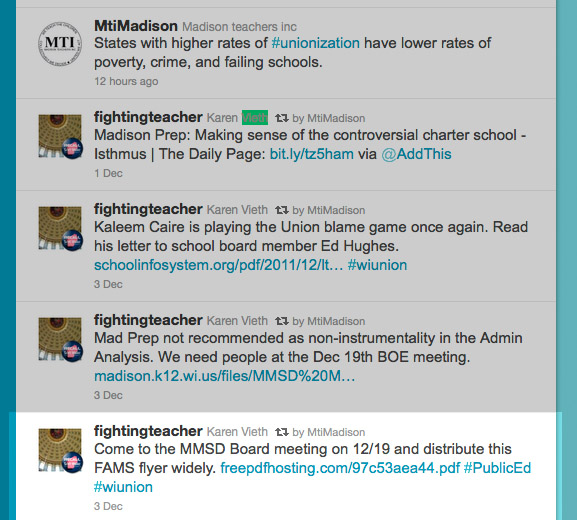
* Please see TJ Mertz’s comment below. A link to the document was forwarded to me via a kind reader from Madison Teachers, Inc. Twitter Feed (a “retweet” of Karen Vieth’s “tweet”). Note that I enjoyed visiting with Karen during several Madison School District strategic planning meetings.
A screenshot of the link:
The outcome of the Madison Prep “question” will surely reverberate for some time.
Finally, I suspect we’ll see more teacher unions thinking different, as The Minneapolis Federation of Teachers has done: Minneapolis teacher’s union approved to authorize charter schools.
Attention Nevada college students: Your tuition is going up again next year.
The Nevada System of Higher Education’s Board of Regents on Friday approved an 8 percent tuition increase for undergraduate students statewide.
Regents and institutional leaders said the permanent tuition hike would help restore some of the multimillion-dollar budget cuts to higher education in recent years.
“States are disinvesting in higher education across the country,” UNLV President Neal Smatresk said. “That’s the direct cause of this…We’re stuck between a rock and a hard place.”
As a fledgling voice of reform in higher education, Salman Khan is an oddity. He cannot name any higher education accrediting agencies off the top of his head. He advocates for competency-based credentialing, but has never heard of Western Governors University. He is capable of talking on the phone for a full hour without using the word “disruptive” once. Until recently, he was an analyst for a hedge fund.
Here is what Khan does know: algebra, statistics, trigonometry, calculus, computer science, biology, chemistry, astronomy, physics, economics, and finance — well enough, at least, to demonstrate the concepts via brief video tutorials on Khan Academy, his free learning website. What began in 2006 as an attempt to tutor his young cousin from afar has evolved into a 2,700-video library with millions of monthly visitors.
Many have lauded Khan’s natural skill as a teacher. Khan’s charmingly unpolished home recordings form the public face of the organization and provide a peg for media narratives about online learning and the YouTube-ification of the textbook in an era where the rising prices and demand for higher education has collided with the Internet’s culture of free.
Chicago Public Schools on Tuesday became the latest large urban district to sign a compact agreement with the education-reform powerhouse Bill & Melinda Gates Foundation, pledging greater cooperation and collaboration between the city’s charter and traditional neighborhood schools.
The agreement allows Chicago to compete for a piece of a $40 million grant from the Gates Foundation, aimed at building relationships between charters and neighborhood schools and allow for the sharing of innovative ideas.
Chinese universities graduate more than 600,000 engineering students a year. China has consistently placed at or near the top of programming competitions. And while we have not seen China become a leader in information technology and computing, I expect that this will change in the coming decade.
Since the Internet revolution of the late 1990s, many successful companies have been built by taking American ideas and localizing them for China. These companies may have “copied” from the United States at first, but they acted swiftly, focused on their customers and developed their products, adding more and more local innovations.
For example, Tencent, one of China’s three Internet juggernauts, started with an instant-messaging product named QQ, which was a replica of the same system on which Yahoo Messenger and MSN Messenger were based. But today, QQ has evolved to become a very different product — a combination of instant messaging, social networking, universal ID and gaming center. QQ has built the world’s largest online community (about 700 million active accounts), while its American counterparts continue to build instant messaging as loss leaders.
Most Atlantic readers know that, although the U.S. spends more per student on K-12 education than any other nation except Luxembourg, students in a growing number of nations outperform our own. But think about this: Among the consistent top performers are not only developed nations (Japan, Finland, Canada), but developing countries and mega-cities such as South Korea, Hong Kong, and Shanghai.
Even if we find a way to educate our future work force to the same standards as this latter group — and we are a very long way from that now — wages in the United States will continue to decline unless we outperform those countries enough to justify our higher wages. That is a very tall order.
You would think that, being far behind our competitors, we would be looking hard at how they are managing to outperform us. But many policymakers, business leaders, educators and advocates are not interested. Instead, they are confidently barreling down a path of American exceptionalism, insisting that America is so different from these other nations that we are better off embracing unique, unproven solutions that our foreign competitors find bizarre.
Kaleem Caire has only been back in Madison for less than two years, but he sure has grabbed our attention.
Caire didn’t waste any time after coming home from a successful private sector career on the East Coast to be the new president for the Urban League of Greater Madison, starting to shake up the local establishment more or less immediately upon arrival. He has been pushing a bold proposal to attack the long-standing issue of minority underachievement in the Madison public schools. His idea for the Madison Preparatory Academy was vetted well in Nathan Comp’s cover story for Isthmus last week.
For well over a year now, Caire has been shuttling between the district administration, Madison Teachers, Inc. (MTI) union leaders, school board members, parents, editorial boards and community meetings fighting for this idea.
In response to union and district administration concerns, he changed the proposal to make the school an “instrumentality” of the district, meaning it would be under school board control and be staffed by MTI member teachers. But that proposal came in at a cost for the district of $13 million over five years. Superintendent Dan Nerad, for whom I have a lot of respect, told the League that he couldn’t support anything over $5 million.
IF you want to see the direction that education reform is taking the country, pay a visit to my leafy, majority-black neighborhood in Washington. While we have lived in the same house since our 11-year-old son was born, he’s been assigned to three different elementary schools as one after the other has been shuttered. Now it’s time for middle school, and there’s been no neighborhood option available.
Meanwhile, across Rock Creek Park in a wealthy, majority-white community, there is a sparkling new neighborhood middle school, with rugby, fencing, an international baccalaureate curriculum and all the other amenities that make people pay top dollar to live there.
Such inequities are the perverse result of a “reform” process intended to bring choice and accountability to the school system. Instead, it has destroyed community-based education for working-class families, even as it has funneled resources toward a few better-off, exclusive, institutions.
This article evaluates the economic viability of a student’s decision to borrow money in order to attend law school. For individuals, firms, and entire nations, the ratio of debt to income serves as a measure of economic stability. The ease with which a student can carry and retire educational debt after graduation may be the simplest measure of educational return on investment.
Mortgage lenders evaluate prospective borrowers’ debt-to-income ratios. The spread between the front-end and back-end ratios in mortgage lending provides a basis for extrapolating the maximum amount of educational debt that a student should incur. Any student whose debt service exceeds the maximum permissible spread between mortgage lenders’ front-end and back-end ratios will not be able to buy a house on credit.
These measures of affordability suggest that the maximum educational back-end ratio (EBER) should fall in a range between 8 and 12 percent of monthly gross income. Four percent would be even better. Other metrics of economic viability in servicing educational debt suggest that the ratio of total educational debt to annual income (EDAI) should range from an ideal 0.5 to a marginal 1.5.
The grin hasn’t changed. It still reaches his eyes.
The grin was there last week at Van Hise Elementary School when one of his classmates asked Awonder Liang, age 8, about his medal.
“Where is it?”
“Right here,” Awonder said. It lay on a nearby table. Awonder picked it up and put it around his neck.
The grin – I’d first seen it a year earlier – is evidence that Awonder can light up a room like any happy 8-year-old.
The medal is evidence of something else. It means Awonder Liang is the best chess player his age in the world.
Congratulations!
Oregon plans to recruit and hire a new “chief education officer” who will have unprecedented power over education, including control of the chancellor of higher education, the next superintendent of Oregon’s public schools and the state community college commissioner.
Gov. John Kitzhaber’s new overarching education board, with control over preschool through universities, unanimously endorsed the general job description for that education officer Thursday.
Kitzhaber said he hopes to have the right person in the job by April.
The chosen leader will need the vision to help Oregon streamline, improve and connect all the education programs and institutions that serve or should serve learners from birth through college, he said. He or she will also have to be an education expert, plus be able to motivate those who work in the current system to embrace change. The political challenges will be huge.
If policymakers (see Brown, Jerry) still aren’t convinced that education data matters, two reports released this week demonstrate that high quality, actionable information about schools and students is vital in efforts to improve education and student outcomes.
Bill summarized the important work of the Data Quality Campaign yesterday. More states than ever are collecting the information educators and policymakers need to make informed decisions about what’s working and what isn’t in schools. But just because the data can be collected, it doesn’t mean that states’ work is complete. Data for Action 2011 identifies four challenges – turf, trust, technical issues, and time – that continue to hinder states’ efforts to utilize the full potential of their data (shameless plug: you should read my report, Data That Matters, for another set of 4 Ts that all states should follow to make their data user-friendly and actionable for school leaders).
Millions of students attend abysmally weak school systems that leave them unprepared for college, even as more jobs require some higher education. The states have an obligation to help these students retool.
More than 35 percent of students need remediation when they reach college, according to the federal government. A study by the organization that administers the ACT, the college entrance exam, finds that only a quarter of the 1.6 million 2011 high school graduates who took the exam met college-readiness benchmarks in English, reading, math and science.
Some students need one or two remedial courses before they can enroll in credit-bearing college classes. Others need so much remedial work that they will exhaust state and federal student aid without ever getting a degree. This is especially troubling because many of these students have passed state exams that are supposed to certify them as ready for college.
The District unveiled its first rankings of public charter schools Tuesday, part of a new rating system that offers parents a broader assessment of school progress than annual standardized test results.
The new performance evaluation shows how test scores of students have grown over the last year, relative to their academic peers across the city. Schools also are assessed against a series of leading indicators and “gateway” measurements that researchers regard as predictors of future educational success. They include third-grade DC CAS reading scores, eighth-grade math scores and 11th-grade PSAT results.
John Gurda wrote this weekend on the Socialist roots of the Milwaukee Public School’s (MPS) Department of Recreation and Community Services. The department offers sports programs, community education, and various other activities for the Milwaukee community. Gurda argues, and I agree, that Milwaukee Recreation is an asset to the city and its residents. The question I have is should it be part of MPS?
I do not question the ability of MPS to run the department, just the rationale for having a program not directly related to the education of MPS students housed in the school district. Maybe the task of providing recreational opportunities for residents of Milwaukee would be better placed at the City or County.
Perhaps more important, Milwaukee Recreation is funded through MPS; 4.4% of the 2011 MPS tax levy ($13.3 million) was for this department. This raises a broader question, should the MPS tax levy be used to raise funds for anything beyond educating MPS pupils?
In 2011, only about 80% ($244,262,102) of the MPS levy went towards regular district operations.
Related: Madison’s Fund 80.
The debate over whether the Madison School Board should give the final OK to the Madison Preparatory Academy is getting a bit nasty.
And that should not be.
While the passion on the part of the advocates for the school, led by the energetic Urban League CEO Kaleem Caire, is perfectly understandable given our schools’ dismal record on minority achievement, so is the questioning from those who aren’t convinced the prep idea will solve that problem.
Now, on the eve of a vote on that final approval, is not the time to point fingers and make accusations, but to come together and reasonably find ways to overcome the obstacles and reassure those who fret about giving up duly elected officials’ oversight of the school and the impact it will have on the entire district’s union contracts if not done correctly.
The union problem is not the fault of the union, but stems from Gov. Scott Walker and the Legislature’s action to dramatically change public employee collective bargaining in Wisconsin. If the union or the School Board makes concessions for Madison Prep, the collective bargaining agreement for the entire district, which is to expire in June 2013, could be negated.
Much more on the proposed Madison Preparatory IB charter school, here.
The conventional wisdom among many education commentators is that U.S. public school teachers “come from the bottom third” of their classes. Most recently, New York City Mayor Michael Bloomberg took this talking point a step further, and asserted at a press conference last week that teachers are drawn from the bottom 20 percent of graduates.
All of this is supposed to imply that the U.S. has a serious problem with the “quality” of applicants to the profession.
Despite the ubiquity of the “bottom third” and similar arguments (which are sometimes phrased as massive generalizations, with no reference to actual proportions), it’s unclear how many of those who offer them know what specifically they refer to (e.g., GPA, SAT/ACT, college rank, etc.). This is especially important since so many of these measurable characteristics are not associated with future test-based effectiveness in the classroom, while those that are are only modestly so.
Still, given how often it is used, as well as the fact that it is always useful to understand and examine the characteristics of the teacher labor supply, it’s worth taking a quick look at where the “bottom third” claim comes from and what it might or might not mean.
Jesse Roe, a ninth-grade math teacher at a charter school here called Summit, has a peephole into the brains of each of his 38 students.
He can see that a girl sitting against the wall is zipping through geometry exercises; that a boy with long curls over his eyes is stuck on a lesson on long equations; and that another boy in the front row is getting a handle on probability.
Each student’s math journey shows up instantly on the laptop Mr. Roe carries as he wanders the room. He stops at each desk, cajoles, offers tips, reassures. For an hour, this crowded, dimly lighted classroom in the hardscrabble shadow of Silicon Valley hums with the sound of fingers clicking on keyboards, pencils scratching on paper and an occasional whoop when a student scores a streak of right answers.
The software program unleashed in this classroom is the brainchild of Salman Khan, an Ivy League-trained math whiz and the son of an immigrant single mother. Mr. Khan, 35, has become something of an online sensation with his Khan Academy math and science lessons on YouTube, which has attracted up to 3.5 million viewers a month.
Mitch Price, via a kind Deb Britt email:
About 12 percent of all charter schools have bargaining agreements. Why do charter schools unionize? What is in these charter school contracts? Can they be considered innovative or models for union reform? And how do they compare to traditional district/union teacher contracts? Center on Reinventing Public Education legal analyst Mitch Price investigated those questions in his study of charter school collective bargaining agreements.
Price examined nine charter schools unionized either by management design or by teacher vote. For comparison, he examined traditional district contracts and analyzed data from non-unionized charter schools as well. He found that the new contracts can be crafted in ways that respect the unique missions and priorities of charter schools, provide teachers with basic protections, and maintain organizational flexibility. However, while these new contracts innovate in many ways, they could go much further given the opportunity to create contracts from scratch.
Chris Cronas, Principal, Wedgwood Elementary
Prior to the Thanksgiving break, we administered a survey asking for feedback from families about their knowledge and thoughts on the changes we are making to the curriculum delivery model at Wedgwood. Thank you to the 259 families who responded to the survey. We have 449 students currently enrolled at Wedgwood, 185 of whom are siblings. If respondents only completed one survey per family, as requested, our sample is quite accurate.
Overall, families want more information about what cluster grouping is. This was expressed in a variety of ways by families of general education, spectrum and special education students. I will attempt to clarify what it is here and how Wedgwood staff is using this information to move forward.
For those who do not know, cluster grouping is a method of grouping gifted students (gifted being identified as students who score in the 98th – 99th percentile on a cognitive ability test) into clusters of 6 students in one classroom that also include high achievers and above average students. The remaining students would be clustered so that the highest achieving students and lowest achieving students are not in the same classroom. With that as a guide, Wedgwood is developing plans to move from having self-contained spectrum classrooms to integrated classrooms using an interpretation of this model. We are already doing this in 1st grade, albeit more heterogeneously than what the research we based our 1st grade model on suggests.
Charlie Mas has more:
Are you confused about what Wedgwood is doing with their Spectrum program? Join the club. Everyone is confused about what Wedgwood is doing with their Spectrum program. The president of the confusion club appears to be the school’s principal, Chris Cronas.
In another issue, Sam Castaneda Holdren, a spokesman for Stand for Children, said the organization collected about 100,000 voter signatures for a ballot question that would codify into law new educator-evaluation regulations approved in June by the state Board of Elementary and Secondary Education.
The new state regulations call for evaluating teachers and administrators partly by the scores of their students on the MCAS statewide tests, feedback from students and parents, by state and local observations in classrooms and other measures.
The ballot question would go beyond the state regulations in some respects, said Jason Williams, executive director of Stand for Children in Massachusetts. For example, the question would mandate that the state Department of Elementary and Secondary Education approve evaluation plans developed through bargaining with unions in school districts if those local plans differ from a state model that will eventually be developed. Right now, the department could only review those local plans, not reject them, Williams said
In a New York Times op-ed article on Monday, Natalie Hopkinson writes that school choice in her neighborhood in Washington has destroyed community-based education for working-class families. With New York ranked No. 1 in the nation in giving parents and students choices, according to one study last week, Amy Stuart Wells, a parent of an eighth grader and a professor at Teachers College, has her own take on New York’s system.
When my son’s high school choice process began last spring, I already had a full-time job. I was not looking for a second one. But as the summer turned to fall, and the high school touring and test-taking kicked into full gear, I watched as many 8th grade parents (myself included) became increasingly bleary eyed and overwhelmed.
We sought each other’s empathy and commented that orchestrating our children’s school choices was like a full-time job — a second one for many of us.
Madison School Board Member Ed Hughes:
The Urban League’s Madison Prep proposal continues to garner attention as we draw closer to the School Board’s December 19 up-or-down vote on the proposal.
This weekend the news has been the school district administration’s analysis of the Urban League’s current proposal for a non-instrumentality charter school (i.e., one where the teachers and other school staff would be employees of the Urban League rather than the school district and the school would be free of most administrative oversight from the district).
The analysis recommends that the School Board reject the Madison Prep proposal, for two principal reasons.
The first is that, as a matter of policy, the administration is opposed to non-instrumentality charter schools because of the lack of day-to-day oversight of their operations. The second reason is that there does not seem to be a way the school district could enter into a contract for a non-instrumentality charter school without running afoul of our collective bargaining agreement (CBA) with Madison Teachers Inc. (MTI).
Much more on the proposed Madison Preparatory IB charter school, here.
Presidents at 36 private colleges earned more than $1 million in 2009, up from 33 the previous year, according to a study by The Chronicle of Higher Education.
The annual study, using data from federal tax documents, found that the median compensation — including salary and benefits — was $385,909, a 2.2 percent increase from the previous year. The median base salary increased by 2.8 percent to $294,489.
The highest-paid president in 2009 was Constantine Papadakis of Drexel University. Mr. Papadakis, who died in April that year, earned $4,912,127, most of it from life insurance and previously accrued compensation paid to his widow. His base salary was $195,726.
The next three top earners — William R. Brody of Johns Hopkins University ($3,821,886); Donald V. DeRosa of University of the Pacific ($2,357,540); and Henry S. Bienen of Northwestern University ($2,240,775) — also left their presidencies.
America now finds itself at an interesting crossroads. Over the next few years, it is estimated that this country will need one million new teachers, as more and more baby boomers begin to retire. (A baby boomer is a person who was born during the demographic Post-War II baby boom and who grew up during the period between 1946 and 1964.)
This impending shortfall of public educators is further exacerbated by the disturbing national trend that has severely undermined job security for many public-sector employees by restricting, or outright prohibiting workers from engaging in the collective bargaining process.
As we have seen, Wisconsin has become the embarrassing leader of the political attack now being orchestrated against the poor and working-class families in this country. But vilifying teachers is nothing new for the Badger State. Former Governor and now U.S. Senate hopeful, Tommy Thompson used teachers and its union (WEAC) as convenient political scapegoats back in the 1990s. He succeeded in making the case that state property taxes were so out of whack, solely as a result of the exorbitant salaries and benefits being afforded to teachers. Talk about pure political demagoguery!
How much is a good school system worth?
The Virginia Beach, Va., school district believes its own system is worth about $1.53 for every $1 spent from the 70,000-student district’s operating fund.
Not content with making an argument that good schools have an economic value that is unmeasurable, the district asked a university economist to calculate just what it brings both to the city and the Hampton Roads region in southeastern Virginia.
The report generated for the district, the third-largest in the state, is more than an academic exercise for James G. Merrill, the Virginia Beach superintendent. The district is one of the few in the state that receive money from local taxpayers based on a revenue-sharing formula, which is currently under fire. As the city and the school district head into budget season, Mr. Merrill said he wanted to make an argument for school funding based on business principles.
Paula Prosper worried that her son was not ready for the differences between his private Montessori school and the public Fairfax County seventh grade she planned to transfer him to next year.
Prosper, a teacher, asked if he and she could sit for a few hours at Longfellow Middle School “to see what happens in classes and to get a feel for the school in general.” The answer was no, with explanations that made little sense.
Prosper said Longfellow’s director of student services, Gail Bigio, told her “it had to do with privacy issues for the teachers — the public employees whose salaries are paid by my tax dollars. Then she brought up immunization and likened it to the students attending the school who wish to have a visiting cousin shadow them.” Longfellow Principal Carole Kihm told me Bigio did not mention teacher privacy.
Roughly one-third of students in Harris County’s public schools leave without a diploma, according to a new analysis from Children at Risk.
The Houston-based research and advocacy nonprofit calculated for the first time a decade of average graduation rates for Harris County. It also calculated graduation rates for all the public high schools with available data in Harris, Brazoria, Chambers, Fort Bend, Galveston, Liberty, Montgomery and Waller counties for the ninth-grade class of 2004-05. The rate reflects students who graduated within six years.
As the graphic below shows, the percentage of students graduating high school has increased over the decade, but black and Hispanic students and those from low-income families graduate at much lower rates than their Anglo, Asian and more affluent classmates.
There’s a debate brewing – mostly via keyboards – about whether schools still need to teach cursive writing to classrooms of digitally wired kids.
I’d be a better defender of beautifully flowing handwriting if my own hadn’t deteriorated over the years to a hybrid of cursive, printing, squiggles and shorthand. My wife nudges me out of the way every time we step up to sign a guest book. My lame defense is that I’m left-handed.
Still, I’m glad I learned cursive at Our Lady of Sorrows, my Catholic elementary school where every classroom came with a strip of capital and lowercase letters above the blackboard. Even if a person doesn’t write that way very often – thank-you notes and postcards come to mind – it’s nice to be able to decipher other people’s hen-scratching.
Wisconsin is one of more than 40 states that don’t require cursive in their core curriculum standards, though the state Department of Public Instruction doesn’t have any data on schools or districts that have actually dropped it in favor of spending more time on other subjects. Cursive may indeed fade away, but who wants to jump first?
What’s most important, said DPI spokesman Patrick Gasper, is learning the various types of writing – persuasive, storytelling, speeches and so forth – and not whether it’s written, printed or typed.
If we don’t change the way ICT is thought about and taught, we’re shutting the door on our children’s futures
So, in the immortal words of Rory Cellan-Jones, the BBC’s technology correspondent, coding (ie computer programming) is “the new Latin”. This was the headline on his blog post about the burgeoning campaign to boost the teaching of computer skills in UK schools.
Dedicated readers will recall that it is also a bee in the bonnet of this particular columnist. The ICT (information and communications technology) curriculum in our secondary schools has been a national disgrace for as long as I can remember. This is because it effectively conflates ICT with “office skills” and generally winds up training them to use Microsoft Office when what they really need is ICT education – that is to say preparation for a world in which Microsoft (and maybe even Google) will be little more than historical curiosities, and PowerPoint presentations will look like Dead Sea scrolls.
Rory Cellan-Jones’s blog post was prompted by signs that the campaign to rethink ICT education is gathering momentum. It was first given a boost by a report written by two elders of the computer games world, Ian Livingstone and Alex Hope, on the need to transform the UK into “the world’s leading talent hub for the video games and visual effects industries”. Their report recommended, among other things, that computer science should become part of the national curriculum.
Michael Greenstone, Adam Looney:
The labor market continued to expand at a modest pace last month, according to today’s employment report. Payroll employment increased by 120,000 jobs in November, and the fraction of Americans with a job ticked up. Including revisions to previous months, total employment was 192,000 higher in November. Private employment increased by 140,000 jobs last month while governments continued to shed jobs. While the unemployment rate jumped down to 8.6 percent, some of the reduction reflected lower labor force participation rather than increases in employment.
While overall job creation has improved slightly, many American workers continue to face serious difficulties in the labor market. These workers tend to have less formal education and/or fewer job-relevant skills. For less-educated workers, the Great Recession has only exacerbated a longer-term trend of diminished earnings and job opportunities.
It’s weird how you can lose track of our ever-changing world. For instance, until recently, I thought “reality TV” meant games about people who were stuck on an island or locked in a house together for the summer. Then, suddenly, I noticed that there were seven different regularly scheduled shows about real housewives, three about people who bid on abandoned storage lockers and two about people who kill wild hogs for a living.
And then there was online education. (Confession: This entire column is actually going to be about online education. I just used the wild hogs to reel you in.)
I always thought that the only kids getting their entire public schooling online were in the hospital, living in the Alaskan tundra, or pursuing a career as a singing orphan in the road company of “Annie.” Not so. There are now around 250,000 cyberschool students in kindergarten through high school and the number is growing fast.
Nobody is forced to go to Dr. Brenda Noach Choice School. The 87 students enrolled this September were there because their parents chose the school.
So why should we be concerned about how the students are doing? None of our business, right?
I would disagree for two reasons: One, those 87 students mean the school is in line to receive more than $500,000 this year in public support. And, two, results for the school’s students a year ago on the state’s standardized tests were bad.
How bad?
A few slices of an answer: Only 18% of the school’s students were rated proficient in reading. None – that is, zero – were proficient in math. There were only a handful of 10th-graders last year, and among them, none scored as proficient in reading, language arts, math, science, or social studies. Zero.
The Brenda Noach school, 3965 N. 15th St., is among a handful of schools at the bottom of the spectrum (judging by test scores and other indicators) of the 106 schools in Milwaukee’s nationally important private school voucher program.
Citing a critical need to not underestimate the stakes at hand, Commissioner of Education Chris Nicastro presented to the State Board of Education today her analysis of ways the state could assist the Kansas City Public Schools in regaining accreditation.
The State Board met in Branson on Dec. 1-2, where discussion of the Kansas City Public Schools was part of the Department of Elementary and Secondary Education’s recommendation for revamping a statewide system of support. This system would identify risk factors and target limited resources to assist unaccredited school districts and those that are at risk of becoming unaccredited. Currently, nearly one dozen schools would receive focused attention.
Here’s the bottom line on public schools in Wisconsin after a big cut in state aid to K-12 education:
• The kids are mostly all right.
• The teachers are smarting from smaller paychecks.
• The full impact of the two-year, $750 million cut won’t be known until next school year.
That’s what a recent survey of Wisconsin school administrators suggests.
The Wisconsin Association of School District Administrators surveyed more than 80 percent of districts across the state in early fall. The results are being cited — and exaggerated — in a variety of ways. The Democrats and unions suggest the sky is falling. Republican Gov. Scott Walker pretends all is well.
And the political spin will only speed and sharpen if Walker faces a recall election next year as expected.
Moving from elementary school to middle school, or from middle school to high school, was simple once. A counselor, principal, or teacher informed the student which school she would attend when summer ended. And the parents got their children to the right school on a specified day at the end of August.
No choices.
No decisions.
Public education long ago parted ways with the one-size-fits-all approach, particularly in urban or suburban school districts large enough to design schools focused on particular areas of student interest. We have moved on to science magnets, liberal arts and fine arts academies, performing arts institutes, and single-gender schools.
The single-gender model for girls has been around for more than 100 years, mostly in parochial and private schools where they have done remarkable work educating young women. They are a novelty in public education. And an all-girls school is the new kid on the block in the Austin school district — and in other districts in Texas.
Recommendations:
We are in agreement that the achievement gaps for low-income students, students of color, students with disabilities, and English Language Learners must be eliminated. The Administration agrees that bolder steps must be taken to address these gaps. We also know that closing these gaps is not a simple task and change will not come overnight, but, the District’s commitment to doing so will not waiver. We also know that to be successful in the long run, we must employ multiple strategies both within our schools and within our community. This is why the District has held interest in many of the educational strategies included in the Madison Prep’s proposal like longer school days and a longer school year at an appropriately compensated level for staff, mentoring support, the proposed culture of the school and the International Baccalaureate Program.
While enthusiastic about these educational strategies, the Administration has also been clear throughout this conversation about its concern with a non-instrumentality model.
Autonomy is a notion inherent in all charter school proposals. Freedom and flexibility to do things differently are the very reasons charter schools exist. However, the non-instrumentality charter school model goes beyond freedom and flexibility to a level of separateness that the Administration cannot support.
In essence, Madison Prep’s current proposal calls for the exclusion of the elected Board of Education and the District’s Administration from the day-to-day operations of the school. It prevents the Board, and therefore the public, from having direct oversight of student learning conditions and teacher working conditions in a publicly-funded charter school. From our perspective, the use of public funds calls for a higher level of oversight than found in the Madison Prep proposal and for that matter in any non-instrumentality proposal.
In addition, based on the District’s analysis, there is significant legal risk in entering into a non- instrumentality charter contract under our collective bargaining agreement with our teachers.
In our analysis of Madison Prep’s initial instrumentality proposal, the Administration expressed concerns over the cost of the program to the District and ultimately could not recommend funding at the level proposed. Rather, the Administration proposed a funding formula tied to the District’s per pupil revenues. We also offered to continue to work with Madison Prep to find ways to lower these costs. Without having those conversations, the current proposal reduces Madison Prep’s costs by changing from an instrumentality to a non-instrumentality model. This means that the savings are realized directly through reductions in staff compensation and benefits to levels lower than MMSD employees. The Administration has been willing to have conversations to determine how to make an instrumentality proposal work.
In summary, this administrative analysis finds concerns with Madison Prep’s non-instrumentality proposal due to the level of governance autonomy called for in the plan and due to our collective bargaining agreement with our teachers. Based on these issues, we cannot recommend to the Board that Madison Prep be approved as a non-instrumentality charter school.
We know more needs to be done as a district and a community to eliminate our achievement gaps. We must continue to identify strategies both within our schools and our larger community to eliminate achievement gaps. These discussions, with the Urban League and with our entire community, need to continue on behalf of all of our students.
In anticipation of the recommendation, Caire sent out an email Friday night to School Board members with a letter responding to concerns about the union contract issue.
The problem concerns a “work preservation” clause in the Madison Teachers Inc. contract that requires all teaching duties in the district be performed by union teachers.
Exceptions to the clause have been made in the past, such as having private day-care centers offer 4-year-old kindergarten, but those resulted from agreements with the union. Such an agreement would nullify the current union contract under the state’s new collective bargaining law, according to the district.
Caire said a recent law signed by Gov. Scott Walker could allow the district to amend its union contract. However, School Board member Ed Hughes, who is a lawyer, disagreed with Caire’s interpretation.
Nerad said even if the union issue can be resolved, he still objects to the school seeking autonomy from all district policies except those related to health and safety of students.
…..
Caire said Madison Prep’s specific policies could be ironed out as part of the charter contract after the School Board approves the proposal. He plans to hold a press conference Tuesday to respond to the district’s review.
“The purpose of a charter school is to free you from red tape — not to adopt the same red tape that they have,” Caire said. “We hope the board will stop looking at all of those details and start looking at why we are doing this in the first place.”
Much more on the proposed Madison Preparatory IB charter school, here.
The fate of Madison Prep, yea or nea, will resonate locally for years. A decisive moment for our local $372M schools.
As Dropout Nation reported on Wednesday, the National Education Association reported in its recent U.S. Department of Labor filing that it spent $133 million in 2010-2011 on lobbying and contributions to groups whose agendas (in theory) dovetail with its own. And the list of organizations and players who have benefited from the union’s largesse grows even larger.
The National Council for Accreditation of Teacher Education, a longtime beneficiary of NEA funds, garnered $400,373 from the union during its last fiscal year. The Great Lakes Center for Education, which, like the Economic Policy Institute, always churns out studies that dovetail nicely with NEA positions, got $250,000 from the national union. (Three affiliates — Michigan Education Association, Education Minnesota, and the Illinois Education Association — chipped in another $30,000, according to each of their respective federal filings.) National Board for Professional Teaching Standards got $10,000 from the union last fiscal year. And the University of Colorado at Boulder also picked up $250,000 for a “sponsored project”, likely something being put together by one of the NEA’s longtime fellow-travelers, Kevin Welner’s National Education Policy Center that is based on the university’s campus.
More here.
Over the last several months it’s been a pleasure to witness the easing of ill will between the leadership of NJ’s primary teachers’ union, NJEA, and members of Gov. Christie’s educational team. After several years of bitter recrimination from both sides of the table, everyone seems to have moved on from the trauma of our botched Race To The Top application and former Comm. Bret Schundler’s resignation. Sure, the sting of last Spring’s health and benefits reform bills, championed by Gov. Christie, must be a sore spot for union leadership, but there appears to be a shared recognition that we should recalibrate the balance between the needs of schoolchildren and the needs of teachers. Suddenly NJ’s 100-year old tenure law is on the table – a boon for both student and professionals – and Ed. Comm. Cerf ‘s speech at NJEA’s Annual Convention earlier this month and was courteously received (except for a few nasty tweets).
So we’ll hold onto the progress and roll our eyes at the retro and reactive press release just out from NJEA President Barbara Keshishian, in which she claims, in outraged tones, that NJ’s alleged achievement gap among black, white, Hispanic, and poor kids is a “classic strawman” on the part of Gov. Christie and “based on a deliberate misuse of the data.”
Fewer than one-third of California students who took a statewide physical fitness test this year managed to pass all six areas assessed, new results show.
State Supt. of Public Instruction Tom Torlakson, a longtime cross-country coach who has made physical fitness a signature issue, announced the results this week as he launched a program to improve children’s health. The campaign will use such celebrity athletes as NBA all-star Bill Walton and others to visit schools to urge students to drink more water, eat more fruits and vegetables and increase their exercise.
“When only 31% of children are physically fit, that’s a public health challenge we can’t wait to address,” Torlakson said in a statement.
The Minneapolis teachers’ union has become the first in the nation to win the right to authorize charter schools.
State officials have approved the Minneapolis Federation of Teachers as a charter school authorizer.
Authorizers don’t run charters; they oversee the administrators and school boards that handle day-to-day operations of a charter school. Authorizers are also primary decision makers on which schools to sponsor.
During the 20-year history of charter schools there have been examples of teachers starting schools, and some charters have unionized teachers.
MFT will be the first union to serve as a charter sponsor. Formally, it has created an organization called the Minnesota Guild of Charter Schools (informally ‘the Guild’) that will serve as authorizer.
This makes sense. I hope we see much more of this.
Perhaps someone will ask WEAC’s Mary Bell about this at the 12.6.2011 WisPolitics lunch.
When the end finally came, it came fast. Spotting Steve’s red BMW convertible parked in the driveway, Culver City police in tactical vests and armed with assault weapons quickly deployed, swarming the front and rear entrances. Wearing a green nylon jacket with RAID splashed across the shoulders, Sergeant Jason Sims knocked on the front door, then ordered his men to break it down with a battering ram. Inside, kids screamed, cried, or just stood there trying to wrap their heads around what they were witnessing–and what their parents were witnessing. Because this was a Thursday, this was Family Night. Expecting to endure an evening of candor with impunity–Guess what, Mother? The world doesn’t revolve around you!–parents had their bean dip and decaf upended by an armed raid. Tilling the big wayward ship of their children’s adolescence had left them chronically alert to trouble, but not like this.
Madison Superintendent Dan Nerad:
Elementary Support & Services
National Novel Writing Month
Future Problem Solving
Math enrichment
GEMS
William & Mary Literature groups
M2 and M3 Math groups
American Math Competition 8
Science enrichment pilot College for Kids I (support)
Middle School Support & Services
WCATY courses
Future Problem Solving
Online courses
Advanced Math courses
Assistance with Science Symposium
American Math Competition 8
College for Kids II (support)
Great Books Pilot
Hybrid Geometry Pilot
High School Support & Services
College Matters at UW Madison
Math Meets (competitions)
Respectful Relationship days
Leadership Conference (pilot, grant application in progress)
Assistance with High School Science Symposium
Mentor Services
1. Falk- Working with students in a writing group
2. Stephens- Working with a group of students in math
3. Lapham-1’1/2″dgrade-Math
4. Schenk- Science/math enrichment
5. Crestwood- Math enrichment
6. Crestwood- Math enrichment
7. Crestwood-Math enrichment
8. Franklin- Math enrichment
9. Randall- Math enrichment
10. Randall – Math enrichment
Of course Madison Prep wants the media opportunity of children waiting in an auditorium, some advocates for the school have demonized teachers, the Madison Prep Board has decided that the only way to make the school happen is to employee non-union staff and not pay them for the extended day and year (that they are also seeking African American and Latino staff, makes this even worse). It should also be noted that school choice backers like the Kochs, the Waltons and (Bradley and Koch funded) ALEC aren’t all that keen on “the right to clean water” either.
Much more on the proposed Madison Preparatory IB charter school, here.
On Dec. 19, the Madison school board is scheduled to vote on whether to approve Madison Preparatory Academy, a charter school that would target at-risk minority students.
For more than 18 months, the proposal — drawn up by the Urban League of Greater Madison as an ambitious step toward closing the district’s racial achievement gap — has polarized the community, with a broad range of critics taking aim on multiple fronts.
The proposal, at least by local standards, is a radical one, under which the Urban League would operate two largely taxpayer-funded, gender-specific secondary schools with an unprecedented level of autonomy. If approved, Madison Prep would open next fall with 120 sixth-graders and peak at 840 students in grades 6 through 12 by its seventh year.
Opponents say the Urban League’s proposal combines flawed educational models, discredited science, fuzzy budgeting and unrealistic projections of student success. While some applaud certain elements of the proposal, like longer school days and academic years, they maintain that Madison Prep won’t help enough students to justify the $17.5 million cost to the district over its first five years.
Madison schools aren’t failing, by any stretch of the imagination, for many students.
In fact, if you’re a white, middle-class family sending your children to public school here, your kids are likely getting an education that’s on a par with Singapore or Finland — among the best in the world.
However, if you’re black or Latino and poor, it’s an unquestionable fact that Madison schools don’t as good a job helping you with your grade-point average, high school graduation, college readiness or test scores. By all these measures, the district’s achievement gap between white and minority students is awful.
These facts have informed the stern (and legitimate) criticisms leveled by Urban League President Kaleem Caire and Madison Prep backers.
But they doesn’t take into account some recent glimmers of hope that shouldn’t be discounted or overlooked. Programs like AVID/TOPS support first-generation college-bound students in Madison public schools and are showing some successes. Four-year-old kindergarten is likely to even the playing field for the district’s youngest students, giving them a leg up as they enter school. And, the data surrounding increasing numbers of kids of color participating in Advanced Placement classes is encouraging.
Stepping back from the local district and looking at education through a broader lens, it’s easy to see that No Child Left Behind and Race to the Top have aimed to legislate, bribe and punish their way toward an unrealistic Lake Wobegon world where all the students are above average.
Remarkable. Are there some excellent teachers in Madison? Certainly. Does Madison’s Administration seek best in the world results? A look at the math task force, seemingly on hold for years, is informative. The long one size fits all battle and the talented and gifted complaint are worth contemplating.
Could Madison be the best? Certainly. The infrastructure is present, from current spending of $14,963/student to the nearby UW-Madison, Madison College and Edgewood College backed by a supportive community.
Ideally, Madison (and Wisconsin) should have the courage to participate in global examinations (Florida Students Take Global Examinations, Wisconsin’s Don’t). Taxpayers and parents would then know if Troller’s assertions are fact based.
Kaleem Caire, via email
December 2, 2011
Greetings Madison Prep.
Tomorrow afternoon, we are expecting to learn that MMSD’s Administration will inform the Madison Metropolitan School District Board of Education that Madison Prep should not be approved. A possible reason we expect will be MMSD’s concern that the current collective bargaining agreement between the District and Madison Teachers Inc. (MTI) has a “work preservation clause” which the teacher’s union advocated for long ago to ensure that it was the only game in town to represent public school teachers in Madison.
Below, is the cover note that I forwarded to Ed Hughes of the Board of Education and copied to a number of others, who had asked a thoughtful question about our proposal to establish Madison Prep as a non-instrumentality charter school, we hope, in fall 2012. Also see the letter attached to this email.
—————————————- ————————————————————————–
December 2, 2011
Greetings Ed.
Attached, please find a letter that contains the answer to your question referenced in your email below. The letter contains the explanation of a path to which Madison Prep could be established as a non-instrumentality public charter school, under Wisconsin law, and in a way that would not violate the current collective bargaining agreement between MMSD and Madison Teachers Inc.
We look forward to answering any questions you or other members of the Board of Education may have.
Thank you so much and Many blessings to you and your family this holiday season.
Onward.
cc: Daniel Nerad, MMSD Superintendent
Dylan Pauly, MMSD Legal Counsel
MMSD Board of Education Members
ULGM Board of Directors
Madison Prep Board of Directors
Godfrey & Kahn, S.C.
Steve Goldberg, CUNA Mutual Foundation
This letter is intended to respond to your November 78,207I email and to suggest that there is a viable option for moving forward with Urban League’s proposal for the Madison Preparatory Academy (“Madison Prep”) that: [i) will reduce cost; and (ii) will not sacrifice the union security provisions of the Collective Bargaining Agreement “Agreement” or “Contract”) between the Madison Metropolitan School District (“MMSD” or “District”) and Madison Teachers, Inc. (“MTI”).
Your email asks for a response to a question concerning how the school district could authorize Madison Prep as a non-instrumentality charter without thereby violating the terms of the District’s Agreement with MTI. Your email references a provision in the MTI Agreement that provides “that instructional duties where the Wisconsin Department of Public Instruction requires that such be performed by a certifìcated teacher, shall be performed only by’teachers.”‘ .See Article I, Section 8.3.a. In addition you note that “the term ‘teacher’ refers to anyone in the collective bargaining unit.” See Article I, Section 8.2. You conclude your email by stating that “it appears that all teachers in MMSD schools — including non-instrumentality charter schools – must be members of the MTI bargaining unit.”
The Urban League is aware of the Agreement’s language and concedes that the language, if enforceable, poses an obstacle as we look for School Board approval of the plan to open and operate a “non-instrumentality” school. Under an instrumentality charter, the employees of the charter school must be employed by the school board. Under a non-instrumentality charter, the school board may not be the employer of the charter school’s staff. See S 118.40(7)(a). Thus, the statement in your email that all teachers, including those in a non-instrumentality charter school – “must be members of the MTI bargaining unit” and, presumably, employed by the school board is not permitted under Wisconsin law.
Under Wisconsin’s charter school law the School Board has the exclusive authority to determine whether a school is an instrumentality or not an instrumentality of the school district. .See S 118.40(7)(a). That decision is an important decision reserved to the School Board alone. The effect of that decision drives whether teachers and staff must be, or cannot be, employees of the School Board. The language of the Contract deprives the School Board of the decision reserved to it under the statute and that language cannot be harmonized to give effect to both the statute and the Agreement. Alternatively the Contract language creates a situation whereby the School Board may exercise its statutory authority to approve a non-instrumentality charter but it must staff the school with school district employees, a result clearly prohibited under the statute. In our view the law trumps the Contract in either of these situations.
The situation described above could likely only be resolved in a court of law. The Contract includes a “savings clause” that contemplates that where a court invalidates a provision in the Agreement, the invalid provision is deleted and the remainder of the contract remains intact. See Article VIII, Section E.
The Urban League is, however, mindful that litigation is both expensive and time consuming. Moreover it is clear that the Contract language will become a prohibited subject of bargaining in the near future when the current Agreement expires. Unfortunately, the children we seek to serve, do not have the time to wait for that day.
Our second purpose in writing is to make you aware of a possible solution to a major obstacle here. One of the major obstacles in moving forward has been the cost associated with an instrumentality school coupled with MTI’s reluctance to work with the District in modifying the Contract to reduce costs associated with staffing and certain essential features of Madison Prep, like an extended school day, As we understand it MTI does not want to modify the Contract because such a modification would result in an earlier application of 2077 Wisconsin Act L0 to the District, members of the bargaining unit and to MTI itself.
We understand MTI’s reluctance to do anything that would hasten the application of Act 10 in the school district, With the passage of 2011. Wisconsin Act 65, that concern is no longer an obstacle.
Act 65 allows the parties to a collective bargaining agreement to enter into a memorandum of understanding that would run for the remaining term of the collective bargaining agreement, for the purpose of reducing the cost of compensation or fringe benefits in the collective bargaining agreement,
The Act also provides that entering into such a memorandum would not be considered a “modification” of the collective bargaining agreement for the purposes of Act 10. Act 65 was published on November 23,2077 and took effect the following day. The law allows the parties to a collective bargaining agreement to enter into such a memorandum no later than 90 days after the effective date of the law.
The Urban League believes that Act 65 gives the Board and MTI the opportunity to make changes that will facilitate cost reductions, based in compensation and fringe benefits, to help Madison Prep move forward. And, the law allows the parties to do so in a way that does not adversely impact the teachers represented by MTI or the union security provisions of the Collective Bargaining Agreement.
For example, the parties could agree to reduce the staffing costs for Madison Prep, The parties could also agree that a longer school day would not have to cost more. And, the parties could agree that the work preservation clause referenced in the first part of this letter does not apply where the School Board has determined a charter school willbe a non-instrumentality of the District, a move that would also most certainly reduce costs. These changes would not be forced upon any existing MTI represented teacher as teachers would apply for vacancies in the school.
We hope that the School Board will give serious consideration to the opportunity presented by Act 65. 0n behalf of the Urban League of Greater Madison and Madison Preparatory Academy, we thank you for your support of Madison Prep.
Much more on the proposed Madison Preparatory IB charter school, here.
Value-added and other types of growth models are probably the most controversial issue in education today. These methods, which use sophisticated statistical techniques to attempt to isolate a teacher’s effect on student test score growth, are rapidly assuming a central role in policy, particularly in the new teacher evaluation systems currently being designed and implemented. Proponents view them as a primary tool for differentiating teachers based on performance/effectiveness.
Opponents, on the other hand, including a great many teachers, argue that the models’ estimates are unstable over time, subject to bias and imprecision, and that they rely entirely on standardized test scores, which are, at best, an extremely partial measure of student performance. Many have come to view growth models as exemplifying all that’s wrong with the market-based approach to education policy.
It’s very easy to understand this frustration. But it’s also important to separate the research on value-added from the manner in which the estimates are being used. Virtually all of the contention pertains to the latter, not the former. Actually, you would be hard-pressed to find many solid findings in the value-added literature that wouldn’t ring true to most educators.
Much more on value added assessment, here.
The Obama administration issued new guidance Friday advising schools and colleges on how they can make race-based enrollment decisions to promote campus diversity, shortly before the Supreme Court is set to consider whether to re-examine a 2003 case holding that universities could sometimes use race in admissions decisions.
“Diverse learning environments promote development of analytical skills, dismantle stereotypes and prepare students to succeed in an increasingly interconnected world,” Attorney General Eric Holder said in a joint release by the Justice and Education departments.
The departments withdrew prior guidance from the Bush administration, which officials said was too vague to assist school administrators seeking to promote diverse student enrollment. The new guidance parses the Supreme Court’s most recent rulings on student diversity to suggest policies the administration believes would not violate the 14th Amendment’s guarantee of equal protection of the laws.
Like the former Bush administration guidance, the new documents advise schools to use race-neutral policies if possible. If those prove insufficient, however, the new guidance states that a school “may consider a student’s race as a ‘plus factor’ (among other, nonracial considerations) to achieve its compelling interests” in diversity.
It would have been understandable if President Barack Obama had ignored education in his first speech to Congress. There were other things to worry about in February 2009: an economy in free fall, health care costs threatening to bankrupt the federal government, a nation bleeding in two protracted foreign wars. Obama had said little about education on the campaign trail. Yet when he took the podium, he made a bold declaration: By 2020, America would regain its historical international lead in college attainment.
Months earlier, Bill Gates had announced a similar priority for his charitable foundation, the richest on the planet. After years of focusing on improving education for students in kindergarten through 12th grade, the Microsoft billionaire had set his sights on college. As would Obama, he called for a major increase in the number of adults with college degrees. Together, the most powerful man in the world and one of the richest created a rare moment of purpose and clarity in American education policy.
But effecting a major increase in college attainment is a daunting task. The percentage of American working-age adults who have graduated from college has hovered around 40 percent for years, with roughly 30 percent holding four-year degrees and another 10 percent associate’s degrees. Obama and Gates were calling for a rise in the college attainment rate to nearly 60 percent in less than a generation, even though many public colleges and universities were already bursting at the seams, and cash-strapped state legislatures were handing down further punishing budget cuts.
High school goes digital. Never mind pep rallies and locker rooms. We’ll look at the rise of online high school.
We all know what school means. Especially high school. Classrooms. Study halls. Pep rallies. Locker rooms. For most, that’s still the formula.
But a rising wave of American students – and not just high school but the full K-12 – is turning away from that. Is getting its education online.
By Creating from Scratch
Some common words have no apparent etymological roots
Many of the new words added to the ever-growing lexicon of the English language are just created from scratch, and often have little or no etymological pedigree. A good example is the word dog, etymologically unrelated to any other known word, which, in the late Middle Ages, suddenly and mysteriously displaced the Old English word hound (or hund) which had served for centuries. Some of the commonest words in the language arrived in a similarly inexplicable way (e.g. jaw, askance, tantrum, conundrum, bad, big, donkey, kick, slum, log, dodge, fuss, prod, hunch, freak, bludgeon, slang, puzzle, surf, pour, slouch, bash, etc).
Words like gadget, blimp, raunchy, scam, nifty, zit, clobber, gimmick, jazz and googol have all appeared in the last century or two with no apparent etymology, and are more recent examples of this kind of novel creation of words. Additionally, some words that have existed for centuries in regional dialects or as rarely used terms, suddenly enter into popular use for little or no apparent reason (e.g. scrounge and seep, both old but obscure English words, suddenly came into general use in the early 20th Century).
Sometimes, if infrequently, a “nonce word” (created “for the nonce”, and not expected to be re-used or generalized) does become incorporated into the language. One example is James Joyce’s invention quark, which was later adopted by the physicist Murray Gell-Mann to name a new class of sub-atomic particle, and another is blurb, which dates back to 1907.
This past weekend the New York Times devoted two big op-eds to the decline of the suburb. In one, new urban theorist Chris Leinberger said that Americans were increasingly abandoning “fringe suburbs” for dense, transit-oriented urban areas. In the other, UC Berkeley professor Louise Mozingo called for the demise of the “suburban office building” and the adoption of policies that will drive jobs away from the fringe and back to the urban core.
Perhaps no theology more grips the nation’s mainstream media — and the planning community — more than the notion of inevitable suburban decline. The Obama administration’s housing secretary, Shaun Donavan, recently claimed, “We’ve reached the limits of suburban development: People are beginning to vote with their feet and come back to the central cities.”
Yet repeating a mantra incessantly does not make it true. Indeed, any analysis of the 2010 U.S. Census would make perfectly clear that rather than heading for density, Americans are voting with their feet in the opposite direction: toward the outer sections of the metropolis and to smaller, less dense cities. During the 2000s, the Census shows, just 8.6% of the population growth in metropolitan areas with more than 1 million people took place in the core cities; the rest took place in the suburbs. That 8.6% represents a decline from the 1990s, when the figure was 15.4%.
Many people think of IQ as a genetic trait, like brown eyes or short legs: You’re born with it and you’re stuck with it. Now, a growing body of research is showing that a person’s IQ can rise–and even fall–over the years.
Scores can change gradually or quickly, after as little as a few weeks of cognitive training, research shows. The increases are usually so incremental that they’re not immediately perceptible to individuals, and the intelligence-boosting effects of cognitive training can fade after a few months.
In the latest study, 33 British students were given IQ tests and brain scans at ages 12 to 16 and again about four years later by researchers at the Wellcome Trust Centre for Neuroimaging at University College London; 9% of the students showed a significant change of 15 points or more in IQ scores.
On a scale where 90 to 110 is considered average, one student’s IQ rose 21 points to 128 from 107, lifting the student from the 68th percentile to the 97th compared with others the same age, says Cathy Price, professor of cognitive neuroscience at the center and co-author of the study, published last month in Nature. Another student’s score skidded out of the “high average” category, to 96 from 114.
PHILANTHROPY: Are you as paranoid about vocational education as you were about business?
MR. GROVE: The details are of course different, but in this way, they are very similar. Paranoia in management involves trying to anticipate who intentionally or unintentionally will slow you down, or who will derail you. Usually this attitude is not taught in school, which is why I wrote my book. Now, as for vocational education, do you recall the words of the presidential report on education [A Nation at Risk] from 1983? It started out by saying, “If an unfriendly foreign power had attempted to impose on America the mediocre educational performance that exists today, we might well have viewed it as an act of war.” Is this paranoia?
Well, the same thing applies to vocational education–only doubly so. Most people don’t even realize the need for more highly trained workers. The assumption remains that technical education is for less intelligent people. The first item cut from educational budgets is vocational education. People are required to be suitably trained for their work requirements, and yet the classes that are required for this are cut to the bone. In some instances, students are halfway through the course when funding is cut and then they are sent home. We create a damned obstacle course for people who want to work!
In a distressed neighborhood north of Miami’s gleaming downtown, a group of enthusiastic but inexperienced instructors from Teach for America is trying to make progress where more veteran teachers have had difficulty: raising students’ reading and math scores.
“These are the lowest performing schools, so we need the strongest performing teachers,” said Julian Davenport, an assistant principal at Holmes Elementary, where three-fifths of the staff this year are Teach for America corps members or graduates of the program.
By 2015, with the help of a $50 million federal grant, Teach for America recruits could make up one-quarter of all new teachers in 60 of the nation’s highest need school districts. In 2010, the Tuscaloosa City Board of Education approved a contract to bring 24 Teach for America teachers into Tuscaloosa. Eight teachers began working in schools in the Central zone — the poorest and lowest-performing zone in the school system — in the 2011-12 school year. Eight more are to arrive in 2012-13 and another eight in 2013-14.
It has become something of a joke here. At the same time President Obama is lavishly praising South Korea’s education system, South Koreans are heaping criticism on it.
In speeches about America’s relative decline, Mr. Obama has repeatedly singled out South Korea’s relentless educational drive, its high university enrollment, and its steady production of science and engineering graduates as worthy of emulation.
His South Korean counterpart, meanwhile, warns of a glut of university graduates and a work force hard-wired to outdated 20th-century manufacturing skills. “Reckless entrance into college is bringing huge losses to families and the country alike,” said President Lee Myung-bak of South Korea recently.
Mr. Lee has raised eyebrows, and hackles, by suggesting that fewer people should go to college from a population of 50 million that sustains 3.8 million undergraduate and graduate students.
Bernie Marcus is a do-it-yourself kind of guy. Sure, he knows his way around sheetrock and, yes, he can talk in great detail about remodeling a bathroom or putting in a backyard deck. But for Marcus, home improvement projects represent a part of something much more profound. Doing it yourself means being able to take control of your own life, shaping your own destiny, daring to accomplish more than you imagine possible. It’s an essential part of being an American. After all, it’s what inspired his signature project. He built a company from scratch, and turned his idea into a household name with a $60 billion market cap. Bernie Marcus built Home Depot.
“It happened because of us,” says Marcus. “I mean, we had no money. When we opened Home Depot in 1979, we were broke. I had just been fired. Some of us were on the verge of bankruptcy. But we had a great idea, and we had some people who were willing to support us. And we put in the work–we put in sweat and tears, our hearts and souls. But today Home Depot has more than 300,000 people working for it. We built it all.”
Two Madison School Board members who say they are likely to vote no on Dec. 19 when the Madison Preparatory Academy proposal comes before the board for final approval or denial have some ideas they believe would better serve all of Madison’s students.
Marj Passman, School Board vice president, says she hopes the local Urban League and its president, Kaleem Caire, will pursue funding for Madison Prep as a private school if the proposal fails to gain approval from a majority of board members. Passman says it’s likely she will vote against Madison Prep as a public charter school, although she will look at an administrative analysis due by Dec. 4 prior to making her final decision.
“There’s been a lot of community support and I’m sure he (Caire) can come up with the money for the school as a private academy,” Passman told me in a recent phone interview.
“Then he could pursue the school in its purest form, he won’t have to compromise his ideas, and he can showcase how all these elements are going to work to help eliminate the achievement gap, increase graduation rates and raise GPAs for minority students,” she says.
…
Board member Maya Cole also tells me she is a “pretty firm no vote” against the Madison Prep proposal. What Cole would like to see as an alternative is a charter school embedded within an existing district middle school like Wright or Toki, using district staff.
Read more: http://host.madison.com/ct/news/local/education/blog/chalkboard-school-board-members-float-alternatives-to-madison-prep-charter/article_9cdb35d8-1bdf-11e1-8845-001cc4c03286.html#ixzz1fLBMOiNx
Black and Hispanic students in a special Madison School District college preparatory program have higher grade point averages, attendance rates and test scores than their peers who aren’t in the program, according to a UW-Madison analysis.
The study of the AVID/TOPS program — geared toward preparing low-income, minority students for college — comes as the Madison School Board contemplates a proposal to create Madison Preparatory Academy, a controversial charter school with similar goals.
Some opponents of Madison Prep argue the AVID/TOPS program is a proven way of helping close the achievement gap between white and minority students.
Superintendent Dan Nerad said the district is pushing ahead with a proposal to expand the program in middle school. It currently serves 491 students at East, West, Memorial and La Follette high schools and Black Hawk Middle School.
“I would not tell you that AVID alone will make the difference,” Nerad said. “But it’s a very important piece for us.”
The new Brookings index on school choice is interesting and worth a look but as I go through it two things seem to jump out. First, despite the rhetoric in the public square there still isn’t a great deal of real choice in education. And second, the index seems to reward places (relatively speaking) that have limited choices but still do all the things you should do (information, transportation etc…nonetheless). That’s like having an incredible restaurant with easy valet parking, wonderful fresh food, great service, and lovely ambiance – but that can only seat four people a night. Nice but limited.
Lately David Foster Wallace seems to be in the air: Is his style still influencing bloggers? Is Jeffrey Eugenides’ bandana-wearing depressed character in The Marriage Plot based on him? My own reasons for thinking about him are less high-flown. Like lots of other professors, I am just now sitting down to write the syllabus for a class next semester, and the extraordinary syllabuses of David Foster Wallace are in my head.
I am not generally into the reverential hush that seems to surround any mention of David Foster Wallace’s name by most writers of my generation or remotely proximate to it; I am not enchanted by some fundamental childlike innocence people seem to find in him. I am suspicious generally of those sorts of hushes and enchantments, and yet I do feel in the presence of his careful crazy syllabuses something like reverence.
Wallace doesn’t accept the silent social contract between students and professors: He takes apart and analyzes and makes explicit, in a way that is almost painful, all of the tiny conventional unspoken agreements usually made between professors and their students. “Even in a seminar class,” his syllabus states, “it seems a little silly to require participation. Some students who are cripplingly shy, or who can’t always formulate their best thoughts and questions in the rapid back-and-forth of a group discussion, are nevertheless good and serious students. On the other hand, as Prof — points out supra, our class can’t really function if there isn’t student participation–it will become just me giving a half-assed ad-lib lecture for 90 minutes, which (trust me) will be horrible in all kinds of ways.”
More parents are opting out of school shots for their children. In eight states now, more than one in 20 public school kindergartners aren’t getting all the vaccines required for attendance, an Associated Press analysis found.
That growing trend among parents seeking vaccine exemptions has health officials worried about outbreaks of diseases that once were all but stamped out.
Take measles, for example. It can lead to pneumonia, encephalitis and death. Since 2000, one in every 250 Americans who got measles died.
The measles vaccine is so effective, 99.9% of those who get vaccinated gain immunity, said Geoffrey Swain, associate professor at the University of Wisconsin School of Medicine and Public Health and chief medical officer for the Milwaukee Health Department.
Many children cannot get the measles vaccine, though, because they aren’t old enough – the first dose of vaccine is recommended between 12 and 15 months. Or, they have medical issues or families with religious beliefs that leave them unprotected and susceptible to measles through no fault of their own, Swain said.
The Obama administration’s decision to allow states to request waivers from No Child Left Behind was a step in the right direction, but only a baby step. Four in five schools across the country will be deemed “failing” this coming year if nothing stops the “train wreck” that Secretary of Education Arne Duncan has said No Child Left Behind (NCLB) will inflict upon the nation’s schools. These include schools in which the vast majority of students are proficient in math and English, as well as schools in which students, teachers, and principals are making real progress in the face of formidable challenges: concentrated poverty, large numbers of students with special-needs, and state budget cuts that have severely reduced the resources needed to address the obstacles to learning.
Duncan’s characterization of NCLB is apt; a recent National Research Council study found that 10 years of test-based accountability “reform” has delivered no significant progress for students. Throughout the country, pressure to improve test scores has led to an increase in intense test preparation. In many cases, this has led to less time for actual learning and reduced the ability of schools to respond to the learning needs of the most disadvantaged students. Instead of focusing on how to deliver high quality instruction schools have become preoccupied with how to produce increases in test scores. Reports of widespread cheating on state exams appearing in city after city are increasingly viewed not as isolated instances of teacher misbehavior, but as a consequence of high-stakes testing.
Parents gathered in the auditorium of the Talented and Gifted School for Young Scholars on Tuesday morning were not happy.
Their school, one of only three citywide gifted and talented programs in Manhattan, shares space in an East Harlem building with three middle schools. They learned recently that one of the schools, Esperanza Preparatory Academy, wants to expand to a high school, and they are concerned that the expansion will cause overcrowding and bring other problems.
Tuesday’s meeting was called by the Education Department last week after parents flooded the office with calls and e-mails expressing concern about the addition of high school grades when their school has children as young as kindergarten.
The Oakland school district is closing five elementary schools next year. Two of its other schools might be converted into independently run charters, taking 800 children with them. And at least one — quite possibly, two — brand new charter schools open next fall, with plans to admit more than 600 students, combined.
But OUSD’s leaders aren’t bracing for a big enrollment drop. They predict the school system’s enrollment will hold firm in September — and even grow slightly (by 125 students, to 38,166).
Will the numbers bear out? They didn’t this fall. Enrollment in the city’s district-run schools, though flat, came in 300 students shy of projections, creating a $1.6 million budget gap that needed to be closed immediately.
Colleges should examine a wider set of social, economic and personal characteristics to determine how they can help students remain in school and graduate, a new report has found (PDF report link).
Aside from SAT scores and high school grade point averages, students’ success in college relies on a number of other factors — often overlooked — that more accurately predict whether they will stay in school, according to the report scheduled for release Tuesday by the Higher Education Research Institute at UCLA.
Using information from a national survey of college freshmen in public and private institutions as well as graduation data, the report found, for example, that students who visit a college before enrolling, participate in clubs and other activities and those who have used the Internet for research and homework are more likely to complete a degree earlier than others. The costs of attending a college and the institution’s size also contribute to students’ success, the report found.
Michigan’s school board elections will be held in November of even-numbered years through legislation signed by Gov. Rick Snyder.
The legislation that the Republican governor signed today will require school board and intermediate school district elections to be held at the same time as November general elections.
Supporters of the legislation say it will ensure that school board elections are held when voter turnout is highest. Supporters say it also should help consolidate elections and save money in some locations.
Dylan Loeb McClain via a kind reader’s email:
Fewer than 2 percent of the 77,000 members of the United States Chess Federation are masters — and just 13 of them are under the age of 14.
Among that select group of prodigies are three black players from the New York City area — Justus Williams, Joshua Colas and James Black Jr. — who each became masters before their 13th birthdays.
“Masters don’t happen every day, and African-American masters who are 12 never happen,” said Maurice Ashley, 45, the only African-American to earn the top title of grandmaster. “To have three young players do what they have done is something of an amazing curiosity. You normally wouldn’t get something like that in any city of any race.”
The chess federation, the game’s governing body, does not keep records on the ethnicity of its members. But a Web site called the Chess Drum — which chronicles the achievements of black chess players and is run by Daaim Shabazz, an associate professor of business at Florida A&M University — lists 85 African-American masters. Shabazz said many of them no longer compete regularly.
One of the common assumptions lurking in the background of our education debates is that “quality” of the teaching workforce has declined a great deal over the past few decades (see here, here, here and here [slide 16]). There is a very plausible storyline supporting this assertion: Prior to the dramatic rise in female labor force participation since the 1960s, professional women were concentrated in a handful of female-dominated occupations, chief among them teaching. Since then, women’s options have changed, and many have moved into professions such as law and medicine instead of the classroom.
The result of this dynamic, so the story goes, is that the pool of candidates to the teaching profession has been “watered down.” This in turn has generated a decline in the aggregate “quality” of U.S. teachers, and, it follows, a stagnation of student achievement growth. This portrayal is often used as a set-up for a preferred set of solutions – e.g., remaking teaching in the image of the other professions into which women are moving, largely by increasing risk and rewards.
Although the argument that “teacher quality” has declined substantially is sometimes taken for granted, its empirical backing is actually quite thin, and not as clear-cut as some might believe.
Chicago Public Schools officials plan to overhaul 10 schools next year, six of which will be managed by a private organization in the latest move by Mayor Rahm Emanuel’s administration to turn to the private sector to aid poorly performing public schools.
The proposed overhauls–commonly called turnarounds–involve the firing of existing staff and improvements to school curriculum and culture. Turnarounds are the first step in a series of school actions that include consolidating and closing underperforming schools.
A new state law requires CPS to announce all school closings and turnarounds by Thursday. There was vociferous opposition to any proposed closings at recent public hearings, which were also required by the law, even though though the list of targeted schools had not yet been released.
The elementary schools slated for turnaround are: Pablo Casals, 3501 W. Potomac Ave.; Melville W. Fuller, 4214 S. Saint Lawrence Ave.; Theodore Herzl, 3711 W. Douglas Blvd.; Marquette, 6550 S Richmond St.; Brian Piccolo, 1040 N Keeler Ave.; Amos Alonzo Stagg, 7424 S Morgan St.; Wendell Smith, 744 E 103rd St. and Carter G. Woodson South Elementary Schools, 4414 S Evans. The Chicago Vocational Career Academy, at 2100 E 87th St., and Tilden Career Community Academy, 4747 S Union Ave., high schools also are targeted for turnaround.
During the last four decades, a well-publicized shift in what undergraduate students prefer to study has taken place in American higher education. The number of young men and women majoring in English has dropped dramatically; the same is true of philosophy, foreign languages, art history, and kindred fields, including history. As someone who has taught in four university English departments over the last 40 years, I am dismayed by this shift, as are my colleagues here and there across the land. And because it is probably irreversible, it is important to attempt to sort out the reasons–the many reasons–for what has happened.
First the facts: while the study of English has become less popular among undergraduates, the study of business has risen to become the most popular major in the nation’s colleges and universities. With more than twice the majors of any other course of study, business has become the concentration of more than one in five American undergraduates. Here is how the numbers have changed from 1970/71 to 2003/04 (the last academic year with available figures):
Reihan Salam directs us to an essay about labor unions by Alan Haus, an IP and employment law attorney in San Francisco. Haus thinks that conservatives ought to be more supportive of the power of labor unions in promoting higher wages:
There is much that could be said about the economic effects of promoting higher wages. For Republicans, the disadvantages should be trumped not only by the advantages but also by a vital consideration of political philosophy: the society of limited government to which most Republicans aspire will only come about in the real world if most Americans earn enough money to save for retirements and college educations, and provide for their long-term healthcare through substantially private markets. Achieving this requires some measure of support for a high wage economy.
But Haus is a lot less enthralled with every other aspect of organized labor:
In his first algebra class last year, Mani Chadaga slumped low in his front-row seat and pretended to read his new textbook intently.
Mani could make himself only so inconspicuous: He was, after all, a second-grader in a junior high class at St. Paul’s Capitol Hill Gifted and Talented Magnet School.
So he stopped trying.
Soon, he was piping up with solutions to the teacher’s questions and standing before his stumped classmates, explaining how he arrived at them. These days, as a third-grader juggling Algebra II and geometry, he kneels in his seat, only a smidgen of his early shyness and all his humility intact.
There is much less competition in the public sector than the private sector, and that has made all the difference.
Since the Great Recession began in 2008, there has been a growing criticism of public sector unions, reflecting taxpayer concerns about union compensation and unfunded pension liabilities. These concerns have led to proposals to change public sector union policy in very significant ways. Earlier this month, voters in Ohio defeated by a wide margin a law that would have restricted union powers, although polls showed broad support for portions of the law that would have reduced union benefits. In Wisconsin, a state with a long-standing pro-union stance, Governor Scott Walker advanced policy in February that would cut pay and substantially curtail collective bargaining rights of many public sector union workers. In Florida, State Senator John Thrasher introduced legislation that would prevent governments from collecting union dues from union worker state paychecks. And it is not just Ohio, Wisconsin, and Florida that are attempting to change the landscape of public unions. Cash-strapped governments in many states are considering ways to reduce the costs associated with public unions.
The Madison School District has agreed to terms for releasing more than 1,000 sick notes submitted by teachers who missed work in February during mass protests over collective bargaining.
The district will remove the teachers’ names and other identifying information from the notes, under an agreement reached Monday with the Wisconsin State Journal, which requested the records under the state’s Open Records Law.
“It’s essentially what we asked for in May,” State Journal Editor John Smalley said Tuesday. “It was never our intention to publish any names or individual situations, but to look at the collective situation of all of these sick notes and how the district as an institution handled it.”
School Board President James Howard said the agreement protects teachers while complying with the newspaper’s needs and a Nov. 21 court ruling ordering the district to turn over the notes. The newspaper sued the district for the records after the district denied requests for them.
Many friends of mine are upset with the legal battle the Wisconsin State Journal waged to obtain the 1,000 sick notes Madison teachers used to get off work during the union protests in February. My own radio host and boss, Kurt Baron, referred to the paper as the “Wisconsin State Urinal” in describing his decision to no longer have the paper as his home page online. Some called into the show and promised to cancel their subscriptions.
Teachers should have a right to individual privacy over their medical records. We shouldn’t know whether John Q. cited herpes or hemorrhoids on his doctor’s note.
I am less sympathetic, however, to the teachers’ right to collective privacy. As long as their names are redacted, the public has the right to know if 273 teachers cited malaria and 345 claimed to suffer from ebola.
Unfortunately the recent ruling will violate individual privacy by allowing the State Journal to see the names of the teachers on the sick notes.
No one wants to see the Kansas City School District recover just enough to regain provisional accreditation and limp along in wounded form for another decade or so.
Kansas Citians are looking for an administrative structure capable of running schools that meet the state’s expectations and prepare students for college and jobs.
With the school district scheduled to become unaccredited on Jan. 1, the Missouri Board of Education is contemplating structural changes. Chris Nicastro, the education commissioner, has spent considerable time trying to figure out what to recommend to the board when it meets Thursday and Friday. At one point, she asked members of the Kansas City school board if they’d be willing to step aside in favor of an appointed board. Most would prefer to remain in charge.
School board governance has not served Kansas City well in recent decades. Candidate choices have mostly been weak. Voter participation in elections has been abysmal. Boards have been factious and meddlesome.
Money And School Performance:
Lessons from the Kansas City Desegregation Experiment by Paul Cioti:
For decades critics of the public schools have been saying, “You can’t solve educational problems by throwing money at them.” The education establishment and its supporters have replied, “No one’s ever tried.” In Kansas City they did try. To improve the education of black students and encourage desegregation, a federal judge invited the Kansas City, Missouri, School District to come up with a cost-is-no-object educational plan and ordered local and state taxpayers to find the money to pay for it.
Kansas City spent as much as $11,700 per pupil–more money per pupil, on a cost of living adjusted basis, than any other of the 280 largest districts in the country. The money bought higher teachers’ salaries, 15 new schools, and such amenities as an Olympic-sized swimming pool with an underwater viewing room, television and animation studios, a robotics lab, a 25-acre wildlife sanctuary, a zoo, a model United Nations with simultaneous translation capability, and field trips to Mexico and Senegal. The student-teacher ratio was 12 or 13 to 1, the lowest of any major school district in the country.
The results were dismal. Test scores did not rise; the black-white gap did not diminish; and there was less, not greater, integration.
The Kansas City experiment suggests that, indeed, educational problems can’t be solved by throwing money at them, that the structural problems of our current educational system are far more important than a lack of material resources, and that the focus on desegregation diverted attention from the real problem, low achievement.
As soon as the school day ended, the rush at the health clinic began.
Two high school seniors asked for sports physicals. A group of teenagers lined up for free condoms. A girl told a counselor she needed a pregnancy test.
The clinic, at Belmont High School near downtown Los Angeles, is part of a rapidly expanding network of school-based centers around the nation offering free or low-cost medical care to students and their families.
In California, there are 183 school health centers, up from 121 in 2004. Twelve more are expected to open by next summer, according to the California School Health Center Assn.
The centers have become a small but important part of the nation’s healthcare safety net, experts say, treating low-income patients who might otherwise not have regular medical care. Now, they add, campus clinics are serving as a model for health officials trying to reduce costs.
Scottish education is being overtaken by systems in other countries around the world, it has been claimed.
The warning comes from Keir Bloomer, a former leader of council education directors and one of the architects of the Curriculum for Excellence.
Mr Keir is heading the Commission on School Reform which will carry out an inquiry into scope for improvement.
He said Scottish education had many strengths but there was a need to increase the pace of improvement.
The commission, established by independent think tanks Reform Scotland and the Centre for Scottish Public Policy, includes representatives from political parties, heads of schools and colleges and figures from the business and sporting worlds.
Christine Eastus was a double major in English and chemistry with plans to go to medical school. Instead — to the chagrin of her parents — she became a teacher.
In the 1970s, she taught English at Greenhill School in Addison, Texas.
“Once I started teaching, it was a completely new world, sort of frightening in a sense, because you’re dealing with students who are so impressionable, but it’s heady stuff particularly when people like you, catch the bug and become writers and let you know about it,” she tells NPR’s John Burnett. “That is a real high, to hear from someone who’s your age still remembering me and I’m sure many of them curse me because I guess I was a bit demanding.”
Lyndsey Layton and Emma Brown:
A Virginia company leading a national movement to replace classrooms with computers — in which children as young as 5 can learn at home at taxpayer expense — is facing a backlash from critics who are questioning its funding, quality and oversight.
K12 Inc. of Herndon has become the country’s largest provider of full-time public virtual schools, upending the traditional American notion that learning occurs in a schoolhouse where students share the experience. In K12’s virtual schools, learning is largely solitary, with lessons delivered online to a child who progresses at her own pace.
Jesse Yeh uses the University of California-Berkeley library instead of buying textbooks. He scrounges for free food at campus events and occasionally skips meals. He’s stopped exercising and sleeps five to six hours per night so he can take 21 credits — a course load so heavy he had to get special permission from a dean.
The only thing he won’t do: take out a student loan.
“I see a lot of my friends who took out student loans, then they graduated and because of the economy right now they still couldn’t find a job,” said the third-year student, whose parents both lost their jobs in 2009 and who grew up in the boom-and-bust town of Victorville, Calif., on a block with several houses in foreclosure. “The debt burden is really heavy on them.”
Workplace mentors used to be older and higher up the ranks than their mentees. Not anymore.
In an effort to school senior executives in technology, social media and the latest workplace trends, many businesses are pairing upper management with younger employees in a practice known as reverse mentoring. The trend is taking off at a range of companies, from tech to advertising.
The idea is that managers can learn a thing or two about life outside the corner office. But companies say another outcome is reduced turnover among younger employees, who not only gain a sense of purpose but also a rare glimpse into the world of management and access to top-level brass.
Christian Oliver and Song Jung-a:
South Korean police have detained a teenager suspected of murdering his mother after she allegedly beat him with a golf club to get better school grades, in a case that has raised questions about the high-pressure nature of the country’s education system.
The macabre incident has shocked the nation, with younger mothers questioning the values of previous generations who have been pushing children hard to improve their school performance.
“Children are being driven to the limit … so many of them suffer from depression, kill themselves or commit impulsive crimes out of desperation,” says Oh Sung-sook, head of the Citizens’ Council for Educational Reform, an activist group.
Psychologists argue that the educational rat-race – children are routinely forced to study late into the night seven days a week and corporal punishment is still permitted – is stunting social development.
Former Secretary of State Condoleezza Rice says she’s concerned about the economy, the deficit, and the “jaded” nature of American politics – but she says the country’s “biggest single problem” is with the public school system.
Rice, speaking to CBS’ Bob Schieffer on a special Thanksgiving edition of “Face the Nation,” argued that the nation’s educational system is failing crucial populations, and that “it’s gonna drive us into class warfare like we’ve never seen before.”
Responding to a question about the current state of American politics, Rice argued that “we’ve become a bit jaded as a country.”
But she said that wasn’t her biggest concern with the future of America right now.
“I think we’ve got a deeper problem,” she said. “It speaks to the way that, for instance, I and my family got ahead. I think the biggest single problem we’ve got is the K-12 education system.”
English class is about to start, and Taneli Nordberg introduces the day’s guests: a row of fresh-faced university students sitting in the back of the classroom. They’re training to be teachers at the University of Helsinki.
Nordberg, 31, wants the eighth-graders to become teachers for a moment.
“I want you to tell the teacher trainees something you would like them to do when teaching and something you want them to avoid doing,” he explains. “In English, please.”
The students tumble up to the chalkboards and start writing. Some of the advice is predictable – “not too much homework” – but much of it is insightful.
The exercise, though short and light, is something of a microcosm of the Finnish educational approach – engagement and collaboration between teacher and student, a comfortable atmosphere, and the expectation of quality in how students express themselves.
Over the past decade, students in Finland have soared on international measures of achievement. They’ve continued to post some of the best scores in the developed world in reading, math and science, according to a respected international exam. The country has one of the narrowest gaps in achievement between its highest and lowest-performing schools, and on average spends less per pupil than the United States.
Students in the Madison School District’s dual-language immersion program are less likely than students in English-only classrooms to be black or Asian, come from low-income families, need special education services or have behavioral problems, according to a district analysis.
School Board members have raised concerns about the imbalance of diversity and other issues with the popular program.
As a result, Superintendent Dan Nerad wants to put on hold expansion plans at Hawthorne, Stephens and Thoreau elementaries and delay the decision to the spring on how to expand the program to La Follette High School in 2013.
“While the administration remains committed to the (dual-language) program and to the provision of bilingual programming options for district students, I believe there is substantial value in identifying, considering and responding to these concerns,” Nerad wrote in a memo to the board.
In Madison’s program, both native English and Spanish speakers receive 90 percent of their kindergarten instruction in Spanish, with the mix steadily increasing to 50-50 by fourth grade.
Bill Turque and Michael Alison Chandler:
Parents across the Washington region will soon have more readily available — and useful– information about how their public schools are doing, the result of new initiatives underway at the local and state level for reporting and displaying education data.
The District, Maryland and Virginia are pledging some changes as part of their applications to the Obama administration for exemption from unpopular requirements of the No Child Left Behind law, among them the mandate for 100 percent proficiency by 2014 on standardized reading and math tests.
Alas, Milwaukee Public Schools: The School Board and administration will never take the kind of bold action that’s needed to stabilize the financial picture. The system is awash in empty buildings, and they won’t do anything about it. They’ll never take real action to improve what goes on in classrooms. It’s hopeless.
Wrong, wrong, and wrong. And maybe wrong about the fourth one.
Without much fuss or attention, this has been an autumn of big change in the way MPS is run. It is still a highly troubled system, but it’s time to give credit to the leaders for taking action on some of the things that most threaten MPS. You can criticize them for not acting sooner or for other things, but let’s take advantage of some holiday cheer to look at recent events. There’s still life in the lumbering giant.
If you ask Superintendent Gregory Thornton, he’ll tell you what’s under way is “a quiet storm, and, when we wake up, the flowers will have bloomed.”
(Thornton, by the way, seems to be talking like a guy who isn’t going to pack up and leave soon, which has been a matter of speculation since shortly after he arrived 17 months ago.)
Among the extended family I saw over the holiday was a young relative who is working as a substitute teacher in the Northeast since he can’t find a full-time teaching post. He shared a story that surprised me, and I wanted to run it by folks here.
He was subbing at a low-performing high school that recently had a well-publicized stabbing. A student in his class pulled what he thought was a real gun on him, and they had a standoff for several minutes until the teen put the “gun” away and the teacher tackled him to the floor. It turned out the gun was a toy, and the student received a three-day suspension for the incident.
The substitute teacher was disappointed with the punishment, but said the school wanted to prevent another round of negative press.
Would such an incident be kept quiet in Georgia? Could it go so easily unreported under zero tolerance policies in which students can get suspended for Tweety Bird key chains?
Here’s a depressing but documented comparison of California taxes and economic climate with the rest of the states. The news is breaking bad, and getting worse (twice a month, I update crucial data on this fact sheet):
California has the 3rd worst state income tax in the nation. 9.3% tax bracket starts at $46,766 for people filing as individuals. 10.3% tax starts at $1,000,000. http://www.taxfoundation.org/files/bp59_es.pdf
Highest state sales tax rate in the nation. 7.25% (as of 1 July – does not include local sales taxes)
http://www.taxfoundation.org/files/bp60.pdf Table #15
California corporate income tax rate (8.84%) is the highest west of the Mississippi (our economic competitors) except for Alaska. http://www.taxfoundation.org/files/bp59.pdf Table #8 – we are 8th highest nationwide.
Richard Sander & Jane Yakowitz:
Rewards are distributed more unevenly within the legal profession than in virtually any other occupation. Most of those who study the careers of lawyers would agree that law school eliteness, law school grades, and social status each play a role in determining which lawyers capture the greatest rewards. But remarkably little effort has been made to directly compare these inputs in explaining career outcomes, to see which of the three matters most, and how they interact.
In this paper, we first examine general beliefs about the importance each of these three factors has upon lawyer careers – beliefs among academics as well as beliefs among the actual participants in the sorting process. We next present some specific findings about each of the three factors. Finally, we directly compare the three factors in regression models of career outcomes. The consistent theme we find throughout this analysis is that performance in law school – as measured by law school grades – is the most important predictor of career success. It is decisively more important than law school “eliteness.” Socioeconomic factors play a critical role in shaping the pool from which law students are drawn, but little or no discernible role in shaping post-graduate careers. Since the dominant conventional wisdom says that law school prestige is all-important, and since students who “trade-up” in school prestige generally take a hit to their school performance, we think prospective students are getting the wrong message.
I have been taking an Under-Graduate Course in Computer Science and Engineering(in short B.Tech CSE) in a reputed Private Engineering in India for one and half years.My college has given me 7.5 grades till now. I would rate them 5/10. I wanted to give them 2 or 3 but presence of Infrastructure and some encouraging professors saved them.
Every day when I go to college I expect to learn something new that would encourage me for research and thinking. And after coming back to my hostel room, I do have something new that make me thinking. But mind you its not because of the college or their intensive study program that I’m paying high fees for; but it is the Internet, the articles at Hacker News and Reddit and other sites that does this. Whenever I get time I tend to open these sites on my not so good Nokia touchscreen phone. It doesn’t have much of features that i can boost of but it does my work. That is the state of our private Universities.
Well I agree with my college friends that most of the students that come to private universities don’t want education but a degree, a campus life and guys they can hook up with. They have their contacts and their Dad’s business after that. Most of the students that come here want spoon feeding. Tell them what is important and coming in exam and they will cram it, cram it so much they can recite it word to word. But still it doesn’t mean professors also does spoon feeding for them and come here for high salaries, comfort and increasing their teaching experience so that later on can go to some Top Government College.
Wisconsin needs a new system of school accountability, but implementing effective measures will be difficult because there are so many different ideas about what it takes to make a good school.
The best schools have high standards in the basics – reading, math, science and writing. But they also excel at art, music and gym. They are places with strong leadership, inspired teachers and an organic system of training and mentoring.
To create more such schools and hold all schools accountable in a fair manner, though, requires all those with an interest in that issue to be at the table. Unfortunately, that’s not the case now.
When Gov. Scott Walker and State Superintendent Tony Evers formed a team to improve school accountability, the Wisconsin Education Association Council chose to sit this one out.
We get it: The state’s largest teachers union has plenty of reason to be upset with Walker for stripping it and other public employee unions of their collective bargaining rights – and for cutting funding to schools. But we still think the union’s refusal to take a place at the table was a mistake. The union needs to be involved in such efforts. Now, it’s on the outside looking in.
Wisconsin’s current assessment system is the oft-criticized WKCE, which has some of our nation’s lowest standards.
A Closer Look at Wisconsin’s Test Scores Reveals Troubling Trend by Christian D’Andrea.
WEAC’s Mary Bell advocates a “holistic” approach to school accountability.
In each of the past three years, the city of Middleton tried to avoid raising property taxes as it paid for three new $18 million public safety buildings.
That will change if the city’s proposed 2012 budget, which calls for an 11.5 percent increase in total property taxes, is approved by the City Council Tuesday night. The increase would amount to about a $150 jump for a $250,000 home, according to city administrator Mike Davis. More specific figures were not available Friday.
“The jump is practically directly related to the debt service for the new public safety buildings,” Davis said.
Middleton opened new fire and EMS stations in 2008 and a new police station in 2010 at a total cost of $18 million, Davis said. The city’s 2011 borrowing costs were more than $3.5 million, and Davis said most of that bill was paid with previously raised money. The tab for 2012 will be $3.6 million.
“Now it’s being picked up mainly by property taxes,” Davis added.
At first glance, Guo Yilei looks like a Chinese success story. Born to a poor peasant family in China’s remote Gansu province, he’s now a 26-year-old computer programmer in the Big Cabbage (as some call Beijing nowadays). By Chinese standards he makes decent money, more than $70 a week. When he has work, that is. It can take months to find the next job. And meanwhile, he’s living in Tangjialing, a reeking slum on the city’s edge where he and his girlfriend rent a 100-square-foot studio apartment for $90 a month. “When I was at school, I believed in the saying, ‘Knowledge can help you turn over a new leaf,'” says Guo. “But since I’ve started working, I only half-believe it.”
Guo and an estimated million others like him represent an unprecedented and troublesome development in China: a fast-growing white-collar underclass. Since the ’90s, Chinese universities have doubled their admissions, far outpacing the job market for college grads. This year China’s universities and tech institutes churned out roughly 6.3 million graduates. Many grew up in impoverished rural towns and villages and attended second- or third-tier schools in the provinces, trusting that studying hard would bring them better lives than their parents had. But when they move on and apply for jobs in Beijing or Shanghai or any of China’s other booming metropolises, they get a nasty shock.
A sweeping tax overhaul unveiled this week by a billionaire-backed coalition of political leaders has drawn fire from the California Teachers Association, one of the most influential groups at the Capitol and on the campaign trail.
The Think Long Committee for California hopes to place initiatives on the November 2012 ballot to raise $10 billion in taxes each year, mostly by charging sales taxes on services. Half of that money would go to K-12 schools. But deep within the plan is a proposal to eliminate a constitutional requirement that California increase funding for schools in good years to compensate for prior cuts.
Education groups like CTA rely on that Proposition 98 requirement as leverage each year when negotiating school funding in the state budget.
The union’s president, Dean E. Vogel, said in a statement, “The Think Long Committee Report was supposed to be a bipartisan path to rebuilding California’s future, not a dangerous detour that would hurt students and the poor. Educators are alarmed by these recommendations to raise taxes on the poor, lower taxes for corporations, dismantle Proposition 98 – the state’s minimum school funding law – and avoid repaying $10 billion already owed to public schools and students.”
A Pivot (someone who works for Pivotal Labs) gave an excellent presentation on observational astronomy the other day. The presentation was so well done that I think it could easily inspire people to learn more about astronomy.
This is one of the questions I think about a lot. I truly believe that for education to be effective you need to tap in to intrinsic motivation. You can’t rely on extrinsic motivators like grades otherwise you run the risk of losing all motivation once the extrinsic motivators are removed.
Passion is a vague term, but it’s often to used to identify some subject or activity that people are strongly intrinsically motivated to do. You never hear people talk about passions rooted in the desire to get a good grade or a big bonus or the chance of promotion. People talk about being passionate about something because of the importance it plays in the world or how it makes them feel at fundamental level.