School Information System

The curse of India’s castes

Sumit Ganguly, IUB:

In 1950, when newly-independent India adopted a democratic constitution, it formally abolished the seemingly atavistic institution of caste.
Under the Constitution’s terms, the age-old practice of ‘untouchability’, that had helped create and sustain a hierarchical social order with religious sanction, was officially drawn to a close. Subsequently, the Indian state also launched the world’s most extensive affirmative action program (referred to as ‘positive discrimination’) designed to bring redress for more than a millennial-span of discrimination. Later, in 1993, it attempted to implement the recommendations of the Mandal Commission Report of 1980 which had called for sweeping reservations in government employment quotas for the socially-disadvantaged castes.
These efforts to bring about social change through constitutional design and enabling legislation did not prove to be a panacea in addressing this social ill. Still, coupled with powerful social movements during the 1960s, in several of India’s southern states, most notably in Tamil Nadu, a virtual non-violent social revolution took place, dramatically challenging sacerdotal authority.

Share

School teacher evaluations are knotty problem

Jamie Munks:

It’s much tougher to implement the law than it is to write it — that’s the lesson educators are learning this summer as they work to implement a complicated new educator evaluation system.
Some area school leaders question how fair the system can be and say they don’t believe it’s possible to get everything done on time with the state’s strict timeline.
“The timetable is practically impossible,” Watertown City School District Superintendent Terry N. Fralick said. “By and large, we feel the timetable cannot be met. But we will do our best to work on it and show good faith.”
District officials will work with the Watertown Education Association and the Watertown Association of Supervisors and Administrators, the unions that cover teachers and principals, respectively. School leaders in other north country districts and across the state will be doing the same thing.

Share

Wisconsin Governor Walker, education leaders seek new school evaluation system System would replace federally imposed system viewed as a failure

Alan Borsuk:

A system for providing clear, plentiful and sophisticated information for judging the quality of almost every school in Wisconsin, replacing a system that leaves a lot desired on all of those fronts – that is the goal of an eye-catching collaboration that includes Gov. Scott Walker, state Superintendent of Public Instruction Tony Evers, and leaders of eight statewide education organizations.
Walker and Evers said Friday that they will seek approval from the U.S. Department of Education to allow the new school accountability system to replace the decade-old, federally imposed one they labeled as broken.
They want at least a first version of the new system to be ready by spring, and to apply it to outcomes for schools in the 2011-’12 school year.
The new accountability program would include every school that accepts publicly funded students, which means that private schools taking part in the state-funded voucher program would, for the first time, be subject to the same rules as public schools for making a wealth of data available to the public. Charter schools and virtual schools would also participate.

Share

Reforming the School Reformers

Paul Tough:

In the early days of the education-reform movement, a decade or so ago, you’d often hear from reformers a powerful rallying cry: “No excuses.” For too long, they said, poverty had been used as an excuse by complacent educators and bureaucrats who refused to believe that poor students could achieve at high levels. Reform-minded school leaders took the opposite approach, insisting that students in the South Bronx should be held to the same standards as kids in Scarsdale. Amazingly enough, those high expectations often paid off, producing test results at some low-income urban schools that would impress parents in any affluent suburb.

Ten years later, you might think that reformers would be feeling triumphant. Spurred in part by the Obama administration’s Race to the Top initiative, many states have passed laws reformers have long advocated: allowing for more charter schools, weakening teachers’ tenure protections, compensating teachers in part based on their students’ performance. But in fact, the mood in the reform camp seems increasingly anxious and defensive.

Last month, Diane Ravitch, an education scholar who has emerged as the most potent critic of the reform movement, wrote an Op-Ed for this newspaper arguing that raising high-poverty schools to consistently high levels of proficiency is much more difficult and less common than reformers make it out to be. When politicians hold up specific schools in low-income neighborhoods as success stories, Ravitch wrote, those successes often turn out, on closer examination, to be less spectacular than they appear. She mentioned the Bruce Randolph School in Denver, which President Obama singled out in his 2011 State of the Union address as an example of “what good schools can do,” and the Urban Prep Academy in Chicago’s Englewood neighborhood, which the education secretary, Arne Duncan, praised in a speech in February. Each school graduates a very high percentage of its seniors, but, Ravitch said, test scores at those schools suggested that students were below average in the basic academic skills necessary for success in college and in life.

Share

Sweden eyes Chinese lessons in schools

Andrew Ward:

Sweden could become the first country in Europe to offer Chinese lessons to all schoolchildren under plans floated by the Swedish education minister.
Jan Björklund said giving future generations access to Chinese language tuition was crucial to national competitiveness.
“Chinese will be much more important, from an economic perspective, than French or Spanish,” he told the Dagens Industri newspaper.
Other western countries have also started introducing Chinese to school curriculums in recognition of China’s growing global role, but Mr Björklund’s plan aims to put Sweden ahead of the pack.

Share

Programs try to save students from ‘summer slide’ in academics

Teresa Watanabe

In a corner of the San Fernando Valley, amid auto body shops and Salvadoran pupusa restaurants, a Hawaiian summer is in full swing.
At Camp Akela, located at Noble Avenue Elementary School in North Hills, kindergartners read about rainbow fish and draw them. Other students study volcanoes, create travel journals, dance the hula and even play in a portable pool.
But the students, most of them low-income English learners, are also learning literacy, math facts and science and are honing writing skills with “coaches” dressed in leis, tropical shirts and grass skirts.

Share

Student Learning and Teachers’ Performance in America

Ann Robertson and Bill Leumer:

The New York Times coverage of the recent National Education Association (N.E.A.) convention focused on the inconsequential, while paying little notice to what harbored fundamental significance. It aimed its spotlight and lingered on what it referred to as a shift in position: “… the nation’s largest teachers’ union on Monday affirmed for the first time that evidence of student learning must be considered in the evaluations of school teachers around the country.” (The New York Times, July 5, 2011).
In fact, there was little in the way of concessions by N.E.A. on this point, as The New York Times article itself conceded: “But blunting the policy’s potential impact, the union also made clear that it continued to oppose the use of existing standardized test scores to judge teachers…” And the Times added that the N.E.A. went on to insist that only those tests that have been shown to be “developmentally appropriate, scientifically valid and reliable for the purpose of measuring both student learning and a teacher’s performance” should be used. This qualification eliminates almost, if not all, conventional tests.
The N.E.A. is right to be cautious about basing teacher evaluations and the fate of teachers on the test scores of their students, as the Obama administration has been single-mindedly promoting. We know that students’ standardized test scores are correlated above all with their economic standing. As Joe Nocera recently pointed out in an op-ed New York Times article (April 25, 2011): “Going back to the famous Coleman report in the 1960s, social scientists have contended — and unquestionably proved — that students’ socioeconomic backgrounds vastly outweigh what goes on in the school as factors in determining how much they learn.”

Share

Oregon Governor Appoints Himself Superintendent of Schools

Allison Kimmel:

In a flurry of education bills passed last week, Oregon governor John Kitzhaber oversaw legislation to appoint an unlikely candidate for superintendent of schools: himself. Though many states have moved towards more centrally controlled education systems, Oregon became the first state to abolish the traditional office of superintendent and appoint the governor as superintendent of public instruction.
The governor will appoint a deputy superintendent to oversee the day-to-day activities in K-12 schools. The deputy must perform any duty designated by the governor and can be removed at any point following consultation with the state school board (which will also be newly appointed by the governor; this “superboard” of officials will oversee spending and policy for all grade levels).
How did this state of affairs come about? After Oregon’s application for the 2010 Race to the Top Competition placed seventh to last, parents and legislators began to press for innovation and reform. Kitzhaber argues that central authority will help him push needed reforms. Kitzhaber is already on the reform track with legislation allowing universities and community colleges to sponsor charter schools and raising the cap on online charter schools. He is also earning pushback from the state’s teacher’s unions.

Share

Okla. superintendent addresses administrators

Sean Murphy:

Delivering her first State of Education address on Thursday, Oklahoma’s new Republican Superintendent Janet Barresi urged public school administrators and teachers to rise to the challenge of budget cuts totaling $100 million this year to public schools.
Barresi, a dentist and charter school organizer elected in November to replace longtime Democratic Superintendent Sandy Garrett, delivered her address to about 2,500 participants at the annual administrative conference at the Cox Convention Center.

Share

More cheating, or else! Scandals in the classroom

The Economist:

IT IS not exactly unusual for children to cheat at school. But Indonesians have learned recently that their teachers add a new twist to a familiar tale: ordering their own pupils to cheat, even if they do not want to. Not surprisingly, the revelation has led to an anxious debate about whether anyone can trust the grades of millions of young men and women who come onto the labour market each year in South-East Asia’s biggest economy.
The scandal came to light at the beginning of June when the mother of a 13-year-old boy in Surabaya, in eastern Java, told the local media that her son had been forced by his teachers to share his answers to a national exam with his classmates. The mother, Siami, first complained to the school but was ignored. So she took her story to a local radio station.

Share

Only hard-working Americans need apply

Theda Skocpol:

What does the Tea Party want? As the debt ceiling debate rages in Washington, that should be the central question in U.S. political discourse. After all, it is the rise of the Tea Party that revitalized the Republican Party in 2009 and gave it the muscle to deliver a “shellacking” to the Democrats in the 2010 midterm elections. And it is the radicalism of the Tea Party and the freshman legislators it elected that is often blamed for the uncompromising stance of the Republicans in the current budget negotiations.
That’s why “The Tea Party and the Remaking of Republican Conservatism,” a recent study of the Tea Party by Theda Skocpol, a Harvard political scientist, and Vanessa Williamson and John Coggin, two graduate students, is so important. An expanded version of the paper, which appeared this spring in the journal Perspectives on Politics, will be published as a book by the Oxford University Press later this year.
Ms. Skocpol is an unashamed progressive, but what is striking about her team’s work is its respect for the Tea Party and its members. “Commentators have sometimes noted the irony that these same Tea Partiers who oppose ‘government spending’ are themselves recipients of Social Security,” the paper notes. “Don’t they know these are ‘big government’ programs?”

Share

Those “So-called” Achievement Gaps

Parker Baxter:

I am disappointed to see Jonathan Kozol, a lion in the struggle for education equity, refer to “so-called” achievement gaps.
Ingraham High School in Seattle, WA, is both racially and economically diverse. Of the 1051 students, half are low income, 30 percent are White, 30 percent Asian, 24 percent African American, and 12 percent Latino. In 2010, 65 percent of Ingraham’s White students were proficient in Math, compared to only 5 percent (yes, 5 percent) of African American students and 16 percent of Latinos.

Share

Student mental health: ‘Need far outweighs resources’

Matthew DeFour:

With nearly one in six students exhibiting mental health problems and fewer specialists to monitor their behavior, Madison school and community leaders are launching new efforts to better treat student mental health.
The Madison school district is expanding services this fall, and Superintendent Dan Nerad is calling for a task force from the broader community, including health care providers, to review the issue and devise solutions.
“The need far outweighs the resources that are currently available,” Nerad said.
Local experts say untreated children’s mental health problems such as depression, anxiety and post-traumatic stress can result in lower academic performance, higher dropout rates, and more classroom disruptions, truancy and crime.
The problems are often exacerbated by childhood trauma related to poverty, domestic violence and substance abuse. Madison’s growing number of low-income students, who account for two-thirds of those exhibiting mental health problems, also face barriers to accessing mental health services, local experts and advocates say.

TJ Mertz advocates property tax increases to support additional Madison School District expenditures.

Share

Indiana schools to teach children to type instead of joined up handwriting

Nick Allen:

In a sign of the endless march of technology individual schools will no longer be required to instruct pupils in long hand from the age of eight, and they may only learn to print.
The move has led to fears that youngsters could grow up not even knowing how to sign their own name.
According to a memo sent by the Department of Education to schools on April 25 they can continue to teach handwriting of they want, but children will be expected to achieve proficiency with a keyboard.

Share

Opposition brewing to stronger teacher evaluations

Tim Louis Macaluso:

A year ago, everyone from President Obama’s education point man Arne Duncan to then Rochester schools Superintendent Jean-Claude Brizard talked about the need for greater teacher accountability. Even the leaders of teachers unions were talking about the importance of holding teachers and principals accountable through more rigorous evaluations.
So much can change in 365 days.
Last week, the New York State United Teachers union sued the State Education Department over teacher evaluations. The union says that the Board of Regents overreached its authority and violated state law by approving stronger regulations for evaluations than the law required.
The regulations allow school districts to double the weight given to state tests, permitting the use of test results to count for up to 40 percent of a teacher’s evaluation. The law allows student test results to count for 20 percent of a teacher’s evaluation.

Share

Seattle teacher discusses the challenges teachers face

Laurie Rogers:

Written by an experienced elementary school teacher, Seattle
Dear Laurie Rogers:
Thanks for writing your book. One of the things that you discuss in your compelling discourse is the low standards that our colleges have had in the subject matter (as opposed to teaching theory, sociology, and psychology) for those who have a desire to become teachers in our public schools.
For the past twenty-two years, I have diligently taught 4th and 5th grade students. For the first eighteen years, I taught math according to the classical mode that you describe in your book. As the reforms took hold, and we were monitored ever more closely, I was forced into using Everyday Math according to a pacing guide set by the district. As you have rightly observed, it is a program that emphasizes coverage and not mastery.
For much of the year, I had 34 students. Of these 34 students, seven had Special Education IEPs and were to be served according to a pull-in model which never quite materialized. I did have a special ed. instructional assistant for 50 minutes a day until she was pulled to serve in a more “needy” classroom. One of my students was mentally retarded and never once scored about the first percentile on the MAP test. Another student started the year almost totally blind and had a personal assistant for two hours out of the day to teach her Braille. Two were removed from their homes by CPS and placed under foster care: one for neglect and the other for domestic violence. Three students were absent for more than 30 days each. I could go on, but I think that you get the picture.

Share

Two U of Minnesota schools consider switching to private-funding only

Jenna Ross:

Weary of unreliable public funding, two of the University of Minnesota’s premier schools are planning for a future without it.
The U Law School and the Carlson School of Management are both looking at trading what little is left of their state funding for private fundraising that could give them more control over how they operate.
The two are poised to join a handful of elite schools nationwide in seeking self-sufficiency instead of state support. It might happen in a year, or longer. But already, the U is assessing the idea’s merits. Being self-reliant could accelerate the schools’ fundraising. But some university leaders, students and alumni worry that it could also weaken their commitment to Minnesota.
The final word will rest with new President Eric Kaler, who took charge of the U Friday along with its $3.7 billion budget, millions of dollars in budget cuts and public pressure to tamp down tuition increases.

Share

Balanced Budgets and Free Lunches in Kaukauna

Madison School Board Member Ed Hughes:

The provisions of the Budget Repair Bill have gone into effect. For school districts that (unlike Madison) did not extend their collective bargaining agreement with their teachers unions, it is a brand new day.
In those districts, collective bargaining agreements are essentially gone and the districts have much wider discretion over compensation and working conditions for their teachers and other staff.
The Kaukauna School District is one that has taken advantage of the Budget Repair Bill provisions. Like nearly all school districts, Kaukauna now requires its teachers and staff to pay the employees’ share of their retirement contributions, which amounts to 5.8% of their salary, and is also requiring a larger employee payment toward the cost of health insurance, up to 12.6% from 10%.
The district also took advantage of the expiration of its collective bargaining agreement to impose a number of other changes on its teachers. For example, it unilaterally extended the work day for high school teachers from 7.5 to 8 hours and increased the teaching load from five to six high school classes a day.

Share

MATC pay raises to be bigger than officials anticipated

Deborah Ziff:

Madison Area Technical College owes its full-time faculty and staff raises of 3.6 percent this year after the cost-of-living index soared.
The expense means the college will need to pay its employees about $1 million more than expected, straining the college’s budget, which is already beleaguered by a 30 percent cut in state aid and a cap on the tax levy.
Under union contracts negotiated in late March, raises for full-time faculty and support staff are tied to cost-of-living increases, based on the Consumer Price Index.
At the time, college administrators estimated the Consumer Price Index would rise by 1.4 percent. But instead, it increased 3.6 percent over the last 12 months, according to numbers that came out June 15.

Share

Long live the fat American Obesity may threaten life expectancy. Or maybe not

The Economist:

AMERICA’S obesity epidemic is so called for a reason. Roughly one in three adults is obese. In 2008 close to 25m Americans were diabetic, according to a study published on June 25th. Nevertheless, Americans are living longer than ever. In 2007 the average life expectancy at birth was 78 years. This follows decades of progress. The question is whether obesity might change that.
National progress in life expectancy masks wide local disparities, according to a study published on June 15th and written by researchers at the University of Washington and Imperial College London. Men in Holmes County, Mississippi, for example, have a life expectancy of 65.9 years, the same as men in Pakistan and 15.2 years behind men in Fairfax, Virginia. Gaps between America’s counties have widened since the early 1980s. Most alarming, 702 counties, or 30% of those studied, saw a statistically significant decline in life expectancy for women from 2000 to 2007; 251 counties saw a statistically significant decline for men.

Share

On Recovery School Districts and Stronger State Education Agencies: Lessons from Louisiana

Paul Hill, Patrick J. Murphy:

In May 2011, state education agency representatives from New Jersey, Oklahoma, and Tennessee attended a series of workshops and briefings organized by the Louisiana Department of Education (LDOE). The sessions described the changes that have taken place in Louisiana over the past six years, including the creation of the Recovery School District (RSD) that redeveloped unproductive schools in New Orleans and elsewhere, the restructuring of the LDOE, and efforts to create a new performance-based organizational culture in state and local education agencies.
Presenters included LDOE staff, RSD administrators, academic observers, nonprofit service partners, and education stakeholders. There was a candid discussion of the LDOE’s overall school improvement goals, steps taken to achieve those objectives, and in some cases missteps made in the effort to dramatically turn around a large number of schools in a relatively short time and to prompt improvements in all schools across the state.

Share

Is Higher Education Worth the Money?

Jim Wolfston:

Promoters of higher education often point to differences in lifetime earnings to justify the price of higher education. Pay for an education today, and the “investment” will pay for itself over the student’s lifetime. Not only will the student make more money, but his or her career will be far more satisfying.
But with the cost of higher education skyrocketing, many families are beginning to question whether a college degree is worth the price. The arithmetic is persuasive. At the stock market’s historical 9% annual return (nominal return over the past 50 years), $100,000 not invested in a four-year college education would be worth over $3 million in 40 years. That return would handsomely eclipse the nominal lifetime earnings difference of $1 million often quoted for college vs. high school graduates. Put aside the fact that the four-year degree is being slowly replaced by the five-year degree, which bumps the cost of higher education even higher.

Share

New York Gov. Andrew Cuomo tells local governments, schools to cinch belts

Joseph Spector

Facing criticism for a property-tax cap that doesn’t include significant mandate relief, Gov. Andrew Cuomo on Tuesday said local governments and schools need to tighten their belts to deal with a cap that will limit tax increases to 2 percent a year.
Municipalities and schools have raised objections over the recently adopted property-tax cap that doesn’t include the broad reforms they were seeking to state-imposed mandated services.
But Cuomo, during a ceremonial tax-cap bill signing outside Buffalo, said schools and local governments need to find ways other than raising taxes.

Share

Anti-PowerPoint Party In Switzerland Tries To Ban Software

Simon McCormack:

One political party in Switzerland thinks PowerPoint presentations are actually costing the country billions of dollars.
The Anti-PowerPoint Party wants to ban the software from being used in Switzerland. It even compares PowerPoint to a disease.

Share

More districts offering online summer school

Angie Mason:

Summer school doesn’t necessarily mean hours spent in a school building anymore.
Several York County school districts have started offering summer school — mostly for students who need to make up courses — online. Some school officials said it’s easier to manage with students’ busy summer schedules and offers more tailored programs.
“Summer school has been a hardship for students and their families forevermore,” said Shelly Merkle, assistant superintendent for administration for the York Suburban School District.
Students have always had difficulty committing to a summer schedule, she said. Some split time with parents or have difficulty finding transportation, or previously planned vacations become problematic.:

Share

Writing About Math

Dan Berrett:

When course requirements at the Massachusetts Institute of Technology shifted 10 years ago, faculty members in the mathematics department found themselves with a new task in their job description. Not only did they have to teach their students to solve equations; they also had to instruct them in writing and communicating effectively on the subject.
This change in duties — which mirrored similar shifts in the teaching of discipline-specific writing at other institutions — gave rise to a host of new challenges, from the administrative to the pedagogic, said Haynes Miller, professor of math at MIT. The math faculty there had to learn how to teach the subject from a different perspective — one in which words, not just numbers and symbols, are given emphasis.

Share

Literacy and Graphic Novels

Inside Higher Ed:

In today’s Academic Minute, the University of North Florida’s Katie Monnin describes how the use of graphic novels in the classroom can improve reading comprehension and attitudes about reading among young readers. Monnin is an assistant professor of literacy at North Florida and author of the forthcoming Really Reading with Graphic Novels and Teaching Content Area Graphic Novels.

Share

Atlanta School Cheating

Heather Vogell, Alan Judd and Bill Rankin

State investigators have uncovered a decade of systemic cheating in the Atlanta Public Schools and conclude that Superintendent Beverly Hall knew or should have known about it, The Atlanta Journal-Constitution has learned.
In a report that Gov. Nathan Deal planned to release today, the investigators name nearly 180 educators, including more than three dozen principals, as participants in cheating on state curriculum tests, officials said over the weekend. The investigators obtained scores of confessions.
The findings suggest the national accolades that Hall and the school system have collected — and the much-vaunted academic progress for which she claimed credit — were based on falsehoods. Raising test scores apparently became a higher priority than conducting the district’s business in an ethical manner.

Douglas Stanglin:

Details are beginning to tumble out from a 428-page report by state investigators on alleged cheating in Atlanta Public Schools.
On Tuesday, Gov. Nathan Deal released only a two-page summary of the report showing organized, systemic cheating in Atlantic Public Schools by scores of educators, including 38 principals.
Deal says “there will be consequences” for educators who cheated and has forwarded the findings to three district attorneys as well as state and city education officials.

PBS NewsHour:

GWEN IFILL: Now, an exhaustive new report reveals nearly 200 educators cheated to boost student test scores in Atlanta, a problem that has surfaced in school districts across the country.
The Georgia investigation commissioned by Gov. Nathan Deal found, results were altered on state curriculum tests by district administrators, principals and teachers for as long as a decade. Educators literally erased and corrected students’ mistakes to make sure schools met state-imposed testing standards. And it found evidence of cheating in 44 of the 56 schools examined for the 2009 school year.

Share

The Curse of India’s Castes

Sumit Ganguly:

Under the Constitution’s terms, the age-old practice of ‘untouchability’, that had helped create and sustain a hierarchical social order with religious sanction, was officially drawn to a close. Subsequently, the Indian state also launched the world’s most extensive affirmative action program (referred to as ‘positive discrimination’) designed to bring redress for more than a millennial-span of discrimination. Later, in 1993, it attempted to implement the recommendations of the Mandal Commission Report of 1980 which had called for sweeping reservations in government employment quotas for the socially-disadvantaged castes.

These efforts to bring about social change through constitutional design and enabling legislation did not prove to be a panacea in addressing this social ill. Still, coupled with powerful social movements during the 1960s, in several of India’s southern states, most notably in Tamil Nadu, a virtual non-violent social revolution took place, dramatically challenging sacerdotal authority.

Share

Seattle & Teach for America

Melissa Westbrook:

A couple of key actions have to happen this week for Teach for America to come to Seattle Schools.
One is at the Board meeting on Wednesday night. There is a state entity called the Professional Educator Standards Board (PESB) that grants educational entities the right to create conditional certificate programs. They require School Board approval has to happen prior to “applying for a conditional certficiate for a teacher candidate. Therefore, Board action is required to hire any TFA candidate if any are selected for hire by a school-based hiring team.”
The second action that needs to happen is on Thursday, at the PESB meeting where the UW’s College of Education will present their proposal for their teaching certificate program for TFA recruits (and only TFA recruits; no one else can apply to this program).
If you would like to let the PESB know what you think of the plan, e-mail them at pesb@k12.wa.us before Thursday.

Share

Wisconsin DPI Superintendent Evers emerges as fierce advocate of schools in face of massive cuts, privatization efforts

Susan Troller:

About a dozen members of a bipartisan, mostly volunteer organization called Common Ground file into Superintendent Tony Evers’ utilitarian conference room in downtown Milwaukee. The group is exploring how to help Milwaukee’s beleaguered schools, and it has scheduled a meeting with the head of the Wisconsin Department of Public Instruction as part of its research.
Tall, thin and gray haired, Evers has a boyish smile and a welcoming manner. He’s now in a white shirt and tie, sans the suit coat he wore to an earlier meeting with suburban school officials in Pewaukee.
Common Ground, a nonpartisan coalition that includes churches, nonprofits and labor unions, has come to Evers’ office today looking for advice on how best to direct its considerable resources toward helping Milwaukee students, whose performance in both traditional public schools and in taxpayer-funded voucher schools ranks at the bottom of major American cities.
After initial pleasantries and introductions are exchanged, Keisha Krumm, lead organizer for Common Ground, asks Evers a question. “At this stage we’re still researching what issue we will be focusing on. But we do want to know what you can do. What’s your power and influence?”

How does Wisconsin compare to other states and the world? Learn more at www.wisconsin2.org.

Share

RSS Local Schools Madison schools losing $6.7 million in Redistributed State Tax Dollars

The Madison School District will lose $6.7 million in state aid next year — $2 million more than it anticipated — according to estimates released Friday by the Department of Public Instruction.
The 13.5 percent cut is third-highest in the state among K-12 districts and higher than the 10 percent cut the School Board used to calculate its preliminary budget last week.
The $43.2 million in aid is also nearly one-third less than the $60.8 million the district received from the state four years ago.
Superintendent Dan Nerad said continuous cuts in state aid are hurting the quality of public education.
“School districts like ours cannot continue to be in an environment like this with increased expectations for student performance, and yet we’re not willing to provide the resources,” Nerad said.

Related: 1983-2007 Wisconsin K-12 Spending Growth via WISTAX:

Share

The Year of School Choice No fewer than 13 states have passed major education reforms

The Wall Street Journal:

School may be out for the summer, but school choice is in, as states across the nation have moved to expand education opportunities for disadvantaged kids. This year is shaping up as the best for reformers in a very long time.
No fewer than 13 states have enacted school choice legislation in 2011, and 28 states have legislation pending. Last month alone, Louisiana enhanced its state income tax break for private school tuition; Ohio tripled the number of students eligible for school vouchers; and North Carolina passed a law letting parents of students with special needs claim a tax credit for expenses related to private school tuition and other educational services.
Wisconsin Governor Scott Walker made headlines this year for taking on government unions. Less well known is that last month he signed a bill that removes the cap of 22,500 on the number of kids who can participate in Milwaukee’s Parental Choice Program, the nation’s oldest voucher program, and creates a new school choice initiative for families in Racine County. “We now have 13 programs new or expanded this year alone” in the state, says Susan Meyers of the Wisconsin-based Foundation for Educational Choice.

Share

New Study Implicates Environmental Factors in Autism

Laurie Tarkan:

A new study of twins suggests that environmental factors, including conditions in the womb, may be at least as important as genes in causing autism.
The researchers did not say which environmental influences might be at work. But other experts said the new study, released online on Monday, marked an important shift in thinking about the causes of autism, which is now thought to affect at least 1 percent of the population in the developed world.
“This is a very significant study because it confirms that genetic factors are involved in the cause of the disorder,” said Dr. Peter Szatmari, a leading autism researcher who is the head of child psychiatry and behavioral neuroscience at McMaster University in Ontario. “But it shifts the focus to the possibility that environmental factors could also be really important.”

Share

Amartya Sen criticises neglect of elementary education

The Hindu Sun:

“India is still paying quite a heavy price for this”
India needs to broaden its base in the spheres of education, healthcare and women’s equality to foster economic growth, said Nobel laureate Amartya Sen after receiving a honorary degree of Doctor of Literature from the National University of Educational Planning and Administration here on Monday.
Speaking at the special convocation, Prof. Sen was as vehement in demanding an equitable status for women as he was in seeking reforms in education and basic healthcare.
“India does have many achievements in the success of a relatively small group of privileged people well trained in higher education and specialised expertise. Yet our educational system remains deeply unjust. Among other bad consequences, the low coverage and low quality of school education in India extracts a heavy price in the pattern of our economic development,” he said.

Share

Massachusetts Curbs Bargaining

Jennifer Levitz:

Heavily Democratic Massachusetts on Friday became the latest state to curtail public workers’ collective-bargaining rights, as lawmakers approved a $30.6 billion budget that gives cities and towns greater leeway to force employees to pay more for their health care.
The restrictions come as states including Ohio and Wisconsin, where Republicans control the governor’s office and legislature, have been attacking collective bargaining.
More-recent moves elsewhere show Democrats, long union allies, are starting to demand more savings from public employees as well. In New Jersey, the Democrat-controlled legislature recently passed cuts to pension and health-care benefits pushed by Republican Gov. Chris Christie.
In Massachusetts, House Speaker Robert A. DeLeo, a Democrat, said after Friday’s vote that “this common-sense reform will save $100 million for cities and towns and preserve the jobs of fire-fighters, police officers and teachers.”

Share

School Spotlight: Camp Invention gets kids to think outside the norm

Pamela Cotant:

Participants in Camp Invention at Glacier Edge Elementary School took recycling to new heights by building clubhouses largely out of materials like cardboard and bubble wrap.
“I just saw this long, thick (cardboard) tube in the recycling room,” said Blake Dey, who will be a second grader at Glacier Edge Elementary School.
When a camp worker said the tube couldn’t be cut with the tools available, it became a roof beam for the clubhouse.
Cayden Corning, who will be a second grader at Verona Area International School, was proud of the “secret area” he made in the clubhouse using a box and bubble wrap.
The clubhouse construction was part of the Curious Cypher Club, a new activity at Camp Invention this year. In addition to creating clubhouses starting with PVC piping for the framework, the campers cracked a variety of puzzling codes and solved a mystery.

Share

California school districts push to reverse new protections for teachers

Kevin Yamamura:

A budget-related bill that Gov. Jerry Brown signed Thursday has sparked a division within the education community as school districts push to reverse new protections for teachers.

Lawmakers passed Assembly Bill 114 in the final 45 minutes of the legislative session Tuesday night. The bill protects teachers from further layoffs in the new fiscal year.

It also requires districts to ignore the possibility they could lose $1.5 billion in classroom funding in December as well as $248 million in school bus money.

Teachers say those protections ensure stability through the school year. District officials say those requirements restrict their ability to plan for a midyear reduction. They are also frustrated by the suspension of requirements that districts show how they balance their budgets for three years.

Share

NEA & Teacher Evaluations

The Wall Street Journal:

Congratulations to the National Education Association, whose members have taken the extraordinary, remarkable, unprecedented move of conceding that teachers should be evaluated, at least a little bit, on how well their students learn.

Imagine that.

On Monday, an assembly in Chicago representing the 3.2 million-member teachers union voted for a policy statement that student scores on standardized tests could be a “limited” part of a broader set of teacher performance indicators. So far, no existing student test appears to meet the NEA’s standards as an appropriate indicator. But hey, the union’s previous standard had been something closer to rewarding teachers merely for showing up and time served, a la Woody Allen’s famous quip about 90% of life. The union also voted to give failing teachers one year, instead of the usual two, to shape up.

Credit here goes less to the NEA than to the laws of political gravity. Teachers unions have never been in such bad odor with the public. More than a dozen states are incorporating test scores in teacher evaluations as part of Education Secretary Arne Duncan’s Race to the Top program.

Share

As Budgets Are Trimmed, Time in Class Is Shortened

Sam Dillon:

After several years of state and local budget cuts, thousands of school districts across the nation are gutting summer-school programs, cramming classes into four-day weeks or lopping days off the school year, even though virtually everyone involved in education agrees that American students need more instruction time.

Los Angeles slashed its budget for summer classes to $3 million from $18 million last year, while Philadelphia, Milwaukee and half the school districts in North Carolina have eviscerated their programs or zeroed them out. A scattering of rural districts in New Mexico, Idaho and other states will be closed on Fridays or Mondays come September. And in California, where some 600 of the 1,100 local districts have shortened the calendar by up to five days over the past two years, lawmakers last week authorized them to cut seven days more if budgets get tighter.

“Instead of increasing school time, in a lot of cases we’ve been pushing back against efforts to shorten not just the school day but the week and year,” said Justin Hamilton, a spokesman for the federal Department of Education. “We’re trying to prevent what exists now from shrinking even further.”

Share

Talking (Exclamation) Points

Aimee Lee Ball:

IN an essay published in 1895 called “How to Tell a Story,” Mark Twain chastised writers who use “whooping exclamation-points” that reveal them laughing at their own humor, “all of which is very depressing, and makes one want to renounce joking and lead a better life.”

One shudders to imagine what Twain would have made of e-mail.

Writing is by definition an imperfect medium for relaying the human voice. And in the age of electronic communication, when that voice is transmitted so often via e-mail and text message, many literate and articulate people find themselves justifying the exclamation point to convey emotion, enthusiasm or excitement. Some do so guiltily, as if on a slippery slope to smiley faces.

Share

Without data, you are just another person with an opinion … Without data, you are just another person with an opinion

Amanda Ripley:

U.S. officials defended their schools–blaming poor performance on the relative prevalence of immigrant families in the United States. But Schleicher and his colleagues noted that native-born Americans performed just as unimpressively. In fact, worldwide, the share of children from immigrant backgrounds explains only 3 percent of the variance between countries. A country’s wealth does not predict success, either. Gross domestic product per capita predicts only 6 percent of the difference in scores. Schleicher also noticed, however, that in the U.S. in particular, poverty was destiny. Low-income American students did (and still do) much worse than high-income ones on PISA. But poor kids in Finland and Canada do far better relative to their more privileged peers, despite their disadvantages.
In Germany, the test became a household name and inspired a prime-time TV quiz show, The PISA Show. Even Schleicher’s father began taking his work more seriously. Meanwhile, Schleicher visited dozens of schools and pored over the data. He concluded that the best school systems became great after undergoing a series of crucial changes. They made their teacher-training schools much more rigorous and selective; they put developing high-quality principals and teachers above efforts like reducing class size or equipping sports teams; and once they had these well-trained professionals in place, they found ways to hold the teachers accountable for results while allowing creativity in their methods. Notably, in every case, these school systems devoted equal or more resources to the schools with the poorest kids.
These days, Schleicher travels the world with a PowerPoint presentation detailing his findings. It seems to have more data points embedded in its scatter plots than our galaxy has stars. When his audiences get distracted by the tribal disputes that plague education, he returns to the facts with a polite smile, like C-3PO with a slight German accent. He likes to end his presentation with a slide that reads, in a continuously scrolling ticker, “Without data, you are just another person with an opinion … Without data, you are just another person with an opinion …”

More, from Steve Hsu.
How does Wisconsin stack up against the world? Learn more, here: www.wisconsin2.org.

Share

Education expert: Pay teachers more, expect more from them

Liz Willen:

Why is the performance of students in other countries surpassing that of U.S. students? It’s a question that Marc S. Tucker, president and chief executive officer of the National Center on Education and the Economy in Washington sought to answer at a May symposium focused on education reforms in other countries, including Canada, China, Finland, Japan and Singapore.
The report, “Standing on the Shoulders of Giants: An American Agenda for Education Reform,” provides some scathing criticism of the U.S. for allowing other nations to catch up and then surpass America in K-12 education.
After the symposium, Tucker spoke about what we can learn from his group’s findings. Below are excerpts of the conversation.
Q: The report indicates that countries outperforming the U.S. have developed strategies we have not. What are the key lessons about high performance we can take away from what is being done elsewhere?

Where does Wisconsin stand globally? Learn more, here: www.wisconsin2.org.

Share

College Completion Report

KIPP:

Released on April 28, 2011, The Promise of College Completion: KIPP’s Early Successes and Challenges reports the college outcomes for our earliest KIPP students. It also examines our early lessons learned in supporting KIPP students through college, and shares the ways we are addressing the challenges of college completion.
Click below to download:

Share

Archaic Method? Cursive writing no longer has to be taught

Sue Loughlin:

Starting this fall, the Indiana Department of Education will no longer require Indiana’s public schools to teach cursive writing.
State officials sent school leaders a memo April 25 telling them that instead of cursive writing, students will be expected to become proficient in keyboard use.
The memo says schools may continue to teach cursive as a local standard, or they may decide to stop teaching cursive altogether.
Greene County resident and parent Ericka Hostetter has mixed feelings about the teaching of cursive. She has three children, and two will be in public schools next fall.
“I’m right in the middle,” she said, noting that she learned about it on Facebook. “I don’t use cursive much. I use keyboard. I use my phone, so even for my generation, I think we use the keyboard more.”

Share

California “gambling with schools”

Manteca Superintendent William Draa:

I will begin by acknowledging there are many facets of the latest California Budget that are onerous to many organizations. With that said, I will focus on the educational piece.
The latest State Budget by our leaders in Sacramento has not only put education in a precarious and unknown position but also ties the hands of the very people who are supposed to protect and lead school districts.
If in January revenues fall $2 billion or more short of projections the following will happen:
School district revenues would be reduced 4 percent, or $1.5 billion (an average of $250 per student)

Share

Green Bay Area school district officials’ pay under scrutiny

Patty Zarling

Michelle Langenfeld will earn $190,000 a year when she takes over as superintendent in mid-July, making her the highest paid school official in the greater Green Bay area.
That’s about what the district would have paid former superintendent Greg Maass if he’d kept his post, Green Bay School Board officials say. Maass, who started a similar position in Massachusetts on Friday, collected roughly $188,000 in 2010-11.
Salaries and benefits for public workers have come under the microscope as governments search for ways to trim costs.
Click on the link at left beneath Related Links to search our salary database.
A new state law requires all public employees to pay 5.8 percent of their salaries toward retirement benefits. Most public employees also are being asked to pay more for insurance to help balance the books.

Share

Editorial: Michigan School reforms add accountability

The Detroit News:

Michigan has joined the ranks of states that have made education reform a priority. Although the state still lags far behind others in terms of student performance, new tenure and teacher evaluation measures should help Michigan students improve.
On Thursday, the Senate passed revised versions of House reform bills. It will now be more difficult for new teachers to achieve the protections of tenure and easier to lose them if they don’t do their jobs well. And teacher performance will be judged largely on how much their students learn.
Similarly, seniority can no longer determine teacher layoffs; rather, the most effective teachers will remain in classrooms. These are common-sense changes, which place the needs of children first.
It was a tough week for lawmakers, squeezed from both sides of the reform debate. Education unions, such as the Michigan Education Association, pressured lawmakers to avoid such rigorous reforms, while groups such as the Education Trust-Midwest and StudentsFirst firmly advocated the changes.
The House quickly signed off on the amended bills, which now head to Gov. Rick Snyder. Although some reforms could be stronger, lawmakers accomplished much in a short amount of time.

Share

Cops in schools too costly: Chicago Public Schools

Rosalind Rossi:

Do all Chicago public high schools really need two Chicago police officers stationed inside them every day — at a cost of $25 million a year?

The tab for police service — begun under former Mayor Richard M. Daley — recently more than tripled, prompting Chicago Public School officials faced with a $712 million deficit to start taking a hard look at whether every penny of that cost is being spent effectively.

“We’re looking at if we need two police officers in every high school all day long. My guess is we don’t,” CPS Chief Administrative Officer Tim Cawley told the Chicago Sun-Times.

Share

Questions linger for Indiana school vouchers

Mikel Livingston:

Public schools aren’t the only ones divided over the state’s new private school voucher program that became law Friday and is supposed to be in place by the time classes start in August.
Greater Lafayette private schools are split over the new system — one that some say will expand educational opportunities but others fear could drag state regulations into the mix and restrict freedoms their classrooms currently enjoy.
A handful of Lafayette area schools will be taking advantage of the program. But with such a short time before the new school year starts, the most basic information about how to use the voucher program created by the General Assembly in April still is not available — not even the online application form.
The process likely will face even greater delays in light of a lawsuit filed Friday in Marion County Superior Court by the Indiana State Teacher’s Association. The lawsuit, which seeks an injunction to prevent the disbursement of funds under the new program, will continue to stall the process as it winds its way through the court system. All the while, private schools hoping to participate wait for answers.

Share

Advocating Teacher Content Knowledge: Lessons From Finland #1 – Teacher Education and Training

Bob Compton:

One of the many things I learned producing my film The Finland Phenomenon, was the importance of setting a very high standard for the education and training of teachers.
Finland’s high school teachers are required to have both a Bachelors and Masters degree in the subject they teach (e.g. – math, physics, history, etc) combined with one-year of pedagogical training with very heavy emphasis in real classroom teaching experience under the guidance of an outstanding seasoned teacher.
By contrast, most U.S. States require only a Bachelors degree from a college of education with an emphasis in the subject to be taught – and frequently that subject matter is taught by professors in the Education School, not in the actual subject department. Think of it as content and rigor “light” for teachers.
So, what should America do to apply this obvious lesson from Finland? My thoughts:
1- each U.S. State needs to cut off the supply of teachers not sufficiently prepared to teach this generation at its source. The source is colleges of education. A State legislature and Governor can change the requirements to be a teacher in their State. All it takes is courage to withstand the screams from colleges of education – the sacred cash cow of most universities.
2- To teach at the high school level, a State should require the prospective teacher to have at least an undergraduate degree in the subject they plan to teach and from the department that teaches that subject (e.g. – teaching math? Require a B.S. from the Math department).

Share

The Gist-Ravitch smackdown

The Providence Journal:

A few weeks back, Governor Chafee invited Deborah Gist, Rhode Island’s commissioner of public schools, to sit in on his meeting, arranged by the Rhode Island Federation of Teachers, with noted education historian Diane Ravitch.
The two energetic foes on school reform reportedly did not get along. Ms. Gist says that Ms. Ravitch kept making points irrelevant to Rhode Island. Ms. Ravitch says Ms. Gist interrupted her discourse repeatedly, and that in encounters with the powerful in America since 1958 (such as Sen. John F. Kennedy [D-Mass.]), she had “never encountered such behavior.”
She demanded an apology from Ms. Gist. They later made peace. Mr. Chafee said he saw nothing inappropriate in Ms. Gist’s behavior.
Both women have egos large enough to encompass their educational ambitions — in fact, Ms. Ravitch has two pedagogical histories under her belt. She was once on Ms. Gist’s “side” on school reform. That changed, says Ms. Ravitch, after she lost confidence in testing and charter schools as the prime strategies for success, and started pushing for more respect (pay) for teachers, less reliance on tests, less hope in charter schools and more trust in — well, so far as we can tell — in the status quo.

Share

South Korea plans to convert all textbooks to digital, swap backpacks for tablets by 2015

Zach Honig:

Well, that oversized Kindle didn’t become the textbook killer Amazon hoped it would be, but at least one country is moving forward with plans to lighten the load on its future generation of Samsung execs. South Korea announced this week that it plans to spend over $2 billion developing digital textbooks, replacing paper in all of its schools by 2015. Students would access paper-free learning materials from a cloud-based system, supplementing traditional content with multimedia on school-supplied tablets. The system would also enable homebound students to catch up on work remotely — they won’t be practicing taekwondo on a virtual mat, but could participate in math or reading lessons while away from school, for example. Both programs clearly offer significant advantages for the country’s education system, but don’t expect to see a similar solution pop up closer to home — with the US population numbering six times that of our ally in the Far East, many of our future leaders could be carrying paper for a long time to come.

Brian S. Hall has more.

Share

For four decades, Father Joe has been a beacon of hope for some of Bangkok’s poorest children. Now two filmmakers are hoping to document his inspiring life

AnneMarie Evans:

Father Joseph Maier describes how a hospital contacted him asking if he could look after a little girl who was blind and had Aids. She had been run over – by her parents.
“This is where you really wonder about the world,” the then 69-year-old priest says. “You can understand warlords and pimps and addicts doing these horrible things. But the parents? Oh, boy! [They] used and abused this child and then tried to kill her. I’m not sure if the devil would compete on this level.”
It’s one of several disturbing scenes in a 15-minute film, which its two Australian filmmakers want to turn into a 90-minute documentary, called Father Joe and the Bangkok Slaughterhouse. The central character is Father Joe, a charismatic Redemptorist priest from the United States, who has been living in the Klong Toey slum since 1973. Shortly after he moved in, he set up the Human Development Foundation and its Mercy Centre, which now employs 330 people and runs 22 kindergartens, as well as a hospice, four orphanages and several other establishments, across Bangkok. “The Slaughterhouse” is a particularly poor area, set around the Klong Toey abattoir, where pigs are killed at night.


Share

Hong Kong’s English Schools Foundation at a Crossroads

Anna Healy Fenton:

Heather Du Quesnay and Carlson Tong Ka-shing make an unlikely double act. Fate has thrown together the lofty, rather intimidating British chief executive of the English Schools Foundation (ESF) and the organisation’s new chairman, an engagingly eager retired accountant. Their mission: to forge a new deal that will secure the future of ESF’s 15 publicly funded schools.
On the way they run the gauntlet of parents fuming at the prospect of already high fees rising by another 3.3 per cent this year, teachers grumpy at their 3 per cent pay rise, a government whose view on funding the ESF is unclear and some taxpayers who are asking why they should subsidise privileged parents anyway.
At the heart of the matter is the foundation’s subvention or subsidy. The colonial administration created the ESF in 1967 to provide affordable British-style education for English speakers. The foundation, set up by government ordinance, was given land and buildings and provided with the same recurrent funding per child as government and aided schools.
“They needed to provide both an English curriculum and also Chinese-style education through the local system, whether that meant teaching in English or Chinese,” says Professor Mark Bray, an expert on international education at the University of Hong Kong.

Share

Verbal fireworks at L.A. school board meeting

Jason Song:

After four Los Angeles school board members were sworn in for four-year terms Friday, a verbal skirmish broke out, with one member calling the newly reelected board president a flunky for Mayor Antonio Villaraigosa.
Monica Garcia, who has strong ties to the mayor, was one of those reelected. She was also reappointed president of the seven-person panel.
But Marguerite Poindexter LaMotte could not let the meeting end without calling out her colleagues for playing politics. She heatedly criticized the district’s actions, including allowing charter school operators to take over some campuses, and Garcia’s leadership. Garcia has served as president, a largely ceremonial position, since 2006.
“I was personally hoping you’d give someone else a chance,” said LaMotte, who nominated Steve Zimmer for the post. “There’s so much that’s wrong…. Something’s got to change. I hope it will not work as it has for the past four years.”

Share

Edcast

Harvard Graduate School of Education: Podcasts.

Share

Smells Like School Spirit

David Brooks:

Diane Ravitch is the nation’s most vocal educational historian. She once was one of the leading intellects behind the education reform movement — emphasizing charter schools, testing and accountability. Over the past few years, she has become that movement’s most vehement critic.
She pours out books, op-ed essays and speeches, including two this week at the Aspen Ideas Festival. She is very forceful, but there are parts of her new message that are hard to take. She is quick to accuse people who disagree with her of being frauds and greed-heads. She picks and chooses what studies to cite, even beyond the normal standards of people who are trying to make a point.
She has come to adopt the party-line view of the most change-averse elements of the teachers’ unions: There is no education crisis. Poverty is the real issue, not bad schools. We don’t need fundamental reform; we mainly need to give teachers more money and job security.
Nonetheless, Ravitch makes some serious points.

Share

National Education Assocation 2011 Chicago Convention Notes & Links

Brian Slodysko and Tara Malone:

Vice President Joe Biden lambasted what he called an increasingly union-hostile “new” Republican party, during remarks delivered to National Education Association representatives today, raising the specter of high profile labor fights picked by Republican governors with public workers unions across the country.
“There is an organized effort to place blame for budget shortfalls on educators and other public workers. It is one of the biggest scams in modern American history,” Biden said during a speech laden with political red meat, smoothing over past disagreements between teachers unions and the Obama Administration.
“The new Republican party has undertaken the most direct assault on labor, not just in my lifetime … but literally since the 1920s,” he said. “This is not your father’s Republican party. This is a different breed of cat.”
Biden’s remarks to one of the nation’s largest teachers unions, a speech that lasted about 30 minutes, came a day before its members are expected to decide whether to cast their support behind the administration in the 2012 presidential election.

Mike Antonucci

The National Education Association Representative Assembly opened this morning in Chicago with 7,321 delegates attending, which is by far the lowest number since I began covering the convention in 1998.
The atmosphere still resembles a political party convention, with speeches, confetti and deafening music, including the new NEA theme song, “Standing Strong”:
“Standing strong, standing tall. Standing up for what is right and true, NEA is standing up for me and you!”
Coming soon to a Chevy truck commercial near you.
It is customary for the mayor of the host city to welcome the delegates, but since the mayor is Rahm Emanuel, NEA prudently got hold of Illinois Gov. Quinn instead. After the delegates adopted the standing rules for the assembly, it was time for NEA president Dennis Van Roekel’s keynote speech.

Mike Antonucci:

There were two new business items (NBIs) of note debated this afternoon. The first was NBI C, submitted by the NEA Board of Directors, which directs the NEA president to “communicate aggressively, forcefully, and immediately to President Barack Obama and US Secretary of Education Arne Duncan that NEA is appalled with Secretary Duncan’s practice of…” and then lists 13 of Duncan’s most heinous crimes, like “Focusing so heavily on charter schools that viable and proven innovative school models (such as magnet schools) have been overlooked, and simultaneously failing to highlight with the same enthusiasm the innovation in our non-charter public schools.”

Stephanie Banchero:

Widespread unhappiness among teachers about President Barack Obama’s education policies is threatening to derail a National Education Association proposal to give him an early endorsement for re-election.
The political action committee of the NEA, the nation’s largest union, adopted a resolution in May to endorse Mr. Obama. The proposal will come before the NEA’s 9,000-member representative assembly on Monday at the union’s annual convention here.
The union has never endorsed a presidential candidate this early in the campaign cycle, instead waiting to make the decision during the election year. But union leaders, anticipating a tough re-election campaign, wanted to bolster support for the president early on, a move that has run into opposition from union members.

Associated Press:

Vice President Joe Biden says the “new Republican Party” fundamentally doesn’t believe in public education the way Democrats do.
“There is an organized effort to place blame for budget shortfalls on educators and other public workers. It is one of the biggest scams in modern American history,” he was quoted as saying by the Chicago Tribune.

Much more, here.

Share

Wisconsin Considering New Ways of Evaluating Teacher Effectiveness

Alan Borsuk:

What does just about every fifth-grader know that stumps experts?
Who the best teachers are in that kid’s school. Who’s hard, who’s easy, who makes you work, who lets you get away with stuff, who gets you interested in things, who’s not really on top of what’s going on. In other words: how good each teacher is.
A lot of the time, the fifth-grader’s opinions are on target.
But would you want to base a teacher’s pay or career on that?
Sorry, the experts are right. It’s tough to get a fair, thorough and insightful handle on how to judge a teacher.
“If there was a magic answer for this, somebody would have thought of it a long time ago,” Bradley Carl of Wisconsin Center for Education Research at the University of Wisconsin-Madison:  told a gathering of about 100 educators and policy-makers last week.

The Wisconsin Center for Education Research at the University of Wisconsin-Madison has been working on “Value Added Assessment” using the oft-criticized WKCE

Share

Growing Number of Districts Seek Bold Change With Portfolio Strategy

Paul Hill, Christine Campbell, via a Deb Britt email:

A growing number of urban districts across the country are profoundly changing the role of the school district and its relationship to schools in order to bring about dramatically better outcomes for students. New York City, New Orleans, Chicago, Denver, Hartford, Baltimore, and Washington, D.C., are among more than 20 districts pursuing a “portfolio strategy” of continuous improvement. These districts are creating diverse options for families in disadvantaged neighborhoods by opening new autonomous schools, giving existing schools more control of budgeting and hiring, and holding all schools to common performance standards.
CRPE has been studying the development of the portfolio strategy in several cities for the past three years. This interim assessment finds that:

Share

Teaching and Learning in the Midst of the Wisconsin Uprising

Kate Lyman:

It all started when my daughter, also a Madison teacher, called me. “You have to get down to the union office. We need to call people to go to the rally at the Capitol.” I told her I hadn’t heard about the rally. “It’s on Facebook,” she responded impatiently. “That’s how they did it in Egypt.”
That Sunday rally in Capitol Square was just the first step in the massive protests against Gov. Scott Walker’s infamous “budget repair bill.” The Madison teachers’ union declared a “work action” and that Wednesday, instead of going to school, we marched into the Capitol building, filling every nook and cranny. The excitement mounted day by day that week, as teachers from throughout the state were joined by students, parents, union and nonunion workers in the occupation and demonstrations.
Madison teachers stayed out for four days. It was four exhilarating days, four confusing days, four stressful and exhausting days.
When we returned to school the following week, I debated how to handle the days off. We had received a three- page email from our principal warning us to “remain politically neutral” as noted in the school board policy relating to controversial issues. We were to watch not only our words, but also our “tone and body language.” If students wanted to talk about the rallies, we were to respond: “We are back in school to learn now.”

Share

Should Tenure Be Abolished?

Andrew Rotherham:

These days tenure for teachers is such a brawl in America’s elementary and secondary schools that it’s easy to forget that it’s more a cornerstone of higher education. When Austan Goolsbee, Chairman of the President’s Council of Economic Advisors, announced earlier this month that he was leaving the White House to return to the University of Chicago it was a reminder just how strong the ties — and inducements — of university tenure can be, and why it has recently come under fire.
At colleges and universities, tenure basically bestows a job for life unless an institution runs out of money. Originally intended to shield professors from meddling by college administrators, donors or politicians, tenure has evolved into one of the most coveted perks in higher education. It signals excellence and it confers employment stability.

Share

The skinny on Oakland Schools’ leaner-than-lean budget

Katy Murphy:

The Oakland school district on Wednesday night unanimously passed a budget for the upcoming school year — a conservative plan that included deep cuts and extra cash reserves to help cushion the district against the state’s volatile funding stream.
The school district’s total budget for 2011-12 is projected to be $472.8 million, down from $650.5 million in 2010-11. More than three-quarters of the decline — $136 million of the $178 million drop — is construction related. That’s because the district has used much of its voter-approved bond money. So (Can you tell where this is going?) board members are already talking about asking Oakland taxpayers to support another levy, possibly next year.
The school district’s general fund is smaller, too, without federal stimulus funds to mitigate years of state cutbacks: $376 million, down from $412 million in 2010-11.

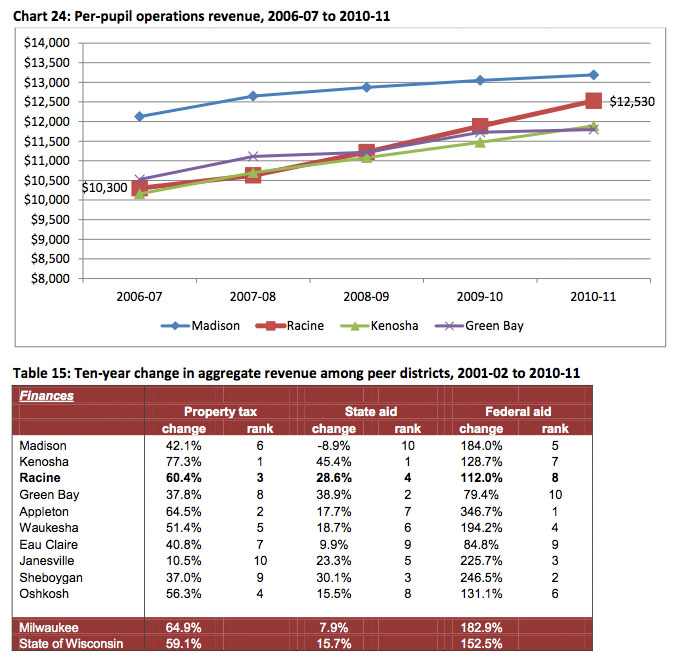
Oakland’s enrollment is 38,826. The current budget is $472,800,000; which yields per student spending of $12,177. Locally, Madison spends roughly $14.5k per student.

Share

Feds’ website enables college-tuition comparisons

Ben Wolfgang:

Can’t decide between that prestigious culinary school or the community college down the street? A new online tool created by the Department of Education could help students make that decision, with detailed price comparisons for colleges and universities of all types across the country.
If you’re looking to go to school for free, New York’s Webb Institute could fit the bill – if you’re lucky enough to get in. The naval architecture and engineering school has only 80 undergraduates, all of whom get full scholarships, making the annual tuition price $0.

Share

E. B. White, The Art of the Essay No. 1

Interviewed by George Plimpton and Frank H. Crowther:

In the issue of The New Yorker dated two weeks after E. B. White died, his stepson, Roger Angell, wrote the following in the magazine’s “Talk of the Town” section:
Last August, a couple of sailors paid an unexpected visit to my summer house in Maine: young sailors–a twelve-year-old-girl and an eleven-year-old boy. They were a crew taking part in a statewide small-boat-racing competition at a local yacht club, and because my wife and I had some vacant beds just then we were willingly dragooned as hosts. They were fine company–tanned and shy and burning with tactics but amenable to blueberry muffins and our exuberant fox terrier. They were also readers, it turned out. On their second night, it came out at the dinner table that E. B. White was a near neighbor of ours, and our visitors reacted to the news with incredulity. “No!” the boy said softly, his eyes traveling back and forth over the older faces at the table. “No-o-o-o!” The girl, being older, tried to keep things in place. “He’s my favorite author,” she said. “Or at least he was when I was younger.” They were both a bit old for Stuart Little, Charlotte’s Web, and The Trumpet of the Swan, in fact, but because they knew the books so well, and because they needed cheering up (they had done badly in the racing), arrangements were made for a visit to E. B. White’s farm the next morning.
White, who had been ill, was not able to greet our small party that day, but there were other sights and creatures there to make us welcome: two scattered families of bantam hens and chicks on the lawn; the plump, waggly incumbent dog, name of Red; and the geese who came scuttling and hissing up the pasture lane, their wings outspread in wild alarm. It was a glazy, windless morning, with some thin scraps of fog still clinging to the water in Allen Cove, beyond the pasture; later on, I knew, the summer southwest breeze would stir, and then Harriman Point and Blue Hill Bay and the islands would come clear again. What wasn’t there this time was Andy White himself: emerging from the woodshed, say, with an egg basket or a length of line in his hand; or walking away (at a mid-slow pace, not a stroll–never a stroll–with the dog just astern) down the grassy lane that turns and then dips to the woods and shore; or perhaps getting into his car for a trip to town, getting aboard, as he got aboard any car, with an air of mild wariness, the way most of us start up on a bicycle. We made do without him, as we had to. We went into the barn and examined the vacant pens and partitions and the old cattle tie-ups; we visited the vegetable garden and the neat stacks of freshly cut stove wood; we saw the cutting beds, and the blackberry patch behind the garage, and the place where the pigpen used to be–the place where Wilbur was born, surely. The children took turns on the old single-rope swing that hung in the barn doorway, hoisting themselves up onto the smoothed seat, made out of a single chunk of birch firewood, and then sailing out into the sunshine and back into barn-shadow again and again, as the crossbeam creaked above them and swallows dipped in and out of an open barn window far overhead. It wasn’t much entertainment for them, but perhaps it was all right, because of where they were. The girl asked which doorway might have been the one where Charlotte had spun her web, and she mentioned Templeton, the rat, and Fern, the little girl who befriends Wilbur. She was visiting a museum, I sensed, and she would remember things here to tell her friends about later. The boy, though, was quieter, and for a while I thought that our visit was a disappointment to him. Then I stole another look at him, and I understood. I think I understood. He was taking note of the place, almost checking off corners and shadows and smells to himself as we walked about the old farm, but he wasn’t trying to remember them. He looked like someone who had been there before, and indeed he had, for he was a reader. Andy White had given him the place long before he ever set foot on it–not this farm, exactly, but the one in the book, the one now in the boy’s mind. Only true writers–the rare few of them–can do this, but their deed to us is in perpetuity. The boy didn’t get to meet E. B. White that day, but he already had him by heart. He had him for good.

Share

On the Milwaukee Public Schools: All hands on deck Sacrifices are needed to ensure that Milwaukee kids are educated despite state budget cuts. The district, its union and businesses should be willing to step up.

Milwaukee Journal-Sentinel:

The state budget has left Milwaukee Public Schools reeling. Meeting this challenge requires a response from the entire community.
Local businesses and foundations will be called on to do more. The Milwaukee Teachers’ Education Association should make a contribution to the district’s pension plan to save teacher positions. And the district itself has to become more efficient by selling unused buildings and finding a less expensive way to feed its 85,000 students.
Of the 519 district employees being sent layoff notices, 354 would be teachers, according to Superintendent Gregory Thornton. Most of the cuts will come in kindergarten through eighth grade. And, as usual, it’s mostly teachers with the least amount of experience who will be shown the door.

Share

Brain Rhythm Associated With Learning Also Linked to Running Speed, Study Shows

Science Daily:

Rhythms in the brain that are associated with learning become stronger as the body moves faster, UCLA neurophysicists report in a new study.
The research team, led by professor Mayank Mehta, used specialized microelectrodes to monitor an electrical signal known as the gamma rhythm in the brains of mice. This signal is typically produced in a brain region called the hippocampus, which is critical for learning and memory, during periods of concentration and learning.
The researchers found that the strength of the gamma rhythm grew substantially as running speed increased, bringing scientists a step closer to understanding the brain functions essential for learning and navigation.

Share

Wisconsin School districts receive state aid estimates

Karen Herzog:

School districts have known for months that their state aid would be significantly cut for the new fiscal year that begins July 1. Today, reality hits home.
General state aid estimates were released this morning for school districts to plug into budgets until final numbers are available in October.
As expected, 410 of the state’s 424 public school districts will receive less aid for the 2011-’12 fiscal year than for fiscal 2010-’11, according to the state Department of Public Instruction, which is required by law to provide general state aid estimates to school districts each July 1.
Many school districts handled the cuts by increasing employee contributions to health care and retirement when contracts expired this week, as part of the state’s new collective bargaining law.
Kaukauna School District, which is expected to lose $2.75 million in state aid, was able to swing a $400,000 budget deficit into an estimated $1.5 million surplus by asking workers to pay more for health insurance and contribute pay toward their pensions, the Post-Crescent in Appleton reported. That district plans to hire teachers and reduce class size.

Share

Winners and losers in the Apple economy

Chrystia Freeland

Once upon a time, the car was the key to understanding the U.S. economy. Then it was the family home. Nowadays, it is any device created by Steven P. Jobs. Call it the Apple economy, and if you can figure out how it works, you will have a good handle on how technology and globalization are redistributing money and jobs around the world.
That was the epiphany of Greg Linden, Jason Dedrick and Kenneth L. Kraemer, a troika of scholars who have made a careful study in a pair of recent papers of how the iPod has created jobs and profits around the world. The latest paper, “Innovation and Job Creation in a Global Economy: The Case of Apple’s iPod,” was published last month in The Journal of International Commerce and Economics.
One of their findings is that in 2006 the iPod employed nearly twice as many people outside the United States as it did in the country where it was invented — 13,920 in the United States, and 27,250 abroad.
You probably aren’t surprised by that result, but if you are American, you should be a little worried. That is because Apple is the quintessential example of the Yankee magic everyone from Barack Obama to Michele Bachmann insists will pull America out of its job crisis — the remarkable ability to produce innovators and entrepreneurs. But today those thinkers and tinkerers turn out to be more effective drivers of job growth outside the United States than they are at home.

Share

School Braces for Hard Truth

Barbara Martinez:

In a ceremony this week, Harlem Day Charter School celebrated its 13 fifth-graders who are moving on to middle school. They represent roughly one-third of the class.
The other two-thirds will have to repeat fifth grade.
That hard truth is one of many that the teachers, students and parents of Harlem Day have been confronting in recent months as the school prepares to become the city’s first attempt at a takeover of a failing charter school.
Only five of 32 teachers will be returning in September. About 100 of all 247 students in the elementary school are being held back. And administrators are having tough conversations with parents about the true state of their children’s academic progress. Parents are being told that students, who for years were passed from grade to grade, lack basic skills.
At Harlem Day, no students were held back last year, despite recent state tests that showed only 20% of students were on grade level in English and 25% were in math.

Share

Seattle School Board Candidates At Metro Dems Event

Melissa Westbrook:

I attended last week’s Metropolitan Democrats meeting. It wasn’t an endorsement event but rather, one for their members to get a first look (and listen) to candidates ranging from King County Council to School Board Directors. It was a good chance to hear from the School Board candidates (although not all were present).
I saw a few other education activists in the crowd – Carol Simmons, Joanna Cullen and former SEA President, Wendy Kimble.
They went by district and District 1 – Peter Maier’s district – was first. Like the other incumbents present, Peter spoke well and smoothly. This is something to be expected from a nearly 4-year incumbent. He pointed out that he had visited every school in his district, every year, over the course of his term. This is very commendable and a great idea for directors. He spoke of his background and that the NSAP had come into being during his term and that he had lead the school district ballot measures that had passed.

Share

What’s the Best Way to Grade Teachers?

Kristina Rizga:

>Last year, battles over charter schools dominated much of education coverage. This year, the controversy over “teacher evaluations” is poised to be the biggest fight among people with competing visions for improving public schools. For a primer on how these new teacher assessments work, don’t miss Sam Dillon’s recent piece in the New York Times. Reporting from Washington, D.C., Dillon found that last year the city fired 165 teachers using a new teacher evaluation system; this year, the number will top 200.

D.C. relies on a relatively new evaluation system called Impact, a legacy of its former school chief Michelle Rhee, who noticed that, despite the district’s low test scores, most teachers were getting nearly perfect evaluations. Rhee and the proponents of this new evaluation system feel that the old system relied too much on the subjective evaluations by the principal or a few experienced teachers. Opponents of the old system say these internal measurements are not data-driven or rigurous enough to allow principals and districts to identify struggling teachers who need assistance or to find the successful ones who deserve to be recognized and empowered.

Impact or other new evaluation systems are currently being implemented in around 20 states. The basic idea to use performance-based evaluations that use external measures such as test scores in addition to the internal measures mentioned above. Sparked by President Obama’s Race to the Top grants, these "value-added" evaluations rely heavily on kids’ test scores in math and reading. Teachers whose subjects are not measured by test scores are observed in the classroom. For example, D.C. teachers get five yearly classroom observations, three by principals and two by "master educators" from other schools.

Share

School Spirit/Sweet Ties

Nick James:

I didn’t learn to have school spirit until I was an upperclassman in college. School gear wasn’t my thing, identifying with a school mascot wasn’t, and the last thing I wanted to do was be associated with the cheerleaders, pep club squad, and athletes that seemed to make up the face of both my high school and college. Only after investing a sizable sum of my own money in a college education, as well as attending a school with a nationally renowned sports team, did I start to budge on the issue.
When I started working in my current position, many of the things that made up a school culture at the schools I attended (and student-taught for) were missing, though I was too wrapped up in dodging pencils and various other projectiles to notice. Our school had no mascot and its only logo was difficult to rally behind, as it was the outline of a computer (as it turns out, few athletes and students want to identify themselves as a piece of plastic a silicon). There were no official school colors, which led to an odd mix of jerseys, ranging from purple and white to gold and blue, and an awkward, generic basketball as on the front of our championship basketball team’s jerseys.

Share

Smartphone app searches other people’s Photos: Finding Your Child

Jacob Aron:

When a child goes missing at a large public event, worried parents and the police would normally search through CCTV footage of the surrounding area. In the future they might try hunting through the photos being taken by smartphone owners instead, using a new system called Theia developed by a team of US researchers.
Privacy concerns aside, searching smartphone photos is a clever idea, but constantly querying someone’s phone sounds like a great way to drain their battery – not a service that many people are likely to sign up for. That’s why Theia is designed to cleverly manage energy usage, while also paying smartphone owners for sharing their photos.
It works like this. People sign up to Theia by downloading a mobile app that can search through photos stored in a folder designated for sharing, while search requests are carried out with a separate piece of software that runs on an ordinary computer. Searchers can select a number of options, such as face and body detection, texture matching, and colour filtering. For example, the system can find pictures of people’s faces against a cloudy sky by combining face detection with a search for cloudy textures and the colour blue.

Share

The Veritas of Harvard

Kevin Carey:

What happens when the gods of high finance dump a gigantic pile of gold on the richest university in the world?
It sounds like the kind of hypothetical one might pose in a smoke-addled dorm room at 2 a.m. But it is, of course, what actually happened to Harvard University, along with a few of its elite competitors, over the last 20 years.
The answer is that the university reveals its true self. It shows the world what it cares about–and what it doesn’t.
In 1990, Harvard had an endowment of about $4.7-billion. That was still a lot of money, about $7.7-billion in today’s dollars. Only five other universities have that much money now. Over the next two decades the pile grew to colossal heights, $36.9-billion by mid-2008.

Share

Using PISA to Internationally Benchmark State Performance Standards

Gary W. Phillips & Tao Jiang via a Dan McGrath email:

This study describes how the Programme for International Student Assessment (PISA) was used for internationally benchmarking state performance standards. The process is accomplished in two steps. First, PISA items are embedded in the administration of the state assessment and calibrated on the state scale. The international item calibrations are then used to link the state scale to the PISA scale through common item linking. The second step is to use the statistical linking as part of the state standard setting process to help standard setting panelists determine how high their state standards need to be in order to be internationally competitive. This process was carried out in Delaware, Hawaii, and Oregon, and results are reported here for two of the states: Hawaii and Delaware.
Key words: Equating, linking, item response theory, international benchmarking.
Introduction
In 2010, the American Institutes for Research obtained permission from the Organization for Economic Cooperation and Development (OECD) to use secure items from the Programme for International Student Assessment (PISA) for purposes of linking state assessments within the United States to the PISA scale. The OECD provided a representative sample of 30 secure PISA items in Reading, Mathematics, and Science. The PISA items covered the 2006 and 2009 PISA assessment cycles. In addition to the PISA items, the Australian Council for Educational Research (ACER), which is the current vender for the OECD contracted to conduct PISA, provided the international item parameters and their standard errors, as well as the linear transformations needed to link the state assessments to the PISA scale. The administration, security, and scoring of the PISA items were carried out by the American Institutes for Research (AIR) based on a License Agreement between AIR and the OECD and monitored by the National Center for Education Statistics (NCES).

Review Wisconsin’s position vs Minnesota, Massachusetts and Singapore, here.

Share

New York Union Sues State to Stop Teacher Evaluations

Jacob Gershman:

New York’s largest teachers union is suing the state Board of Regents over the state’s new system for evaluating public-school teachers, a move that could derail plans by the city and hundreds of other school districts to start basing reviews on how well students perform on standardized tests.
In court papers filed in state Supreme Court late Monday, New York State United Teachers claimed that education officials violated the law when they gave school districts the option of assigning significantly more weight to state assessments in their annual reviews of teachers.
Under the law, teachers could lose their jobs if their students continually fail to improve their scores on state standardized tests.
The union, a labor federation representing hundreds of thousands of teachers, claims that the regulations handed down by the Board of Regents run afoul of the evaluation law, which lawmakers approved last year and is set to take effect in July.
The union’s suit is asking a judge to put the evaluation plan on hold until courts rule on whether it’s legal.

Share

A Letter to Principals About Levers

Tom Vander Ark:

I hope you enjoyed a few days off after a busy year. To the normal craziness of spring, you probably had the heartache of considering budget cuts and layoffs.
You probably work in a state and district that imposes a lot of constraints on your hiring, curriculum, materials, school hours, and facilities. After food and transportation, if your district takes more than 5% for administration your kids are getting shorted.
Let’s think about the improvement levers you’ve been able to influence:
1) Culture: the behavior you model, the tone of your communications, and the way you deal with challenges shape the culture of your school community.
2) Goals: the way you describe and champion learning expectations for your students and goals for your staff may be your most important role. The habits of mind that you encourage could shape student thinking for decades.

Share

Achieving cultural competency in the classroom

Susan Troller:

A former classroom teacher who grew up in the inner city in Milwaukee, Andreal Davis is the assistant director for equity and family involvement for the Madison Metropolitan School District. She is in charge of making sure resources are allocated fairly among schools, that students come to school prepared and that they have equal access to learning opportunities. And in a district where there are now more students of color than there are white students, and where the number of students from economically disadvantaged families is just a shade under 50 percent, an increasingly important part of Davis’ job is to help teachers, students and their families work together effectively.
Research shows that a strong partnership between home and school is one of the most critical elements in helping all students succeed, but when there’s little common ground or cultural understanding between teachers and the families they are serving, misunderstandings and communication failures are inevitable, and can lead to rocky relationships.

Share

The GOP Fails Pennsylvania Kids

William McGurn:

The next time some Republican wonders why the African-American community doesn’t just come to its senses and start to vote the GOP ticket, point him to Pennsylvania.
This past November, Republican Tom Corbett successfully campaigned for governor on a platform that included giving Pennsylvania moms and dads more options for where they can send their children to school. Given that he enjoys Republican majorities in both the House and Senate, prospects for making good on this promise were, as the Philadelphia Inquirer recently put it, “once considered a slam dunk.” With just two days before the legislature takes off for the summer, however, the GOP leadership is sending mixed signals. As we go to press, school choice is in political limbo.
At the heart of this debate is Senate Bill 1. Co-sponsored by Republican Sen. Jeffrey Piccola and Democrat Anthony Williams, it would allow parents of a needy child to take the money the state pays to their home school district and apply it to the public, private or parochial school of their choice. The plan would be phased in and expanded over three years. It further includes a $25 million increase in a popular state program that gives tax credits to businesses that donate money for scholarships.

Share

Labor Pushes Back at Chicago Mayor Emanuel

HUNTER CLAUSS and DAN MIHALOPOULOS:

Barely six weeks after his inauguration as mayor, Rahm Emanuel faced his first open dispute Wednesday with a unionized workforce that largely opposed his candidacy.
In a statement issued Wednesday afternoon, labor officials responded testily to Emanuel’s public threat earlier in the day to lay off hundreds of city workers unless their unions accept his demands for unspecified “work rule changes and efficiencies.”
Emanuel said his proposal would save the city $20 million, and its rejection would force him to lay off more than 600 city workers, but labor leaders shot back that the plan was “unacceptable.”
The impasse came as a two-year contract concession agreement with city worker unions was set to expire Thursday. Under the deal, forged by Mayor Richard M. Daley in 2009, workers took as many as 24 unpaid days off work each year and gave up overtime pay and wage increases.

Share

Justice approves bill allowing school boards to be removed en masse

Nancy Badertscher and Kristina Torres:

The U.S. Department of Justice on Tuesday approved a new law that gives Gov. Nathan Deal the power to suspend the entire Atlanta school board for jeopardizing the city district’s accreditation.
With that consent, state school board members will hold a hearing that involves the local nine-member board no later than July 31. They will then make a recommendation to the governor.
Deal does not have to follow the state board’s recommendation. But if he suspends local members, Deal will make interim appointments and ousted board members will be allowed to appeal for reinstatement.
“I’m pleased,” said House Majority Whip Edward Lindsey, R-Atlanta, who helped write the bill that gave Deal such extraordinary power over the board’s future. “Now we can focus on the best needs of the 48,000 children in Atlanta Public Schools.”

Share

WEAC & Teacher Union Dues

Steve Gunn, via a kind reader’s email:

No wonder bullying remains a persistent problem in public schools.
When teachers engage in such behavior, kids can be expected to follow their example.
It’s become apparent that bullying may be necessary to guarantee the survival of the Wisconsin Education Association Council, the state’s largest teachers union.
That’s because state law will no longer bully on behalf of the union.
Until now, anyone who secured a teaching job at a Wisconsin public school automatically became a de facto member of the teachers union. Teachers had the option of avoiding official membership, but dues were still deducted from their paychecks and they were still represented by the union.

Share

Those Tweedy Old Admissions Deans? They’re All Business Now

Eric Hoover:

Years ago, he wore a tweed jacket and smoked a pipe. He was friendly but aloof, a thoughtful fellow toiling in the shade of mystique.
Back then, he was more of a sage than a salesman. It’s said that he could judge applicants’ potential by reading their essays and absorbing their words in interviews. His college’s bottom line was someone else’s concern; he was paid to counsel students, not to crunch numbers.

Steve Hsu has more.

Share

Florida Leads the Nation in the Percentage of High School Students Enrolled in High Level Classes; Some States Still Leave Low-Income Students Behind; Others Make Surprising Gains

by Sharona Coutts and Jennifer LaFleur:

Florida is a state of stark contrasts. Travel a few miles from the opulent mansions of Miami Beach and you reach desperately poor neighborhoods. There’s the grinding poverty of sugar cane country and the growing middle class of Jacksonville. All told, half the public-school students in Florida qualify for subsidized lunches. Many are the first in their families to speak English or contemplate attending college.
In many states, those economic differences are reflected in the classroom, with students in wealthy schools taking many more advanced courses.
The Opportunity Gap
But not in Florida. A ProPublica analysis of previously unreleased federal data shows that Florida leads the nation in the percentage of high-school students enrolled in high-level classes–Advanced Placement and advanced math. That holds true across rich and poor districts.
Studies repeatedly have shown that students who take advanced classes have greater chances of attending and succeeding in college.
Our analysis identifies several states that, like Florida, have leveled the field and now offer rich and poor students roughly equal access to high-level courses.
In Kansas, Maryland and Oklahoma, by contrast, such opportunities are far less available in districts with poorer families.
That disparity is part of what experts call the “opportunity gap.”

Wisconsin’s results are here, while Madison’s are here.

Share

WEAC sues over law giving Wisconsin Governor Walker power over DPI rules

Jason Stein:

Members of state teachers unions sued Thursday to block part of a law giving Gov. Scott Walker veto powers over rules written by other state agencies and elected officials.
The lawsuit is the latest in a series of legal skirmishes between the GOP governor and public employee unions.
In the case, parents of students and members of the Wisconsin Education Association Council and Madison Teachers Inc. challenge the law for giving Walker the power to veto administrative rules written by any state agency. That law wrongly gives Walker that power over the state Department of Public Instruction headed by state schools superintendent Tony Evers, the action charges.
“The state constitution clearly requires that the elected state superintendent establish educational policies,” WEAC President Mary Bell, a plaintiff in the suit, said in a statement. “The governor’s extreme power grab must not spill over into education policy in our schools.”
The measure, which Walker signed in May, allows the governor to reject proposed administrative rules used to implement state laws.

Share

Hollowing out the ivory tower

Tim Black:

‘The idea – which I have to say has affected large numbers of politicians – that you can just give people at university a certificate and, hey presto, they’ll earn this amount more and the country will be x-amount richer has always seemed so bizarre to me that I have to pinch myself that so many apparently rational people believe exactly that.’
Professor Alison Wolf is a breathless speaker – as I discovered while trying to keep up during the course of our interview. But as the author of Does Education Matter? Myths About Education and Economic Growth, and more recently of the government-commissioned Review of Vocational Education, Wolf is certainly worth listening to on the plight of British universities. And nowhere is her insight more valuable than when it comes to tackling what she has called ‘the great secular faith of our age’ – namely, the idea that education is the key to economic growth, swelling both an individual’s bank balance and expanding a nation’s GDP.

Share

Oregon Gov. Kitzhaber’s school reforms mark a decline in teachers’ union influence

Nigel Jaquiss:

The state’s most powerful political force got rolled in the 2011 Legislature.
Last week, Gov. John Kitzhaber and his allies rammed a dozen education bills through roadblocks erected by the 48,000-member Oregon Education Association.
A coalition of Kitzhaber, House Republicans, a few Democrats willing to buck the teachers’ union, and newly emboldened interest groups handed the OEA its biggest policy setbacks in years.
“There is a strong desire for real movement forward on education, and people were willing to break a few eggs to get there,” says Rep. Chris Garrett (D-Lake Oswego), one of three Democrats who voted “yes” on HB 2301, a controversial online charter-school bill that catalyzed the breakthrough.
To be sure, OEA successfully pushed for a $175 million increase in the K-12 budget over Kitzhaber’s opening proposal, and the union helped forestall any significant changes to the Public Employees Retirement System this session. But in terms of educational politics, this session saw substantive bills that have been stymied for many sessions zip through.

Share

L.A. School District Decides To Go Easier On Homework

Eyder Peralta:

After banning flavored milk, the Los Angeles Unified School District is doing something kids all over will cheer about: They issued a decree that homework can only count for only 10 percent of a student’s grade. The policy goes into effect July 1.
The idea behind the new rule is that it will level the playing field for students who don’t have educational support at home. Also, Los Angeles isn’t alone in this new approach. The Los Angeles Times reports:

In many districts, limits are being placed on the amount of homework so students can spend more time with their families or pursue extracurricular activities like sports or hobbies. The competition to get into top colleges has left students anxious and exhausted, with little free time, parents complain.

Share

Fog of Common Core (Lessons from Arizona’s Adoption)

David Griffith:

Today marks one year since Arizona adopted the common core state standards, but you wouldn’t know it based on any information provided by public officials or the press in Arizona. Indeed, you would have an impossible time finding any details about the Arizona State Board’s official action to adopt the standards.
Last year, I wrote about the bizarre situation where states that were completely overhauling their K-12 reading and math standards in favor of the more advanced, 21st century common core state standards were not only downplaying this standards transformation, but in some instances, also appeared to be proactively burying the information.
Arizona fell into this last group as I mentioned last July:

Share

Charlotte’s New Superintendent

Eric Frazier:

Almost three weeks after Superintendent Peter Gorman’s resignation, the Charlotte-Mecklenburg school board on Tuesday bid him goodbye and named Chief Operating Officer Hugh Hattabaugh as interim leader.
Board members approved a separation agreement that effectively made the meeting Gorman’s last as superintendent, ending a five-year reign marked by rising test scores, budget cuts and aggressive reforms that sparked outcry from teachers.
Board members praised Gorman for increasing student achievement and managing a diverse, 135,000-student school system full of competing constituencies, even at the cost of increasingly personal criticisms leveled at him.

Share

Kaukauna Area School District projects $1.5 million surplus after contract changes to health care, retirement savings; Milwaukee Plans to Lay Off 354 Teachers

Appleton Post-Crescent:

As changes to collective bargaining powers for public workers take effect today, the Kaukauna Area School District is poised to swing from a projected $400,000 budget shortfall next year to a $1.5 million surplus due to health care and retirement savings.
The Kaukauna School Board approved changes Monday to its employee handbook that require staff to cover 12.6 percent of their health insurance and to contribute 5.8 percent of their wages to the state’s pension system, in accordance with the new collective bargaining law, commonly known as Act 10.
“These impacts will allow the district to hire additional teachers (and) reduce projected class sizes,” School Board President Todd Arnoldussen wrote in a statement Monday. “In addition, time will be available for staff to identify and support students needing individual assistance through individual and small group experiences.”

Karen Herzog

Milwaukee Public Schools Superintendent Gregory Thornton announced at a news conference this afternoon that 519 layoff notices would be issued for next school year, including 354 teachers.
Most of the teacher cuts come at the elementary level. The district has about 125 elementary schools. The elementary schools most affected are those that lost funding for a program that reduces class sizes.
The layoffs are the result of a number of budgetary factors, including the loss of $84 million in state aid to MPS for the next fiscal year, Thornton said.
Thornton called on the Milwaukee Teachers’ Education Association to reconsider the district’s request that teachers pay 5.8% of their salaries toward their pensions, which would have reduced the number of layoffs by about 200 teachers.

More on Kaukana, here.

Share

Wisconsin School District Administrative Cost Comparison

WISTAX via sp-eye:

Phil Frei and his Traveling Pie-in-the-Sky Budget Show like to compare Sun Prairie administrative costs to the state average. And we look great! That trick’s not working so well anymore. As they say in the deep south, “that dog don’t hunt”. Heck even the new associate editor for the STAR, covering the recent budget hearing, asked if we didn’t have a more realistic comparison.
Well… here’s where we rank: 45th. Not even in the top 10%. At least when we look at Administrative costs per student.

Madison spends $1003/student (7.8% of operating expenditures).

Share

Third Circuit, Landmark Victories for Student Speech Limit Schools’ Ability To Censor Students Online

Erica Goldberg:

Yesterday, the full court for the United States Court of Appeals for the Third Circuit issued two simultaneous opinions to resolve how much control grade schools and high schools may exercise over their students’ off-campus, online speech. In Layshock v. Hermitage School District and J.S. v. Blue Mountain School District, the 14-judge court delivered two landmark victories for free speech, holding that school officials cannot “reach into a child’s home and control his/her actions there to the same extent that it can control that child when he/she participates in school sponsored activities.” In the cases, two students had been disciplined for creating parody MySpace profiles mocking their respective principals. The Third Circuit held that schools cannot punish students’ online speech simply because it is vulgar, lewd, or offensive. In addition to their impact in the grade school and high school settings, these decisions further solidify the robust free speech rights that must be afforded to college students engaging in online speech.
We previously blogged about Layshock and J.S. last year, when separate three-judge panels of the Third Circuit issued contrary decisions despite the very similar facts in the two cases. In Layshock, the Third Circuit had held that a then-senior in high school could not be suspended, placed in a special education class, and banned from extracurricular activities for a parody MySpace profile which described his principal as being a “big steroid freak” and belittled the size of the principal’s penis, among other insults. In J.S., a different panel of the Third Circuit had held that a then-middle school honor student could be suspended, without violating the First Amendment, for her MySpace profile. J.S.’s profile parodied her principal as stating, “I love children, sex (any kind), dogs, long walks on the beach, tv, being a dick head, and last but not least my darling wife [a guidance counselor at the school] who looks like a man.”

Share

Another study points to advantages of printed textbooks

Nicholas Carr:

Even as administrators and legislators push schools to dump printed books in favor of electronic ones, evidence mounts that paper books have important advantages as tools for learning. Last month, I reported on a study out of the University of Washington which showed that students find printed books more flexible than e-books in supporting a wide range of reading and learning styles. Now comes a major study from the University of California system showing that students continue to prefer printed books to e-books and that many undergraduates complain that they have trouble “learning, retaining, and concentrating” when reading from screens.
The University of California Libraries began a large e-textbook pilot program in 2008. In late 2010, more than 2,500 students and faculty members were surveyed to assess the results of the program. Overall, 58% of the respondents said they used e-books for their academic work, with the percentage varying from 55% for undergraduates to 57% for faculty to 67% for graduate students. The respondents who used e-books were then asked whether they preferred e-books or printed books for their studies. Overall, 44% said they preferred printed books and 35% said they preferred e-books, with the remainder expressing no preference. The preference for print was strongest among undergraduates, 53% of whom preferred printed books, with only 27% preferring e-books. Graduate students preferred printed books by 45% to 35%, and faculty preferred printed books by 43% to 33%.

Share

Detroit Public Schools’ Roberts faces public at forum on school budget

CHASTITY PRATT DAWSEY

In less than 10 minutes, Detroit Public Schools Emergency Manager Roy Roberts tonight reviewed an 11-page summary of the district’s $1.2-billion budget for next school year that projects cutting $200 million from the deficit and reducing all wages by 10%.
Roberts’ first public hearing on the budget since taking over in May as the state appointee in charge of DPS began tonight at 6 p.m.
The budget projects that the $327-million deficit will be reduced to $127 million as DPS sells $200 million in bonds, he said.
“We treasure your input, we’re going to take it to heart,” Roberts said to the audience.

Share

Politics in China’s exam system

Eric Fish:

“A fox served fish soup in a flat plate and invited the crane to share it with him ‘equally’. But it turned out the crane couldn’t drink any because of his long beak, and the fox hogged it all. What does this fable tell us?”
If you answered, “The bourgeois declare ‘everyone is equal before the law’, but this form of equality is the essence of capitalism,” congratulations, you’d be one step closer to qualifying for graduate school in China. If not, better luck next year.
Over 1.5 million people sat this year’s National Entrance Examination for Postgraduates (NEEP), China’s equivalent to the Graduate Record Examinations used in the United States. The annual test given each January is the first hurdle most students
must clear before being considered for grad-school admission. The majority of its content differs based on school and major, but 20% of the exam is a politics and philosophy section uniform across the entire nation.

Share

Operations bring smiles back to cleft-palate tots

Lana Lam:

Moments after Mao Dongmei gave birth to her first son, doctors in her hometown of Qidong Lusi in Jiangsu province gave her one piece of advice: get rid of your baby because he is deformed.
“After I gave birth, the doctors suggested I abandon my son because he would not be able to suck on the breast,” 26-year-old Mao said.
Her son, Gu Yanhu, who is now 15 months old, was born with a cleft lip and palate, a congenital deformity that affects one in 600 children born on the mainland.
“But I felt confident that I could look after my baby. I could never abandon him. It was the right choice,” Mao said, as she stroked the dozing toddler after his operation at a charity hospital in Hangzhou run by Operation Smile.

Share

Self-evaluation a key skill students must acquire for effective learning

David Carless

One of the most effective ways students can improve their ability to learn for themselves is through the development of self-evaluative skills.
Self-evaluation is judging the quality of one’s performance and planning strategies for self-improvement.
This is important, because students learn best when taking responsibility for their own progress.
Students must understand what constitutes quality work. Without an appreciation of quality, it is difficult for students to use feedback to improve their performance. Children can develop such skills by being asked to consider what they are learning, and identify strengths and weaknesses in their work.

Share