John Mauldin:
“Seeing that the status quo is untenable, countries are embarking on fiscal consolidation plans. In the United States, the aim is to bring the total federal budget deficit down from 11% to 4% of GDP by 2015. In the United Kingdom, the consolidation plan envisages reducing budget deficits by 1.3 percentage points of GDP each year from 2010 to 2013 (see eg OECD (2009a)).
“To examine the long-run implications of a gradual fiscal adjustment similar to the ones being proposed, we project the debt ratio assuming that the primary balance improves by 1 percentage point of GDP in each year for five years starting in 2012. The results are presented as the green line in Graph 4. Although such an adjustment path would slow the rate of debt accumulation compared with our baseline scenario, it would leave several major industrial economies with substantial debt ratios in the next decade.
“This suggests that consolidations along the lines currently being discussed will not be sufficient to ensure that debt levels remain within reasonable bounds over the next several decades.
“An alternative to traditional spending cuts and revenue increases is to change the promises that are as yet unmet. Here, that means embarking on the politically treacherous task of cutting future age-related liabilities. With this possibility in mind, we construct a third scenario that combines gradual fiscal improvement with a freezing of age-related spending-to-GDP at the projected level for 2011. The blue line in Graph 4 shows the consequences of this draconian policy. Given its severity, the result is no surprise: what was a rising debt/GDP ratio reverses course and starts heading down in Austria, Germany and the Netherlands. In several others, the policy yields a significant slowdown in debt accumulation. Interestingly, in France, Ireland, the United Kingdom and the United States, even this policy is not sufficient to bring rising debt under contro
[And yet, many countries, including the US, will have to contemplate something along these lines. We simply cannot fund entitlement growth at expected levels. Note that in the US, even by “draconian” estimates, debt-to-GDP still grows to 200% in 30 years. That shows you just how out of whack our entitlement programs are.
Sidebar: This also means that if we – the US – decide as a matter of national policy that we do indeed want these entitlements, it will most likely mean a substantial VAT tax, as we will need vast sums to cover the costs, but with that will come slower growth.]
TJ Mertz reflects on the Madison School District’s 2010-2011 budget and discusses increased spending via property tax increases:
I was at a meeting of Wisconsin Alliance for Excellent Schools people yesterday. Some of the people there were amazed at the hundreds of Madisonians who came out to tell the Board of Education that they preferred tax increases to further cuts. Some of the people were also perplexed that with this kind of support the Board of Education is cutting and considering cutting at the levels they are. I’m perplexed too. I’m also disappointed.
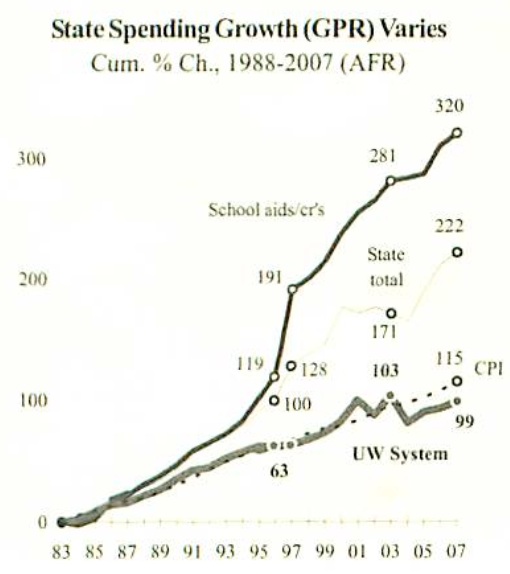
We’ll likely not see significant increases in redistributed state and federal tax dollars for K-12. This means that additional spending growth will depend on local property tax increases, a challenging topic given current taxes.
Walter Russell Mead on Greece’s financial restructuring:
What worries investors now is whether the Greeks will stand for it. Will Greek society resist the imposition of savage cuts in salaries and public services, and will the government’s efforts to reform the public administration and improve tax collection (while raising taxes) actually work?
The answer at this point is that nobody knows. On the plus side, the current Greek government is led by the left-wing PASOK party. The trade unions and civil service unions not only support PASOK; in a very real way they are the party. Although the party’s leader George Papandreou is something of a Tony Blair style ‘third way’ politician who is more comfortable at Davos than in a union hall, the party itself is one of Europe’s more old fashioned left wing political groups, where chain-smoking dependency theorists debate the shifting fortunes of the international class war. The protesters are protesting decisions made by their own political leadership; this may help keep a lid on things. If a conservative government had proposed these cuts, Greece would be much nearer to some kind of explosion.
On the minus side, the cuts are genuinely harsh, with pay cuts for civil servants of about 15% and the total package of government spending cuts set at 10 percent of GDP. (In the United States, that would amount to federal and state budget cuts totaling more than $1.4 trillion, almost one quarter of the total spending of all state and local governments plus the federal government combined.) The impact on Greek lifestyles will be even more severe; spending cuts that severe will almost certainly deepen Greece’s recession. Many Greeks stand to lose their jobs and, as credit conditions tighten, may face losing their homes and businesses as well.
Much more on the Madison School District’s 2010-2011 budget here.